Hampton Park Terrace in Charleston in Charleston County, South Carolina — The American South (South Atlantic)
H.M.S. Seraph
Photographed by R. C.
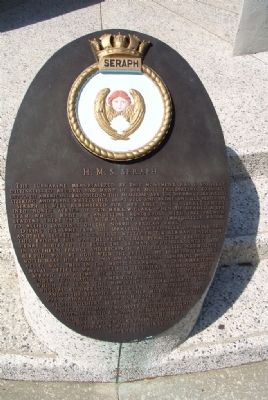
1. Seraph Monument Plaque
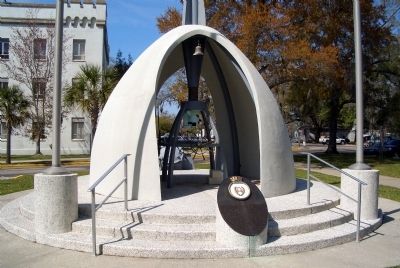
The submarine memorialized by this monument, has a uniquely distinguished record, and many of her most fascinating exploits involved Americans. Embodied in this memorial are the Seraph's fore hatch, steering and plane wheels, her ship's bell and badge, and her periscope.
Seraph is well remembered for her role in the secret entry into North Africa of Gen. Mark W. Clark when he headed a spy team which made a clandestine rendezvous with Free French leaders there in the critical days of 1942 immediately prior to allied landings on the North African Coast.
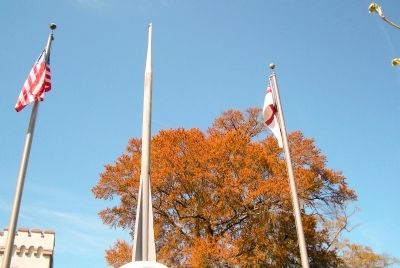
During the same year this submarine successfully accomplished another secret mission that mystified the German Enemy. In this episode she was the vessel that permitted French Gen. Henri H. Giraud to elude the Germans who surrounded him in Southern France and escape to aid the Allied Cause. Since Giraud was at odds with the British, he insisted that he would make his escape only on an American submarine. No such vessel was then in the Mediterranean, so an American Naval Officer was placed in technical command of the Seraph. For a time she had two captains and operated under two flags, The American and Royal Navy Ensigns which fly above this monument to commemorate this unusual co-operation between two nations.
Among the Seraph's many other historic missions was a gigantic ruse which saved thousands of allied soldiers' lives in World War II. A book entitled "The Man Who Never Was" describes this adventure, and a moving picture was based on the book. Another book, "The Ship That Had Two Captains," deals primarily with the Giraud adventure.
Topics and series. This historical marker is listed in these topic lists: War, World II • Waterways & Vessels. In addition, it is included in the Historic Bells series list. A significant historical year for this entry is 1942.
Location. 32° 47.933′ N,
this page online

Regionally, this marker is in Historic Charleston and in the Lowcountry. It is also in the American South, specifically in the Deep South, and on the Eastern Seaboard. Globally, it is in the North Atlantic Region, North America, the Western Hemisphere, the Western World, and the Anglosphere. Historically, it finds itself in what was once the territory of the Mississippian Culture, one of the original Thirteen Colonies, one of the Confederate States of America, and the Antebellum South.
Other nearby markers. At least 8 other markers are within walking distance of this marker: Anchor of the U.S.S. Coral Sea (about 300 feet away, measured in a direct line); Citadel Flag (about 400 feet away); CPT Christopher James Kenny (about 400

Photographed by R. C., March 19, 2007
2. Detail of the Saraph's Ship's Badge
Also see . . .
1. HMS Seraph (P219). Wikipedia entry (Submitted on September 29, 2021, by Larry Gertner of New York, New York.)
2. Mincemeat and the Imaginary Man. Damn Interesting website entry about "The Man Who Never Was." (Submitted on April 4, 2008, by Ronald Claiborne of College Station, Texas.)
3. 70th Anniversary: “Mincemeat Swallowed Whole”. National WWII Museum website entry (Submitted on September 19, 2023, by Larry Gertner of New York, New York.)
4. Captain Bill Jewel. Historical Militaria Obituaries website entry:
Mentioned as part of the Captain's obituary, the Seraph Monument is the only place in the United States permitted to fly the White Ensign of the Royal Navy. (Submitted on April 4, 2008, by Ronald Claiborne of College Station, Texas.)
Photographed by R. C., March 19, 2007
3. Seraph's fore hatch, steering and plane wheels, her ship's bell and badge, and her periscope.
Photographed by R. C., March 19, 2007
4. The American Flag and Royal Navy Ensign

via National WWII Museum, unknown
5. H.M.S. Seraph
Credits. This page was last revised on September 19, 2023. It was originally submitted on April 4, 2008, by Ronald Claiborne of College Station, Texas. This page has been viewed 4,273 times since then and 101 times this year. Photos: 1, 2, 3, 4. submitted on April 4, 2008, by Ronald Claiborne of College Station, Texas. 5. submitted on September 19, 2023, by Larry Gertner of New York, New York. • Craig Swain was the editor who published this page.
