Carthage in Moore County, North Carolina — The American South (South Atlantic)
Plank Road

Photographed by Dynasty Shaurice Gilmore, November 24, 2016
1. Plank Road Marker
Fayetteville and Western Plank Road
North Carolina History Project website entry
Click for more information.
North Carolina History Project website entry
Click for more information.
This street is the route of Fayetteville-to-Salem plank road, a toll road 129 miles long, built 1849-54.
Erected 1948 by Archives, Conservation and Highway Departments. (Marker Number K-26.)
Topics and series. This historical marker is listed in these topic lists: Charity & Public Work • Man-Made Features • Roads & Vehicles. In addition, it is included in the North Carolina Division of Archives and History series list. A significant historical year for this entry is 1849.
Location. 35° 20.715′ N, 79° 24.97′ W. Marker is in Carthage, North Carolina, in Moore County. It is at the intersection of Monroe Street (State Highway 24/27) and North McNeill Street (State Highway 22), on the right when traveling west on Monroe Street. Touch for map. Marker is at or near this postal address: 109 Monroe St, Carthage NC 28327, United States of America. Touch for directions.

Regionally, this marker is in the Piedmont. It is also in the American South and specifically in the Upper South. Globally, it is in North America, the Western Hemisphere, the Western World, and the Anglosphere. Historically, it finds itself
this page online
Other nearby markers. At least 8 other markers are within 2 miles of this marker, measured as the crow flies: Andrew Johnson (within shouting distance of this marker); Flying for France (about 400 feet away, measured in a direct line); In Honor of James Rogers McConnell (about 400 feet away); Buggy Company (approx. 0.2 miles away); James McConnell (approx. 0.2 miles away); Carthage Methodist Cemetery (approx. 0.3 miles away); Carthage Methodist Church (approx. 0.3 miles away); Lt. Robert "Hoyle" Upchurch (approx. 1.2 miles away). Touch for a list and map of all markers in Carthage.
Regarding Plank Road. The Fayetteville-Western Road extended 129 miles from Fayetteville to High Point and from their to Salem with side courses that passed through Spout Springs and Gulf, and also a route that ran from Cameron to Carthage to Asheboro.
The plank road movement in North Carolina came to success in the late 1840's. 1842, Governor John Motley Morehead had suggested the
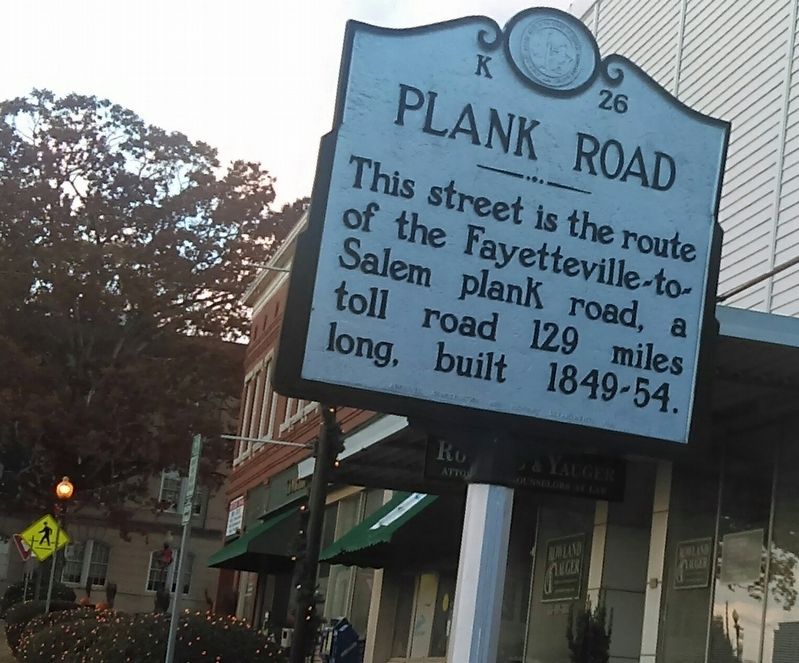
Photographed by Dynasty Shaurice Gilmore, November 24, 2016
2. Plank Road Marker
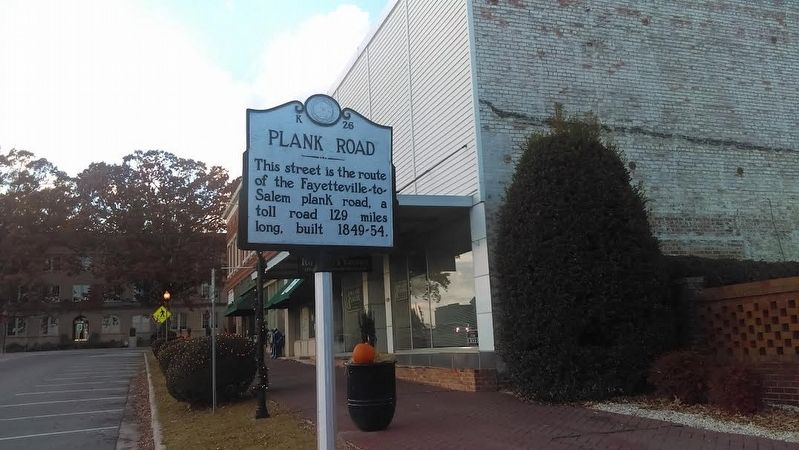
Photographed by Dynasty Shaurice Gilmore, November 24, 2016
3. Plank Road Marker
Credits. This page was last revised on April 29, 2024. It was originally submitted on November 28, 2016, by Dynasty Shaurice Gilmore of Rocky Mount, North Carolina. This page has been viewed 1,229 times since then and 109 times this year. Photos: 1, 2, 3. submitted on November 28, 2016, by Dynasty Shaurice Gilmore of Rocky Mount, North Carolina. • Bernard Fisher was the editor who published this page.
