Fort Dickerson
Defending Knoxville
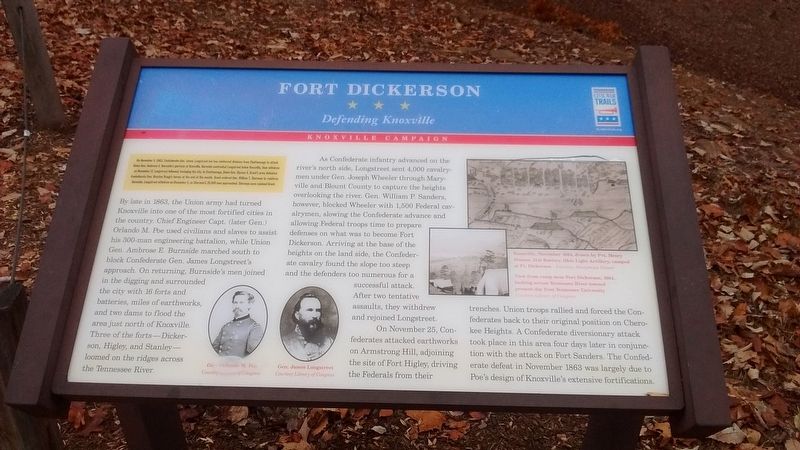
By late in 1863, the Union army had turned Knoxville into one of the most fortified cities in the country. Chief Engineer Capt. (later Gen.) Orlando M. Poe used civilians and slaves to assist his 300-man engineering battalion, while Union Gen. Ambrose E. Burnside marched south to block Confederate Gen. James Longstreet's approach. On returning, Burnside's men joined in the digging and surrounded the city with 16 forts and batteries, miles of earthworks, and two dams to flood the area just north of Knoxville. Three of the forts - Dickerson, Higley, and Stanley
this page online
As Confederate infantry advanced on the river's north side, Longstreet sent 4,000 cavalrymen under Gen. Joseph Wheeler through Maryville and Blount County to capture the heights overlooking the river. Gen. William P. Sanders, however, blocked Wheeler with 1,500 Federal cavalrymen, slowing the Confederate advance and allowing Federal troops time to prepare defenses on what was to become Fort Dickerson. Arriving at the base of the heights on the land side, the Confederate cavalry found the slope too steep and the defenders too numerous for a successful attack. After two tentative assaults, they withdrew and rejoined Longstreet.
On November 25, Confederates attacked earthworks on Armstrong Hill, adjoining the site of Fort Higley, driving the Federals from their trenches. Union troops rallied and forced the Confederates back to their original position on Cherokee Heights. A Confederate diversionary attack took place in this area four days later in conjunction with the attack on Fort Sanders. The Confederate defeat in November 1863 was largely due to Poe's design of Knoxville's extensive
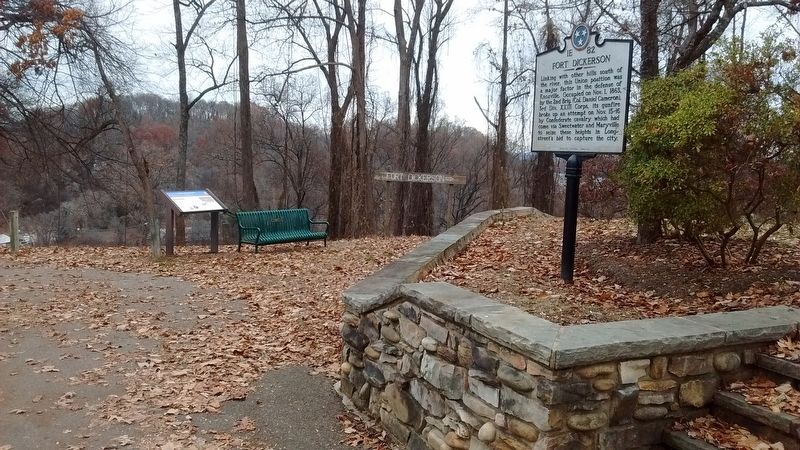
Erected by Tennesse Civil War Trails.
Topics and series. This historical marker is listed in this topic list: War, US Civil. In addition, it is included in the Tennessee Civil War Trails series list. A significant historical month for this entry is November 1863.
Location. 35° 56.9′ N, 83° 54.95′ W. Marker is in Knoxville, Tennessee, in Knox County. It is in South Knoxville. It is on Fort Dickerson Road Southwest when traveling north. Marker is located within Fort Dickerson Park. Touch for map. Marker is at or near this postal address: 3001 Fort Dickerson Rd SW, Knoxville TN 37920, United States of America. Touch for directions.

Regionally, this marker is in East Tennessee. It is also in the American South, specifically in the Upper South, in Appalachia, and specifically in Southern Appalachia. Globally, it is in North America, the Western Hemisphere, the Western World, and the Anglosphere. Historically, it finds itself in what was once the original Cherokee Nation, the territory of the Mississippian Culture, one of the Confederate States of America, and the Antebellum South.
Other nearby markers. At least 8 other markers are within walking distance of this marker: Fort Dickerson 1863–64 (within shouting distance of this marker); Civil War Knoxville (within shouting distance of this marker); The 1863 Siege of Knoxville (within shouting distance of this marker); a different marker also named Fort Dickerson (within shouting distance of this marker); a different marker also named Fort Dickerson (about 300 feet away, measured in a direct line); Forts Dickerson and Stanley (about 700 feet away); Back Door to Knoxville (approx. 0.3 miles away); a different marker also named Fort Dickerson (approx. 0.3 miles away). Touch for a list and map of all markers in Knoxville.
Credits. This page was last revised on December 19, 2016. It was originally submitted on December 17, 2016, by Tom Bosse of Jefferson City, Tennessee. This page has been viewed 1,217 times since then and 50 times this year. Photos: 1, 2. submitted on December 17, 2016, by Tom Bosse of Jefferson City, Tennessee. • Bill Pfingsten was the editor who published this page.
