
Santiago de Querétaro in Querétaro, Mexico — The Central Highlands (North America)
José M. Arteaga
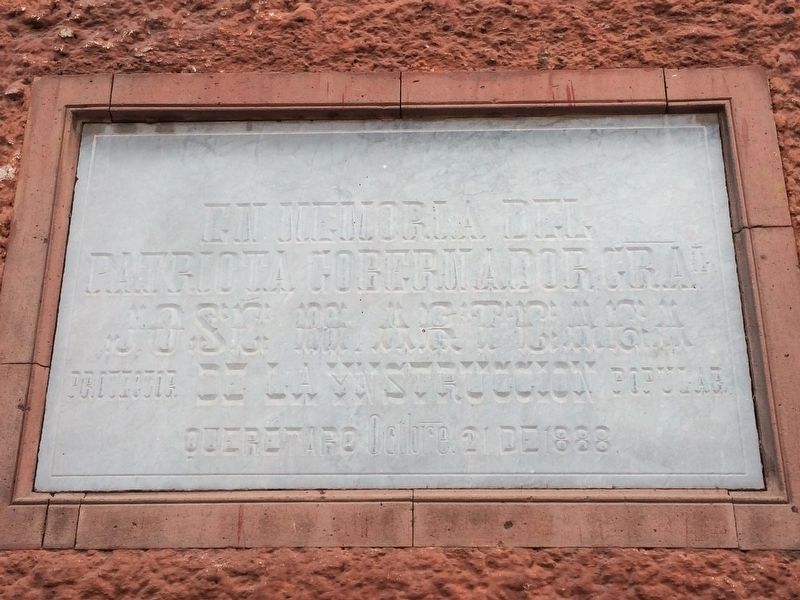
Photographed by J. Makali Bruton, December 4, 2016
1. José M. Arteaga Marker
patriota Gobernador Gral.
Jose M. Arteaga
Protector de la instrucción popular
Queretaro, Octubre, 21 de 1888.
English translation:
In memory of the patriot
Governor General José María Arteaga
Protector of popular instruction
Querétaro, October 21, 1888
Erected 1888.
Topics. This historical marker is listed in these topic lists: Education • Patriots & Patriotism • Wars, Non-US. A significant historical date for this entry is October 21, 1888.
Location. 20° 35.468′ N, 100° 23.49′ W. Marker is in Santiago de Querétaro, Querétaro. It is on Calle Benito Juárez Sur, on the left when traveling south. Touch for map. Marker is at or near this postal address: 13 Calle Benito Juárez Sur, Santiago de Querétaro QUE 76000, Mexico. Touch for directions.

Regionally, this marker is in Central Mexico and in the Bajío. Globally, it is in North America, specifically in Mesoamerica, on the Ring of Fire, and in the Western Hemisphere. Historically, it finds itself in what was once New Spain, a Spanish colony, and the Aztec Empire.
Other nearby markers. At least 8 other markers are within walking distance of this marker:
this page online
Regarding José M. Arteaga. José María Arteaga (b. August 7, 1827, Mexico City - d. October 21, 1865 Uruapan, Michoacán) was a member of the Mexican military and a politician. Although he began his career as a tailor, with the outbreak of the Mexican-American War in 1846 he joined the military. He fought in the Reform Wars and against the Second French Mexican Empire. He was executed by an order of Maximilian, together with General Salazar, Coronels Jesús Díaz and Trinidad Villagómez, and Captain Juan González. He also served as governor of Jalisco and
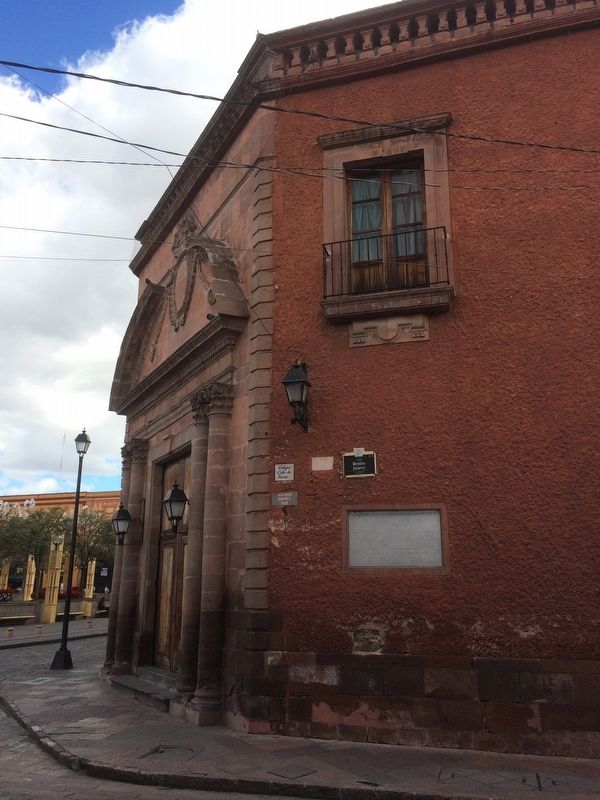
Photographed by J. Makali Bruton, December 4, 2016
2. José M. Arteaga Marker
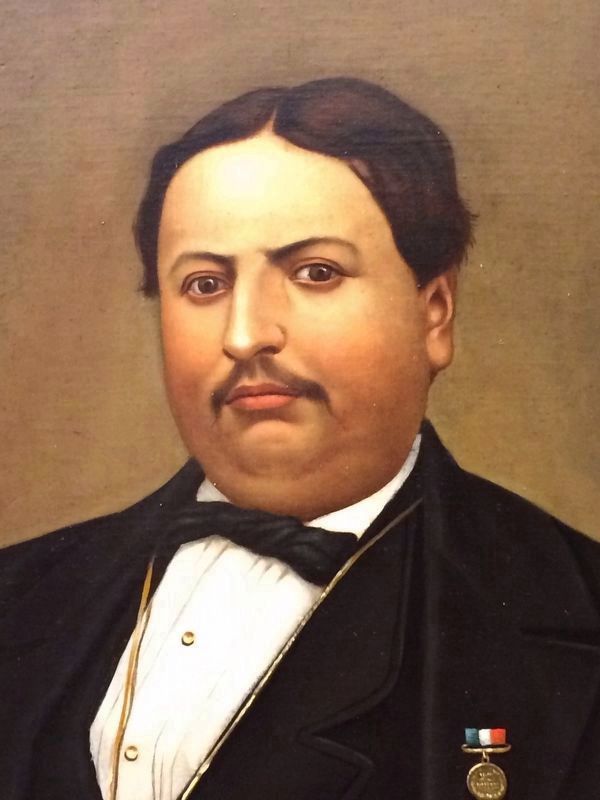
Photographed by J. Makali Bruton, July 22, 2017
3. José M. Arteaga
José María Arteaga, by Sánchez R., 19th century, oil on cloth. The original is in the Querétaro Regional Museum.
Credits. This page was last revised on July 23, 2017. It was originally submitted on January 5, 2017, by J. Makali Bruton of Washington, District of Columbia. This page has been viewed 817 times since then and 30 times this year. Photos: 1, 2. submitted on January 5, 2017, by J. Makali Bruton of Washington, District of Columbia. 3. submitted on July 23, 2017, by J. Makali Bruton of Washington, District of Columbia.
