Louisville in Jefferson County, Kentucky — The American South (East South Central)
Zachary Taylor Home
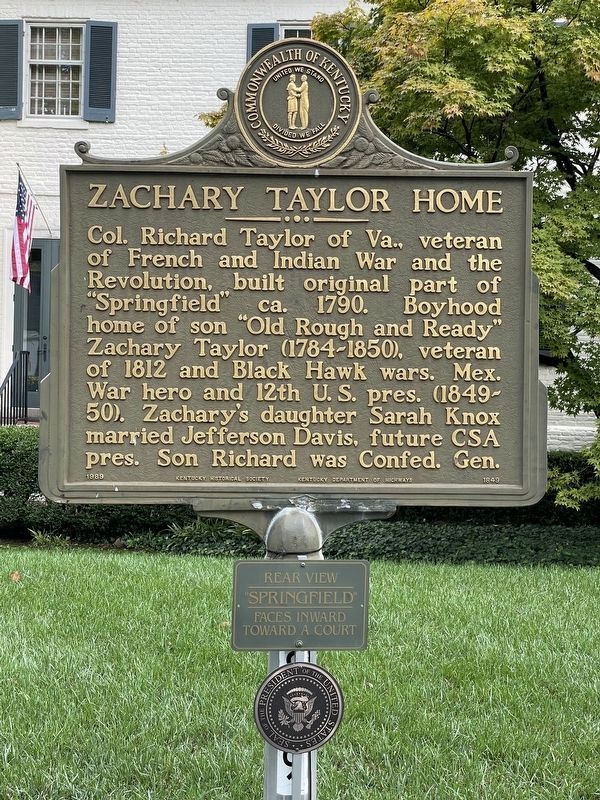
Photographed by Brian Anderson, September 20, 2021
1. Zachary Taylor Home Marker
Erected 1989 by Kentucky Historical Society Kentucky Department of Highways. (Marker Number 1849.)
Topics and series. This historical marker is listed in these topic lists: Government & Politics • War of 1812 • War, Mexican-American. In addition, it is included in the Former U.S. Presidents: #12 Zachary Taylor, and the Kentucky Historical Society series lists. A significant historical year for this entry is 1790.
Location. 38° 16.764′ N, 85° 38.842′ W. Marker is in Louisville, Kentucky, in Jefferson County. It is on Apache Road. Touch for map. Marker is at or near this postal address: 5608 Apache Road, Louisville KY 40207, United States of America. Touch for directions.

Regionally, this marker is in the American South, specifically in
this page online
Other nearby markers. At least 8 other markers are within walking distance of this marker: A different marker also named Zachary Taylor Home (about 500 feet away, measured in a direct line); First Marine Division Memorial (approx. 0.3 miles away); U.S.S. Canberra CA-70 (approx. 0.3 miles away); World War II 75th Division Memorial (approx. 0.3 miles away); Address by President Lincoln (approx. 0.4 miles away); Locust Grove (approx. 0.4 miles away); Zachary Taylor National Cemetery (approx. 0.4 miles away); Col. Richard Taylor (1744-1829)/George Rudy (1744-1806) (approx. half a mile away). Touch for a list and map of all markers in Louisville.
Also see . . . Zachary Taylor House. Wikipedia entry:
Links to National Register of Historic Places Nomination Form (Submitted on March 20, 2025, by Larry Gertner of New York, New York.)
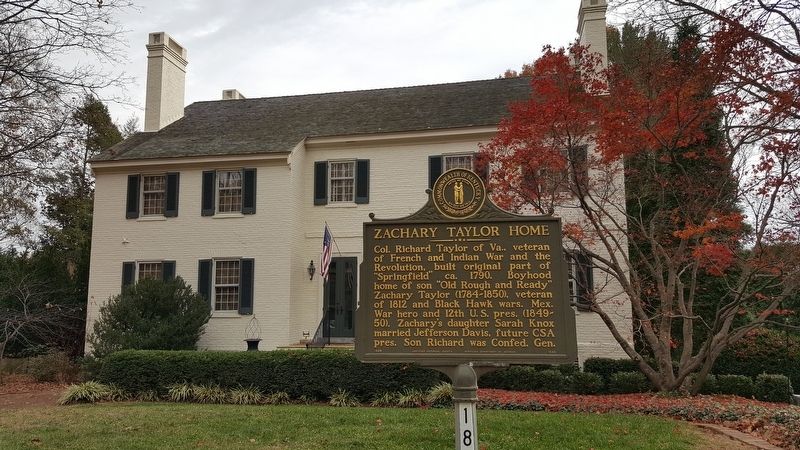
Photographed by Pat Filippone, November 23, 2016
2. Zachary Taylor Home Marker
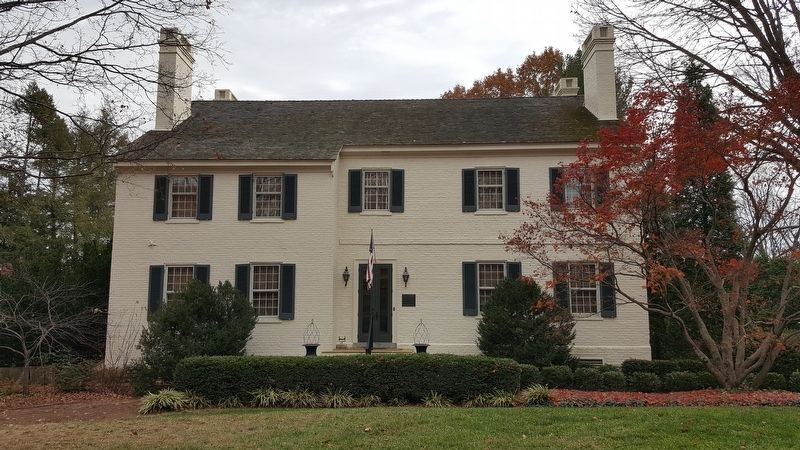
Photographed by Pat Filippone, November 23, 2016
3. Zachary Taylor Home Marker
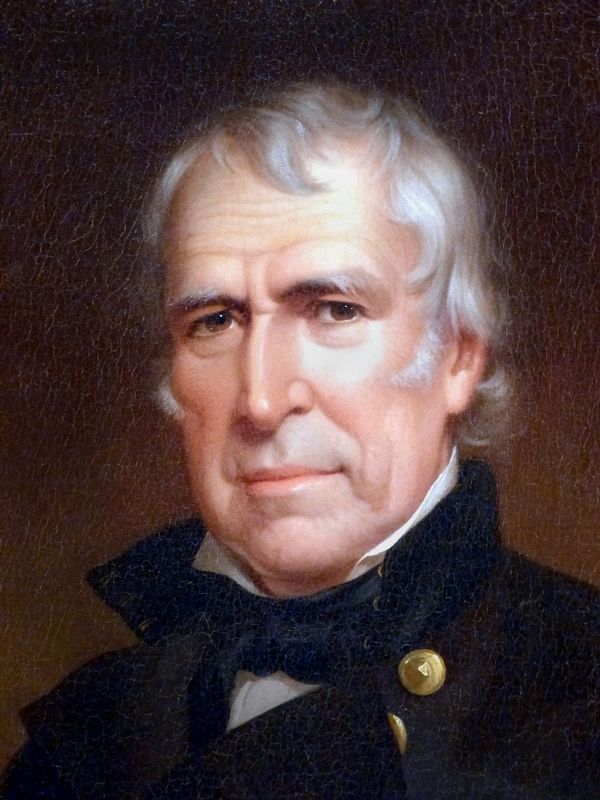
Photographed by Allen C. Browne, April 1, 2016
4. Zachary Taylor
This 1848 portrait of Zachary Taylor by James Reid Lambdin hangs in the National Portrait Gallery in Washington, DC.
“Throughout his career as a professional soldier Zachary Taylor took no more than a passing, interest in politics. But his victories at the battles of Palo Alto, Monterrey, and Buena Vista during the Mexican War changed all of that. In their wake, this ‘rough and ready’ general became eminently ripe for elective office. Even if Taylor had wanted to, he perhaps could not have stopped the groundswell of determination within the Whig Party to elect him president in 1848.
Upon entering the White House, Taylor declared his intention to bring harmony to the Union. Yet his refusal to placate the South by allowing slavery in some of the new territories acquired during the Mexican war did quite the opposite. Within a year of Taylor's coming to office, the country seemed to be moving toward civil war. Only after his unexpected death in July 1850 did compromise on this divisive issue become possible.” — National Portrait Gallery
“Throughout his career as a professional soldier Zachary Taylor took no more than a passing, interest in politics. But his victories at the battles of Palo Alto, Monterrey, and Buena Vista during the Mexican War changed all of that. In their wake, this ‘rough and ready’ general became eminently ripe for elective office. Even if Taylor had wanted to, he perhaps could not have stopped the groundswell of determination within the Whig Party to elect him president in 1848.
Upon entering the White House, Taylor declared his intention to bring harmony to the Union. Yet his refusal to placate the South by allowing slavery in some of the new territories acquired during the Mexican war did quite the opposite. Within a year of Taylor's coming to office, the country seemed to be moving toward civil war. Only after his unexpected death in July 1850 did compromise on this divisive issue become possible.” — National Portrait Gallery
Credits. This page was last revised on March 20, 2025. It was originally submitted on January 15, 2017, by Pat Filippone of Stockton, California. This page has been viewed 1,441 times since then and 45 times this year. Photos: 1. submitted on November 12, 2021, by Brian Anderson of New Albany, Ohio. 2, 3. submitted on January 15, 2017, by Pat Filippone of Stockton, California. 4. submitted on January 16, 2017, by Allen C. Browne of Silver Spring, Maryland. • Bill Pfingsten was the editor who published this page.
