Near Winchester in Frederick County, Virginia — The American South (Mid-Atlantic)
Second Battle of Winchester
"The guns in Star Fort greeted them"
| — | Gettysburg Campaign | — |
Photographed by Pete Skillman, January 21, 2017
1. Second Battle of Winchester Marker
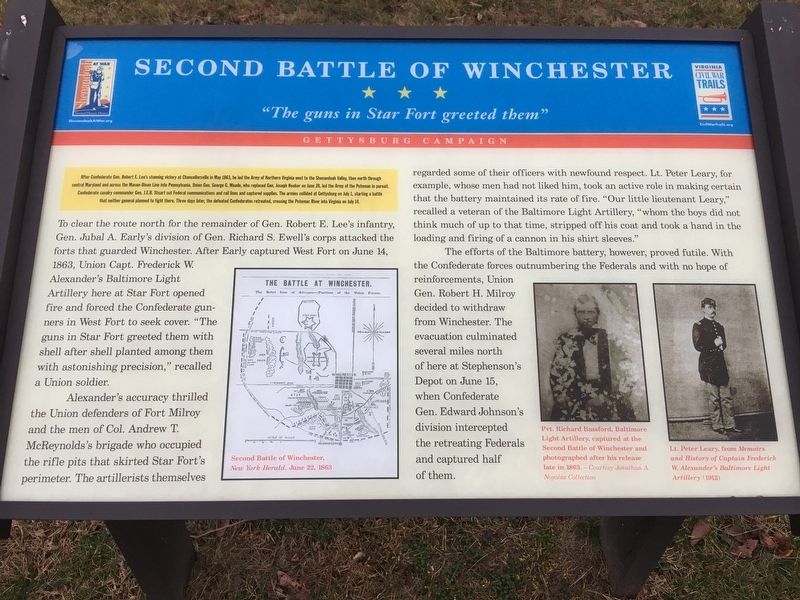
After Confederate Gen. Robert E. Lee's stunning victory at Chancellorsville in May 1863, he led the Army of Northern Virginia west to the Shenandoah Valley, then north through central Maryland and across the Mason-Dixon Line into Pennsylvania. Union Gen. George G. Meade, who replaced Gen. Joseph Hooker on June 28, led the Army of the Potomac in pursuit. Confederate cavalry commander Gen. J.E.B. Stuart cut Federal communications and rail lines and captured supplies. The armies collided at Gettysburg on July 1, starting a battle that neither general planned to fight there. Three days later, the defeated Confederates retreated, crossing the Potomac River into Virginia on July 14.
(main text)
To clear the route north for the remainder of Gen. Robert E. Lee's infantry, Gen. Jubal A. Early's division of Gen. Richard S. Ewell's corps attacked the forts that guarded Winchester. After Early captured West Fort on June 14, 1863, Union Capt. Frederick W. Alexander's Baltimore Light Artillery here at Star Fort opened fire and forced the Confederate gunners in West Fort to seek cover. "The guns in Star Fort greeted them
this page online
Alexander's accuracy thrilled the Union defenders of Fort Milroy and the men of Col. Andrew T. McReynolds's brigade who occupied the rifle pits that skirted Star Fort's perimeter. The artillerists themselves regarded some of their officers with newfound respect. Lt. Peter Leary, for example, whose men had not liked him, took an active role in making certain that the battery maintained its rate of fire. "Our little lieutenant Leary," recalled a veteran of the Baltimore Light Artillery, "whom the boys did not think much of up to that time, stripped off his coat and took a hand in the loading and firing of a cannon in his shirt sleeves."
The efforts of the Baltimore battery, however, proved futile. With the Confederate forces outnumbering the Federals and with no hope of reinforcements, Union Gen. Robert H. Milroy decided to withdraw from Winchester. The evacuation culminated several miles north of here at Stephenson's Depot on June 15, when Confederate Gen. Edward Johnson's division intercepted the retreating Federals and captured half
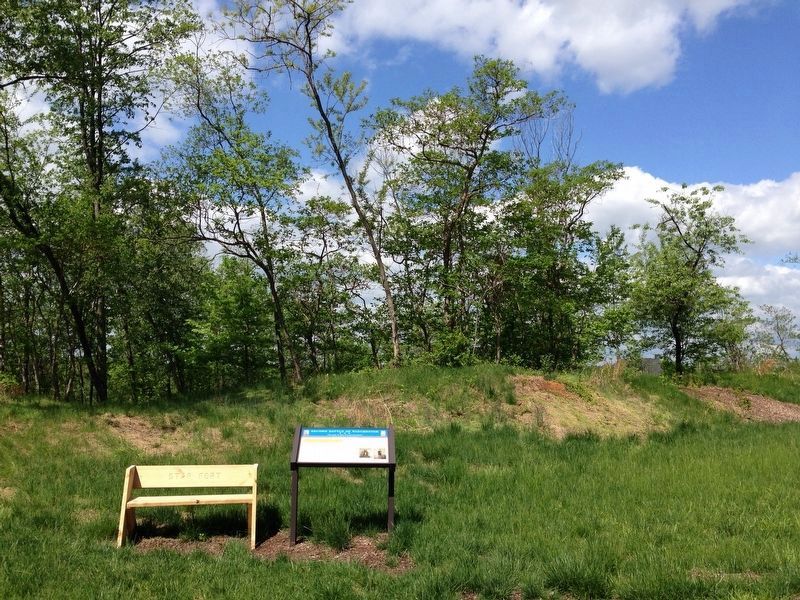
May 17, 2014
2. Second Battle of Winchester Marker
(captions)
(map) Second Battle of Winchester, New York Herald, June 22, 1863
(left photo) Pvt. Richard Bassford, Baltimore Light Artillery, captured at the Second Battle of Winchester and photographed after his release late in 1863. - Courtesy Jonathan A. Noyalas Collection
(right photo) Lt. Peter Leary, from Memoirs and History of Captain Frederick W. Alexander's Baltimore Light Artillery (1912)
Erected by Virginia Civil War Trails.
Topics and series. This historical marker is listed in these topic lists: Forts and Castles • War, US Civil. In addition, it is included in the Virginia Civil War Trails series list. A significant historical month for this entry is June 1863.
Location. This marker has been replaced by another marker nearby. It was located near 39° 12.371′ N, 78° 9.837′ W. Marker was near Winchester, Virginia, in Frederick County. It could be reached from Fortress Drive 0.1 miles north of North Frederick Pike (U.S. 522), on the right when traveling north. Touch for map. Marker was at or near this postal address: 512 Fortress Drive, Winchester VA 22603, United States of America. Touch for directions.

Regionally, this marker was in the Shenandoah Valley. It was also in the American South, specifically in the Upper South, and in the Mid-Atlantic. Globally, it was in North America, the Western Hemisphere, the Western World, and the Anglosphere. Historically, it found itself in what was once the territory of the Mississippian Culture, one of the original Thirteen Colonies, one of the Confederate States of America, and the Antebellum South.
Other nearby markers. At least 8 other markers are within walking distance of this location: The Retreat (within shouting distance of this marker); Duel of the Forts (within shouting distance of this marker); a different marker also named Constructing Star Fort (within shouting distance of this marker); The Civilian's War (within shouting distance of this marker); A Place of Refuge (about 300 feet away); Lord Fairfax (approx. ¼ mile away); Fort Collier (approx. 0.6 miles away); George Washington in Winchester (approx. 0.6 miles away). Touch for a list and map of all markers in Winchester.
Other markers no longer nearby. Constructing Star Fort (was within shouting distance of this marker but has been replaced with another marker now near it); Third Battle of Winchester (was within shouting distance of this marker but has been permanently removed); Civil War Earthworks (was within shouting distance of this marker but has been permanently removed); a different marker also named Second Battle of Winchester (was within shouting distance of this marker but has been permanently removed); Star Fort (was about 300 feet away, measured in a direct line but has been permanently removed).
Related marker. Click here for another marker that is related to this marker. This marker has been replaced by another at this location.
Credits. This page was last revised on October 13, 2024. It was originally submitted on January 21, 2017, by Pete Skillman of Wilmington, Delaware. This page has been viewed 1,059 times since then and 32 times this year. Photos: 1. submitted on January 21, 2017, by Pete Skillman of Wilmington, Delaware. 2. submitted on January 23, 2017. • Bernard Fisher was the editor who published this page.
