Near Winchester in Frederick County, Virginia — The American South (Mid-Atlantic)
Civil War Earthworks
"Where they are compelled by nature ... to resort to it"
Photographed by Pete Skillman, January 21, 2017
1. Civil War Earthworks Marker
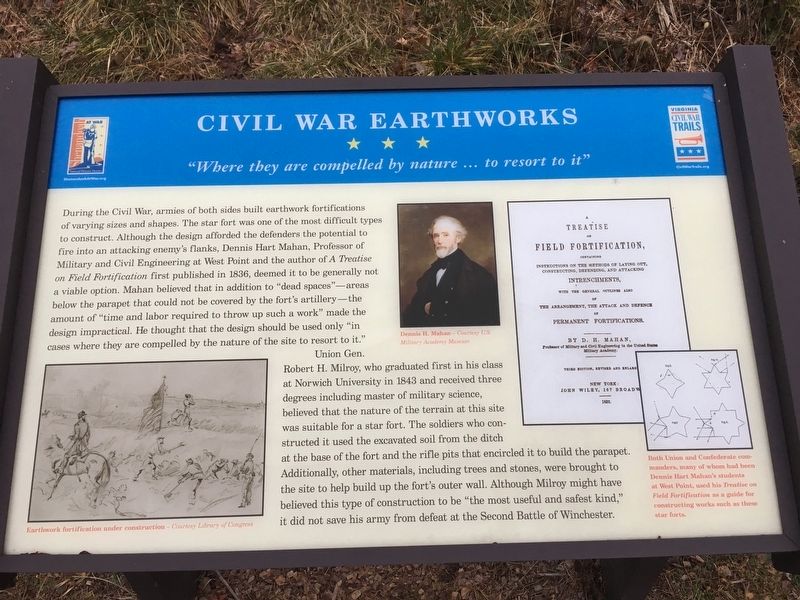
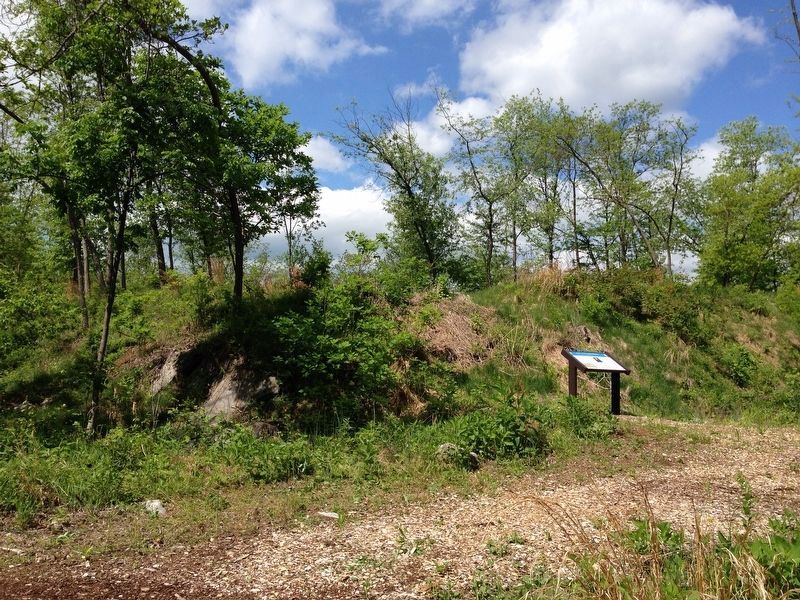
Union Gen. Robert H. Milroy, who graduated first in his class at Norwich University in 1843 and received three degrees including master of military science, believed that the nature of the terrain at this site was suitable for a star fort. The soldiers who constructed it used the excavated soil from the ditch at the base of
this page online
(captions)
(left illustration) Earthwork fortification under construction - Courtesy Library of Congress
(middle illustration) Dennis H. Mahan - Courtesy U.S. Military Academy Museum
(right illustration) Both Union and Confederate commanders, many of whom had been Dennis Hart Mahan's students at West Point, used his Treatise on Field Fortifications as a guide for constructing works such as these star forts.
Erected by Virginia Civil War Trails.
Topics and series. This historical marker is listed in these topic lists: Forts and Castles • War, US Civil. In addition, it is included in the Virginia Civil War Trails series list.
Location. Marker has been permanently removed. It was located near 39° 12.374′ N, 78° 9.807′ W.
May 17, 2014
2. Civil War Earthworks Marker
We have been informed that this marker is no longer there and will not be replaced. This page is an archival view of what was.
Regionally, this marker was in Virginia’s Shenandoah Valley. It was also in the American South, specifically in the Upper South, and in the Mid-Atlantic. Globally, it was in North America, the Western Hemisphere, the Western World, and the Anglosphere. Historically, it found itself in what was once the territory of the Mississippian Culture, one of the original Thirteen Colonies, one of the Confederate States of America, and the Antebellum South.

Other nearby markers. At least 8 other markers are within walking distance of this location: The Retreat (a few steps from this marker); The Civilian's War (within shouting distance of this marker); A Place of Refuge (within shouting distance of this marker); Duel of the Forts (within shouting distance of this marker); Constructing Star Fort (about 300 feet away, measured in a direct line); Lord Fairfax (approx. 0.3 miles away); Fort Collier (approx. half a mile away); George Washington in Winchester (approx. half a mile away). Touch for a list and map of all markers in Winchester.
Other markers no longer nearby. Second Battle of Winchester (was within shouting distance of this marker but has been permanently removed); a different marker also named Second Battle of Winchester (was within shouting distance of this marker but has been replaced with another marker now near it); Third Battle of Winchester (was within shouting distance of this marker but has been permanently removed); a different marker also named Constructing Star Fort (was about 300 feet away but has been replaced with another marker now near it); Star Fort (was about 400 feet away but has been permanently removed).
Credits. This page was last revised on October 13, 2024. It was originally submitted on January 21, 2017, by Pete Skillman of Wilmington, Delaware. This page has been viewed 960 times since then and 21 times this year. Photos: 1. submitted on January 21, 2017, by Pete Skillman of Wilmington, Delaware. 2. submitted on January 23, 2017. • Bernard Fisher was the editor who published this page.
