
Near Stephenson in Frederick County, Virginia — The American South (Mid-Atlantic)
Third Battle of Winchester
"One Moving Mass of Glittering Sabers"
| — | 1864 Valley Campaigns | — |
Photographed by Craig Swain, August 25, 2007
1. Third Battle of Winchester Marker
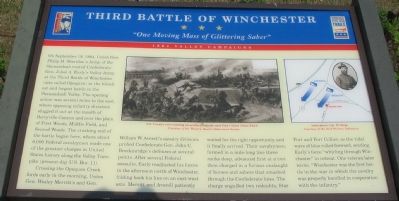
Crossing the Opequon Creek fords early in the morning, Union Gen. Wesley Merritt’s and Gen. William W. Averell’s cavalry divisions probed Confederate Gen. John C. Breckinridge’s defenses at several points. After several Federal assaults, Early readjusted his forces in the afternoon north of Winchester, folding back his line on an east-west axis. Merritt and Averell patiently waited for the right opportunity, and it finally arrived. Their cavalrymen, formed in a mile-long line three ranks deep,
this page online
Erected by Virginia Civil War Commission.
Topics and series. This historical marker is listed in this topic list: War, US Civil. In addition, it is included in the Virginia Civil War Trails series list. A significant historical month for this entry is September 1863.
Location. Marker has been permanently removed. It was located near 39° 13.802′ N, 78° 6.589′ W. Marker was near Stephenson, Virginia, in Frederick County. It was at the intersection of Milburn Road (County Route 662) and Old Charlestown Road (County Route 761), on the right when traveling south on Milburn Road. Touch for map. Marker was in this post office area: Stephenson VA 22656, United States of America.
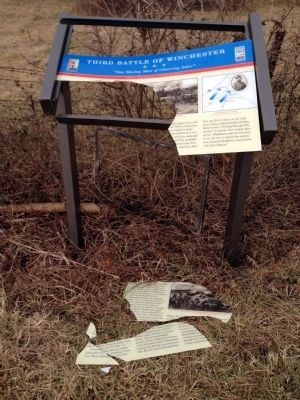
We have been informed that this marker
Photographed by Craig Swain, August 25, 2007
2. Two Civil War Trails Markers at Stephenson
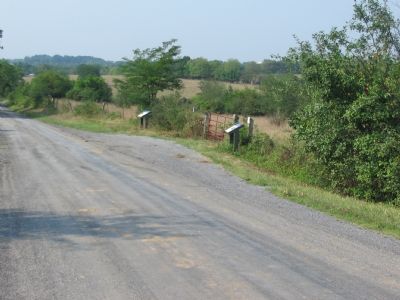
Merritt's portion of the charge passed to the west (on the right of the picture), generally parallel to Milburn Road.
Regionally, this marker was in Virginia’s Shenandoah Valley. It was also in the American South, specifically in the Upper South, and in the Mid-Atlantic. Globally, it was in North America, the Western Hemisphere, the Western World, and the Anglosphere. Historically, it found itself in what was once the territory of the Mississippian Culture, one of the original Thirteen Colonies, one of the Confederate States of America, and the Antebellum South.

Other nearby markers. At least 8 other markers are within 2 miles of this location, measured as the crow flies: Roots Of Methodism In Frederick County Milburn Chapel (approx. 0.4 miles away); a different marker also named Roots Of Methodism In Frederick County Milburn Chapel (approx. 0.4 miles away); Action at Stephenson’s Depot (approx. 0.6 miles away); 1st Maryland Battery (CSA) Memorial (approx. 0.6 miles away); Triceratops (approx. 0.9 miles away); Lake Anhinga (approx. 0.9 miles away); Wayne A. Whitham Rest Area (approx. 0.9 miles away); Interrupted by War (approx. 1.3 miles away).
Photographed by Craig Swain, August 26, 2007
3. Cavalry Fords of the Opequon
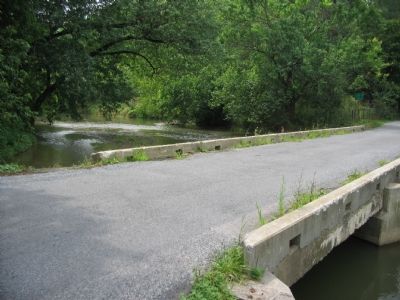
Merritt's Division forded the Opequon where present day Old Charlestown Road (Route 761) crosses the creek. From this point, the Federals advanced down the road towards Stephenson. Their advance was countered by Confederate cavalry under Gen. John McCausland. Eventually Merritt's men formed on line near where Stephenson Road intersects the Martinsburg Pike (U.S. 11). (Close to the monument for the June 1863 Battle of Second Winchester.)
Other markers no longer nearby. Stephenson Depot (was within shouting distance of this marker but has been confirmed missing); John Rutherford's Farm (was approx. 1.3 miles away but has been replaced with another marker now near it); Rutherford's Farm (was approx. 1.3 miles away but has been replaced with another marker now near it); Battle of Rutherford's Farm (was approx. 1.3 miles away but has been replaced with another marker now near it).
More about this marker. A painting of “U.S. Cavalry over-running an artillery redoubt near Fort Collier (Stine Field)” is on the upper center section of the marker. A map showing the location of the charge is on the right side, with a portrait of Captain M. Birge.
Also see . . .
1. Opequon or Third Winchester. National Park Service narrative of the battle. The action discussed on the marker is summarized as phase nine of this rather complex battle. (Submitted on September 7, 2007, by Craig Swain of Leesburg, Virginia.)
2. General Wesley Merritt. While somewhat overshadowed by the other big names,
January 18, 2015
4. Third Battle of Winchester Marker
Credits. This page was last revised on July 17, 2026. It was originally submitted on September 7, 2007, by Craig Swain of Leesburg, Virginia. This page has been viewed 2,841 times since then and 35 times this year. Last updated on January 21, 2017, by Pete Skillman of Townsend, Delaware. Photos: 1, 2, 3. submitted on September 7, 2007, by Craig Swain of Leesburg, Virginia. 4. submitted on January 18, 2015. • Bernard Fisher was the editor who published this page.
