Augusta in Richmond County, Georgia — The American South (South Atlantic)
James Ryder Randall
1839 — 1908
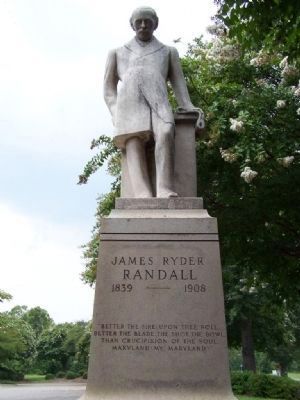
Photographed by Mike Stroud, 2008
1. James Ryder Randall Marker
Better the blade, the shot, the bowl,
Than Crucifixion of the soul,
Maryland! My Maryland!"
Erected 1936 by The Randall Memorial Committee of Chapter "A" United Daughters of the Confederacy Augusta Georgia.
Topics and series. This historical marker is listed in these topic lists: Arts, Letters, Music • Communications • War, US Civil. In addition, it is included in the United Daughters of the Confederacy series list.
Location. 33° 28.62′ N, 81° 58.621′ W. Marker is in Augusta, Georgia, in Richmond County. It is on Greene Street. Touch for map. Marker is in this post office area: Augusta GA 30901, United States of America. Touch for directions.

Regionally, this marker is in the American South and specifically in the Deep South. Globally, it is in North America, the Western Hemisphere, the Western World, and the Anglosphere. Historically, it finds itself in what was once the territory of the Mississippian Culture, one of the original Thirteen Colonies, one of the Confederate States of America, and the Antebellum
this page online
Other nearby markers. At least 8 other markers are within walking distance of this marker: Sacred Heart Cultural Center (within shouting distance of this marker); Curtis Baptist Church (about 700 feet away, measured in a direct line); Meadow Garden (approx. ¼ mile away); a different marker also named Meadow Garden (approx. ¼ mile away); George Walton (approx. ¼ mile away); Revolutionary War Patriots (approx. ¼ mile away); Baptism (approx. 0.3 miles away); A Historical Timeline of Augusta (approx. 0.3 miles away). Touch for a list and map of all markers in Augusta.
Regarding James Ryder Randall. James Ryder Randall, a 22-year-old Baltimore native teaching English literature at Poydras College in Pointe-Coupee, Louisiana, was outraged at the news of Union troops being marched through his home town. This incident stirred Randall’s Southern sympathies, inspiring him to write a poem said to be American’s "most martial poem." Maryland, My Maryland was first published in the April 26, 1861 edition of the New Orleans Delta.
The poem, the best known of all Randall's poetry, quickly found its way back to Baltimore where it was
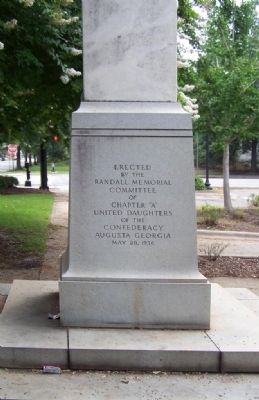
Photographed by Mike Stroud, 2008
2. James Ryder Randall Marker, North face
After the war was over in 1865, Randall served several positions with various newspapers. His final post was as an editor and correspondent for the Augusta Chronicle. He died in Augusta, Georgia January 15, 1908.
Maryland, My Maryland has nine stanzas. The passage on this monument is from the eighth stanza. Randall's poem was adopted as the Maryland State song in 1939 (Chapter 451, Acts of 1939; Code State Government Article, sec. 13-307).
Related marker. Click here for another marker that is related to this marker. The use of “Maryland, My Maryland” during the war is discussed on this marker.
Also see . . .
1. Maryland, My Maryland. The poem (here) is sung to the traditional tune of "Lauriger Horatius" ("O, Tannenbaum"). (Submitted on August 10, 2008, by Mike Stroud of Bluffton, South Carolina.)
2. Smithsonian Listing. Description:
Full-length standing figure of the poet James Ryder Randall, looking downward. The figure leans on a podium at his back, with his proper left hand resting on scroll on top of the podium. The statue is placed atop a marble base with inscriptions on front and rear.(Submitted on May 26, 2025, by J.T. Lambrou of New Boston, Michigan.)
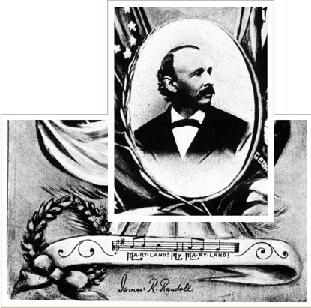
3. Portrait of James Ryder Randall
Detail from postcard, Jack Kelbaugh Collection of Civil War Photographs, MSA SC4325-52, Maryland State Archives

Photographed by J.T. Lambrou, April 10, 2025
4. James Ryder Randall
Perspective showing the location of the statue across from the Sacred Heart Cultural Center.

Photographed by J.T. Lambrou, April 10, 2025
5. James Ryder Randall
Randall is also one of the men on the nearby Four Southern Poets Monument. The words are a repeat of the section of the "Maryland, My Maryland" poem on this sculpture of him.
Credits. This page was last revised on May 26, 2025. It was originally submitted on August 10, 2008, by Mike Stroud of Bluffton, South Carolina. This page has been viewed 3,765 times since then and 50 times this year. Photos: 1, 2. submitted on August 10, 2008, by Mike Stroud of Bluffton, South Carolina. 3. submitted on August 11, 2008, by Kevin W. of Stafford, Virginia. 4, 5. submitted on May 26, 2025, by J.T. Lambrou of New Boston, Michigan. • Kevin W. was the editor who published this page.
