Angels Camp in Calaveras County, California — The American West (Pacific Coastal)
Stalactite/Stalagmite
Photographed by James King, December 24, 2016
1. Stalactite/Stalagmite Marker
Inscription.
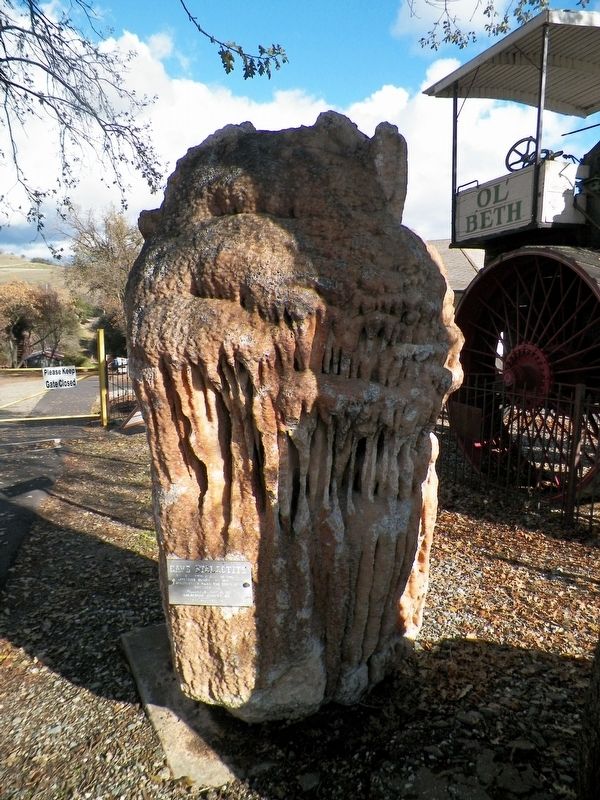
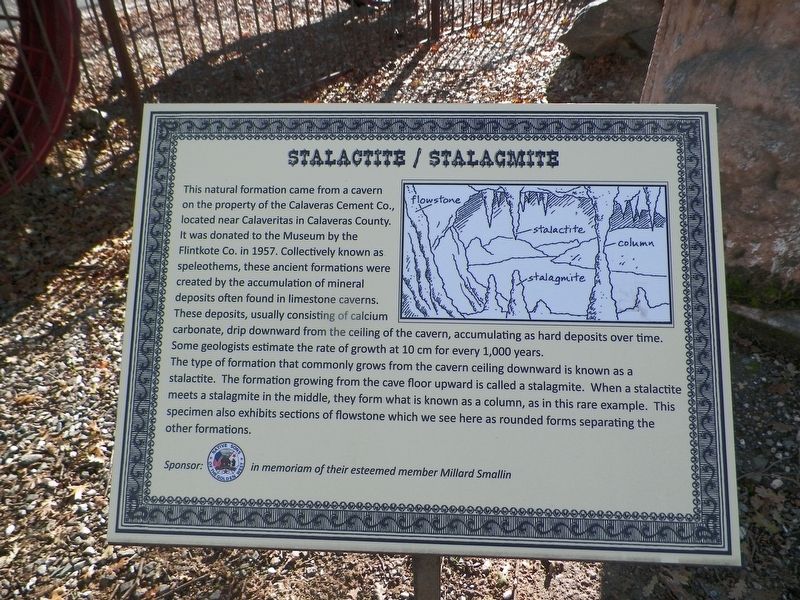
Stalactite/Stalagmite. . This natural formation came from a cavern on the property of the Calaveras Cement Co., located near Calaveritas in Calaveras County. It was donated to the museum by the Flintkote Co. in 1957. Collectively known as speleothems, these ancient formations were created by the accumulation of mineral deposits often found in limestone caverns. These deposits, usually consisting of calcium carbonate, drip downward from the ceiling of the cavern, accumulating as hard deposits over time. Some geologists estimate the rate of growth at 10 cm for every 1,000 years. The type of formation that commonly grows from the cavern ceiling downward is known as a stalactite. The type of formation that commonly grows from the cave floor upward is called a stalagmite. When a stalactite meets a stalagmite in the middle, they form what is known as a column, as in this rare example. This specimen also exhibits sections of flowstone which we see here as rounded forms separating the other formations.
This natural formation came from a cavern on the property of the Calaveras Cement Co., located near Calaveritas in Calaveras County. It was donated to the museum by the Flintkote Co. in 1957. Collectively known as speleothems, these ancient formations were created by the accumulation of mineral deposits often found in limestone caverns. These deposits, usually consisting of calcium carbonate, drip downward from the ceiling of the cavern, accumulating as hard deposits over time. Some geologists estimate the rate of growth at 10 cm for every 1,000 years. The type of formation that commonly grows from the cavern ceiling downward is known as a stalactite. The type of formation that commonly grows from the cave floor upward is called a stalagmite. When a stalactite meets a stalagmite in the middle, they form what is known as a column, as in this rare example. This specimen also exhibits sections of flowstone which we see here as rounded forms separating the other formations.
Erected by Angels Camp Museum, sponsored by Native Sons of the Golden West in memory of esteemed member Millard Smallin.
Location. 38° 4.527′ N, 120° 32.741′ W. Marker is in Angels Camp, California, in Calaveras County. It is on South Main Street (California Route 49), on the left when traveling south. The marker and specimen are on the south side of the horseshoe driveway at the museum. Touch for map. Marker is at or near this postal address: 753 South Main Street, Angels Camp CA 95222, United States of America. Touch for directions.

Regionally, this marker is in California’s Gold Country and in the Sierra Nevada. It is also in the American Mountain West. Globally, it is in North America, the Pacific Rim, the Western Hemisphere, the Western World, and the Anglosphere. Historically, it finds itself in what was once New Spain and also Mexicos Alta California.
Other nearby markers. At least 8 other markers are within walking distance of this marker: Ol' Beth (here, next to this marker); Serpentine Drill Core Section (here, next to this
Credits. This page was last revised on March 5, 2017. It was originally submitted on February 26, 2017, by James King of San Miguel, California. This page has been viewed 1,107 times since then and 20 times this year. Photos:1, 2. submitted on February 26, 2017, by James King of San Miguel, California. • Syd Whittle was the editor who published this page.