Bolton Hill in Baltimore, Maryland — The American Northeast (Mid-Atlantic)
Confederate Soldiers and Sailors Monument
Reconciling History
| — | Baltimore's Confederate Monuments | — |
Photographed by Don Morfe, February 26, 2017
1. Confederate Soldiers and Sailors Monument Marker
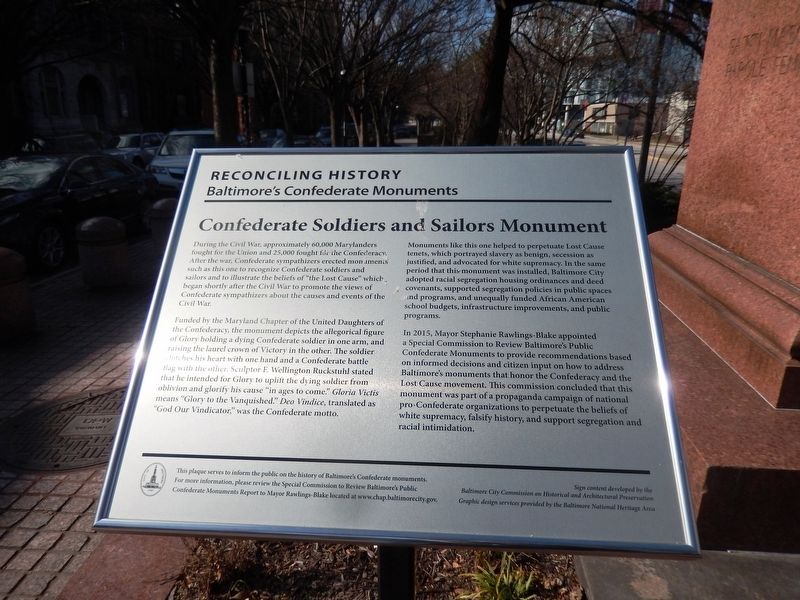
During the Civil War, approximately 60,000 Marylanders fought for the Union and 25,000 fought for the Confederacy. After the war, Confederate sympathizers erected monuments such as this one to recognize Confederate soldiers and sailors and to illustrate the beliefs of “the Lost Cause” which began shortly after the Civil War to promote the views of Confederate sympathizers about the causes and events of the Civil War.
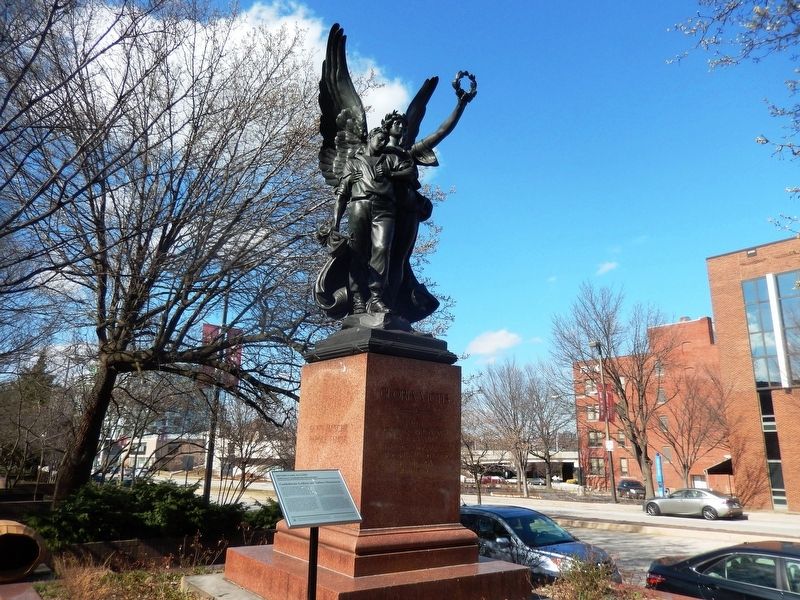
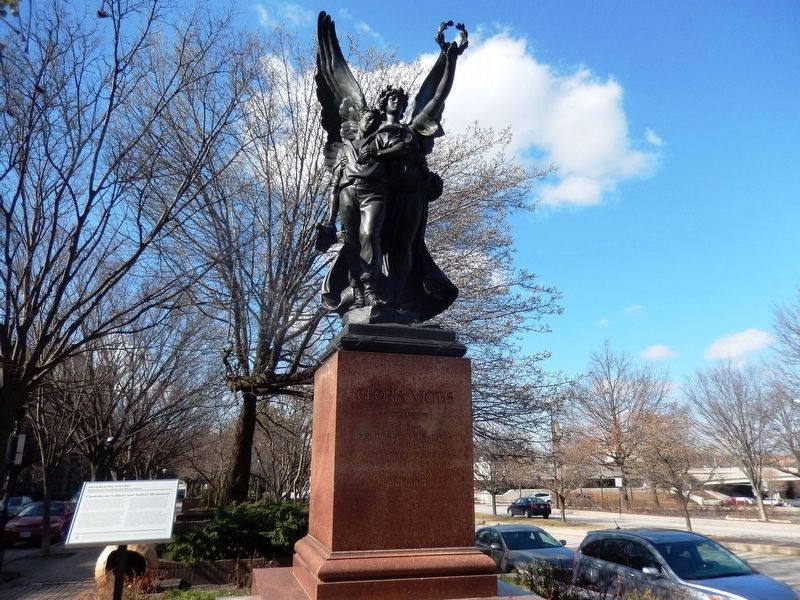
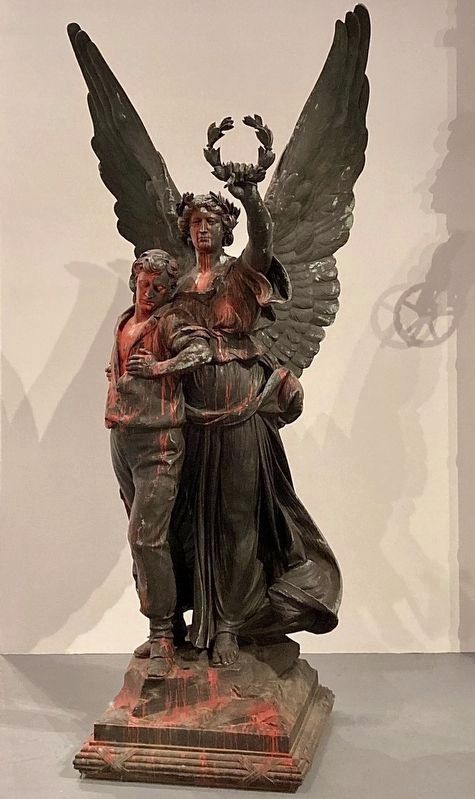
Funded by the Maryland Chapter of the Daughters of the Confederacy, the monument depicts the allegorical figure of Glory holding a dying Confederate soldier in one arm, and raising the laurel crown of Victory in the other. The soldier clutches his heart with one hand and a Confederate battle flag with the other. Sculptor F. Wellington Ruckstuhl stated that he intended for Glory to uplift the dying soldier from oblivion and glorify his cause “in ages to come.” Gloria Victis means “Glory to the Vanquished.” Deo Vindice, translated as “God Our Vindicator,” was the Confederate motto.
Monuments like this one helped to perpetuate Lost Cause tenets, which portrayed slavery as benign, secession as justified,
this page online
In 2015, Mayor Stephanie Rawlings-Blake appointed a Special Commission to Review Baltimore’s Public Confederate Monuments to provide recommendations based on informed decisions and citizen input on how to address Baltimore’s monuments that honor the Confederacy and the Lost Cause Movement. This commission concluded that this monument was part of a propaganda campaign of national pro-Confederate organizations to perpetuate the beliefs of white supremacy, falsify history, and support segregation and racial intimidation.
This plaque serves to inform the public on the history of Baltimore’s Confederate monuments. For more information, please review the Special Commission to Review Baltimore’s Public Confederate Monuments Report to Mayor Rawlings-Blake located at w.w.w.chap.baltimorecity.gov.
Sign content
Photographed by Don Morfe, February 26, 2017
2. Confederate Soldiers and Sailors Monument Marker
Topics. This monument and memorial is listed in this topic list: War, US Civil.
Location. Monument has been reported missing. It was located near 39° 18.528′ N, 76° 37.35′ W. Monument was in Baltimore, Maryland. It was in Bolton Hill. It was on Mount Royal Avenue. Touch for map. Monument was in this post office area: Baltimore MD 21217, United States of America. Touch for directions.

Regionally, this memorial monument was in Central Maryland. It was also in the American Mid-Atlantic, in the Chesapeake Bay Region, and on the Eastern Seaboard. Globally, it was in the North Atlantic Region, North America, the Western Hemisphere, the Western World, and the Anglosphere. Historically, it found itself in what was once one of the original Thirteen Colonies and also the Antebellum South.
Other nearby markers. At least 8 other markers are within walking distance of this location: Gloria Victis (here, next to this marker);
Photographed by Don Morfe, February 26, 2017
3. Confederate Soldiers and Sailors Monument

Photographed by Don Morfe, August 19, 2017
4. Confederate Soldiers and Sailors Monument Marker-Base only
The statue was removed by the City of Baltimore on August 16, 2017 because it was deemed offensive to the public
Photographed by Craig Baker, February 7, 2026
5. Confederate Soldiers and Sailors Statue
A museum display at The Geffen Contemporary at MOCA in Los Angeles in 2026.
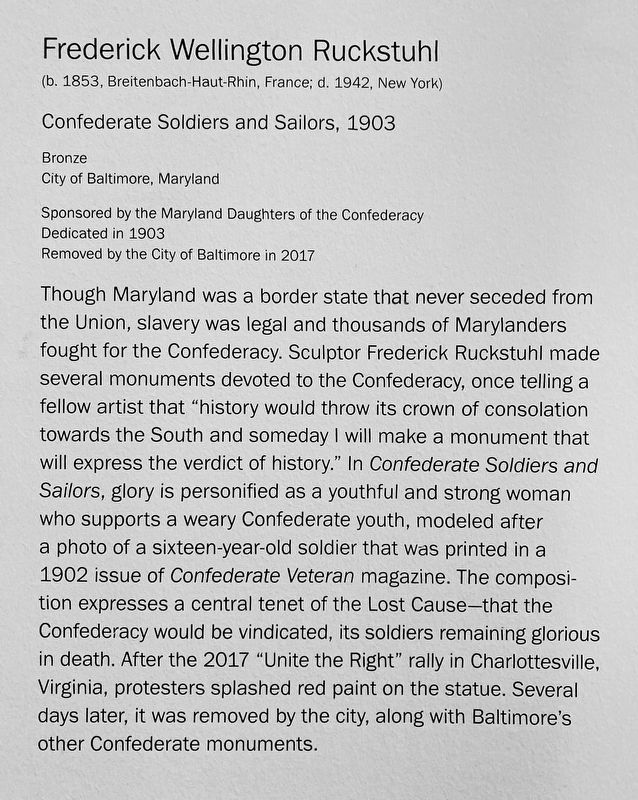
Photographed by Craig Baker, February 7, 2026
6. Museum Display Information
Credits. This page was last revised on February 16, 2026. It was originally submitted on March 5, 2017, by Don Morfe of Baltimore, Maryland. This page has been viewed 1,127 times since then and 92 times this year. Photos: 1, 2, 3. submitted on March 5, 2017, by Don Morfe of Baltimore, Maryland. 4. submitted on August 20, 2017, by Don Morfe of Baltimore, Maryland. 5, 6. submitted on February 7, 2026, by Craig Baker of Sylmar, California. • Bill Pfingsten was the editor who published this page.
