Fisherman's Wharf in San Francisco City and County, California — The American West (Pacific Coastal)
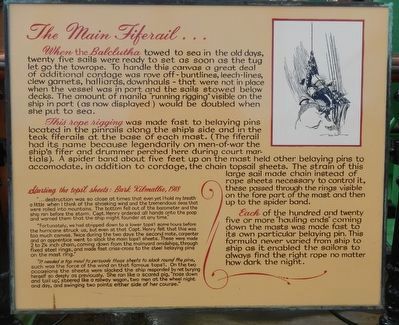
The Main Fiferail...
Photographed by Barry Swackhamer, March 4, 2017
1. The Main Fiferail... Marker
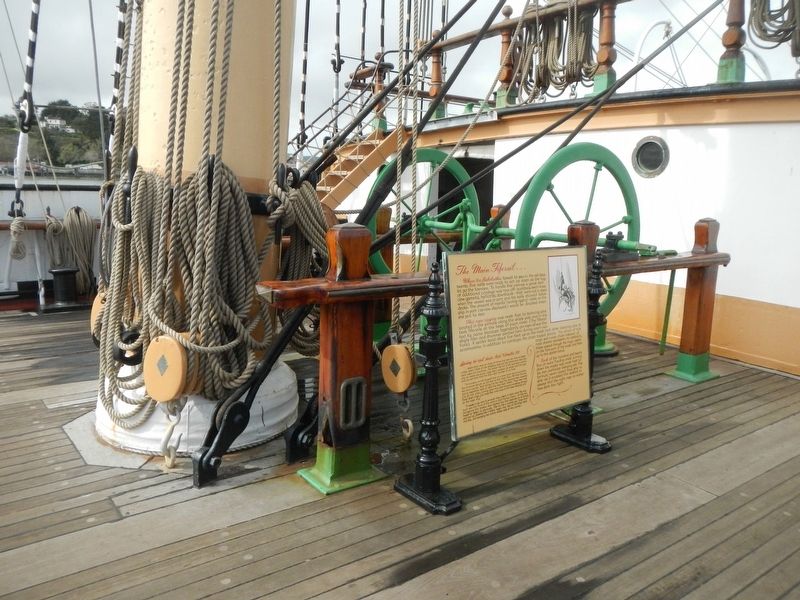
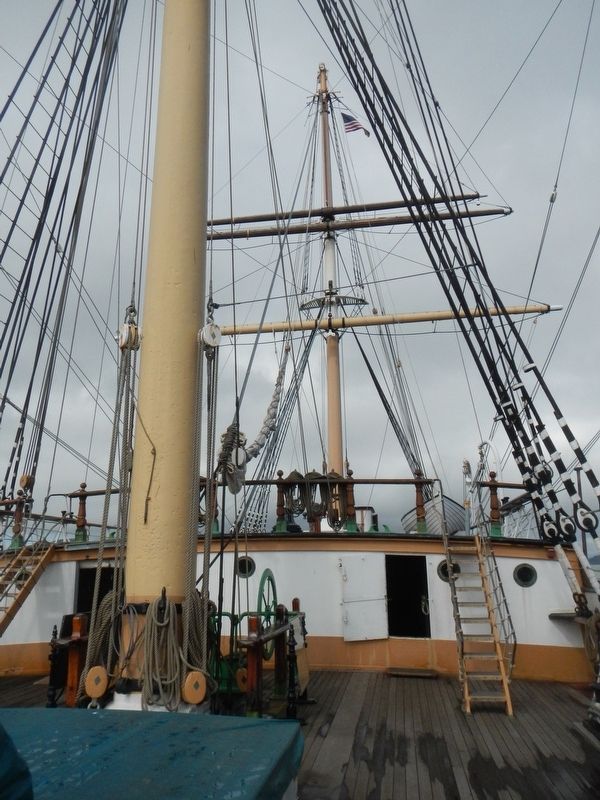
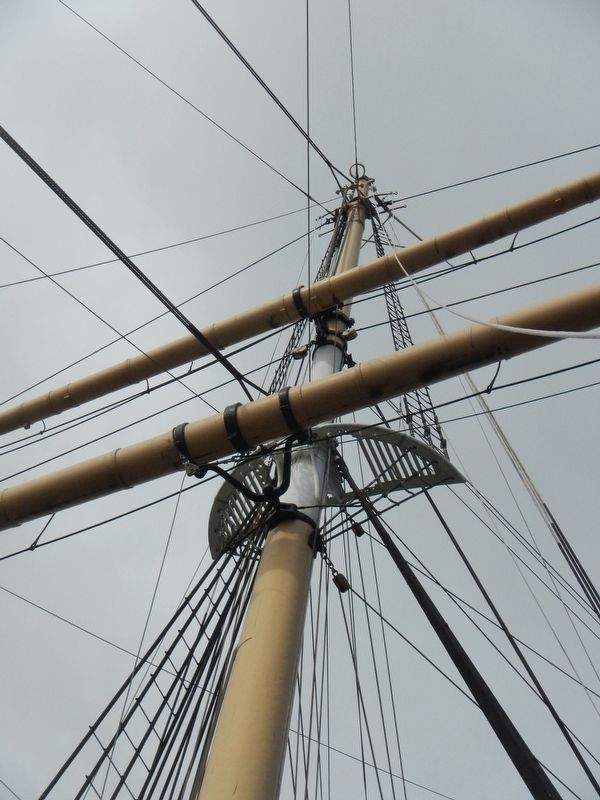
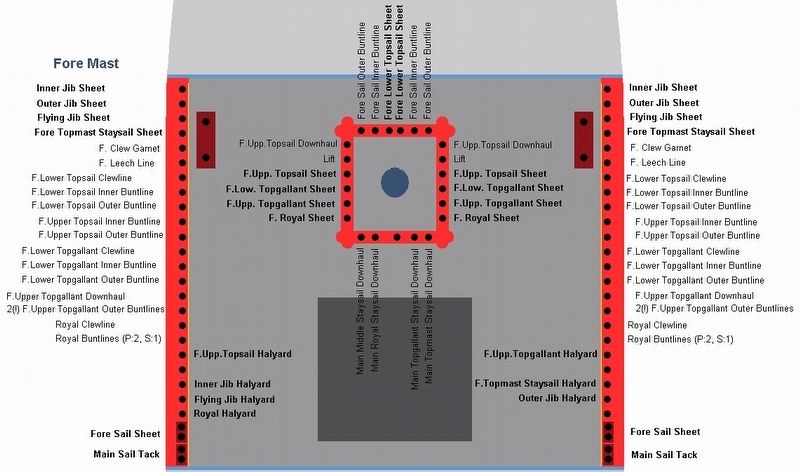
This rope rigging was made fast to belaying pins located in the pintails along the ship's side and in the teak fireflies at the base of each mast, (The fiferail had its name because legendarily on men-of-war the ship's fifer and drummer perched here during court martial). A spider band about five feet up on the mast held other belaying pins to accommodate, in addition to cordage, the chain topsail sheets. The strain of this large large sail made chain instead of rope sheets necessary to control it, these passed through the rings visible on the fore part of the mast and then up to the spider band.
Each of the hundred and twenty-five or more "hauling ends" coming
this page online
"... destruction was so close at times that even yet I hold my breath a little when I think of the shrieking wind and the tremendous seas that were rolled into mountains. The bottom fell out of the barometer and the ship ran before the storm. Ca9t. Henry ordered all hands onto the poop and warned them that the ship might founder at any time."
"Fortunately, we had stripped down to a lower top'l some hours before the hurricane struck us, but even at that Capt. Henry felt that this was too much canvas. Twice during the two days the second mate, carpenter and an apprentice went to slack the main tops'l sheets. These were made 2 to 2 1/4 inch chain, coming down from the main yard amid ship, through fixed steel rings, and made fast criss-cross to the steal belaying pins on the mast ring.
"it needed a top maul to persuade those sheets to slack around the pins, such was the force of the wind
Photographed by Barry Swackhamer, March 4, 2017
2. The Main Fiferail and Marker
Topics. This historical marker is listed in this topic list: Waterways & Vessels.
Location. 37° 48.596′ N, 122° 25.363′ W. Marker is in San Francisco, California, in San Francisco City and County. It is in Fisherman's Wharf. It can be reached from Htde Street near Jefferson Street, on the left when traveling north. Touch for map. Marker is at or near this postal address: 2950 Hyde Street, San Francisco CA 94109, United States of America. Touch for directions.

Regionally, this marker is on the Coast Ranges. It is also on the American Pacific Coast. Globally, it is in North America, on the Ring of Fire, on the Pacific Rim, in the Western Hemisphere, in the Western World, and in the Anglosphere. Historically, it finds itself in what was once New Spain and also Mexico’s Alta
Photographed by Barry Swackhamer, March 4, 2017
3. The Main Mast and Fiferail
Other nearby markers. At least 8 other markers are within walking distance of this marker: Steering the Ship... (a few steps from this marker); Hicks Engine (a few steps from this marker); Balclutha (a few steps from this marker); Felucca Nuovo Mondo (within shouting distance of this marker); The Deckhouse (within shouting distance of this marker); Scow Schooner Alma (within shouting distance of this marker); The Half-Deck (within shouting distance of this marker); The Carpenter Shop... (within shouting distance of this marker). Touch for a list and map of all markers in San Francisco.
More about this marker. This marker is locate on board the Balclutha, docked at Hyde Street Pier.
Photographed by Barry Swackhamer, March 4, 2017
4. The Main Mast
Photographed by Unknown
5. Diagram of the Arrangement of Lines at the Foremast onboard the 4-masted barque Nippon Maru
Credits. This page was last revised on February 7, 2023. It was originally submitted on March 10, 2017, by Barry Swackhamer of Brentwood, California. This page has been viewed 431 times since then and 32 times this year. Photos: 1, 2, 3, 4, 5. submitted on March 10, 2017, by Barry Swackhamer of Brentwood, California.
