Biloxi in Harrison County, Mississippi — The American South (East South Central)
Downtown Biloxi
| — | Historic Biloxi | — |
Photographed by Mark Hilton, March 22, 2017
1. Downtown Biloxi Marker
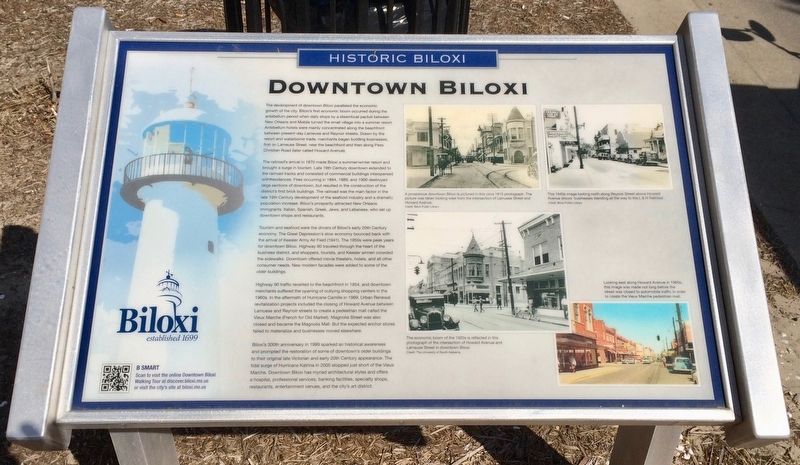
The railroad's arrival in 1870 made Biloxi a summer/winter resort and brought a surge in tourism. Late 19th Century downtown extended to the railroad tracks and consisted of commercial buildings interspersed with residences. Fires occurring in 1884, 1889, and 1900 destroyed large sections of downtown, but resulted in the construction of the district's first brick buildings. The railroad was the main factor in the late 19th Century development of the seafood industry and a dramatic population increase. Biloxi's prosperity attracted New Orleans immigrants:
this page online
Tourism and seafood were the drivers of Biloxi's early 20th Century economy. The Great Depression's slow economy bounced back with the arrival of Keesler Army Air Field (1941). The 1950s were peak years for downtown Biloxi. Highway 90 traveled through the heart of the business district, and shoppers, tourists, and Keesler airmen crowded the sidewalks. Downtown offered movie theaters, hotels, and all other consumer needs. New modern facades were added to some of the older buildings.
Highway 90 traffic reverted to the beachfront in 1954, and downtown merchants suffered the opening of outlying shopping centers in the 1960s. In the aftermath of Hurricane Camille in 1969, Urban Renewal revitalization projects included the closing of Howard Avenue between Lamuese and Reynoir streets to create a pedestrian mall called the Vieux Marche (French for Old Market). Magnolia Street was also closed and became the Magnolia Mall. But the expected anchor stores failed to materialize and businesses moved elsewhere.
Biloxi's 300th anniversary
Photographed by Mark Hilton, March 22, 2017
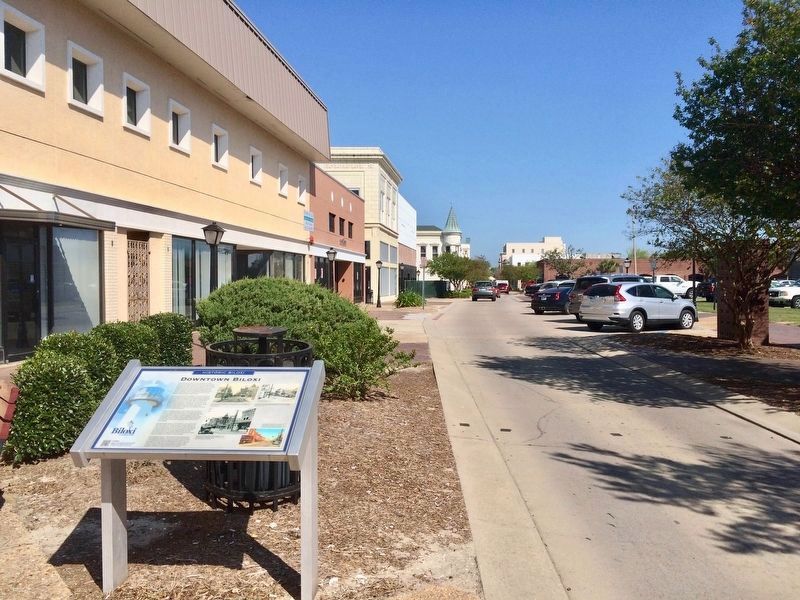
2. Downtown Biloxi looking east (this is a one-way street, running east, in this area).
[Photo Captions]
Middle top: A prosperous downtown Biloxi is pictured in this circa 1910 photograph. The picture was taken looking west from the intersection of Lameuse Street and Howard Avenue. Credit: Biloxi Public Library
Middle: The economic boom of the 1920s is reflected in this photograph of the intersection of Howard Avenue and Lameuse Street in downtown Biloxi. Credit: Biloxi Public Library
Right Top: This 1940s image looking north along Reynoir Street above Howard Avenue shows businesses standing all the way to the L & N Railroad. Credit: Biloxi Public Library
Right Middle: Looking east along Howard Avenue in 1960s, this image was made not long before the
Photographed by Mark Hilton, March 22, 2017
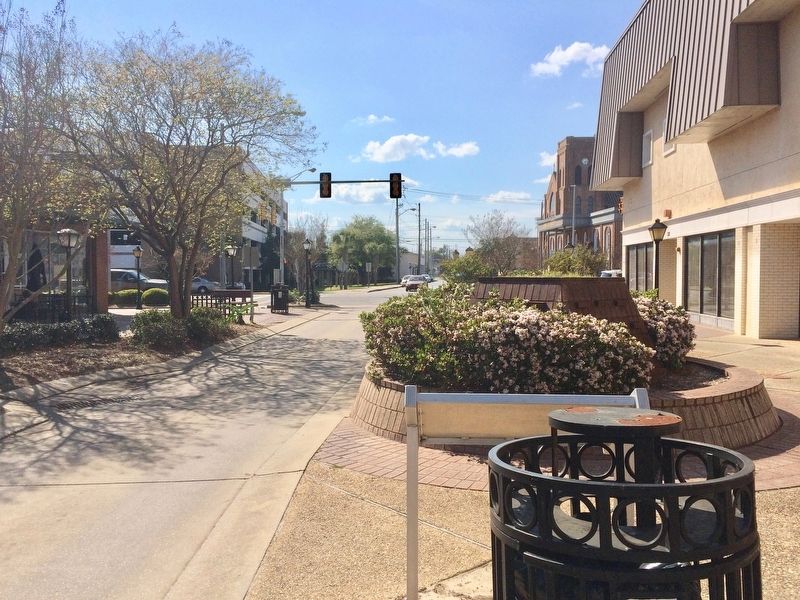
3. Downtown Biloxi looking west towards Reynoir Street.
Erected 2015 by the City of Biloxi.
Topics. This historical marker is listed in these topic lists: Industry & Commerce • Railroads & Streetcars • Waterways & Vessels. A significant historical year for this entry is 1870.
Location. 30° 23.805′ N, 88° 53.402′ W. Marker is in Biloxi, Mississippi, in Harrison County. It is on Howard Avenue east of Reynoir Street, on the left when traveling east. Howard Avenue, along here, is also known as Vieux Marche Mall (French for Old Market). Touch for map. Marker is at or near this postal address: 834 Howard Avenue, Biloxi MS 39530, United States of America. Touch for directions.

Regionally, this marker is in the American South, specifically in the Deep South, and on the Gulf Coast. Globally, it is in North America, a Gulf of Mexico state, the Western Hemisphere, the Western World, and the Anglosphere. Historically, it finds itself in what was once New Spain, the Viceroyalty of New France, the territory of the Mississippian Culture, one of the Confederate States of America, and the Antebellum South.
Other nearby markers. At least 8 other markers are within walking distance of this marker: Cathedral of the Nativity (B.V.M.) (about 300 feet away, measured in a direct line); The Magnolia Hotel (approx. 0.2 miles away); Biloxi City Hall (approx. 0.2 miles away); Biloxi Public Library 1925 (approx. ¼ mile away); Historic Downtown Biloxi (approx. 0.3 miles away); High Water Mark (approx. 0.3 miles away); Historic Downtown Biloxi Walking Tour (approx. 0.3 miles away); Brielmaier House (approx. 0.3 miles away). Touch for a list and map of all markers in Biloxi.
Credits. This page was last revised on March 25, 2017. It was originally submitted on March 25, 2017, by Mark Hilton of Montgomery, Alabama. This page has been viewed 994 times since then and 109 times this year. Photos: 1, 2, 3. submitted on March 25, 2017, by Mark Hilton of Montgomery, Alabama.
