1023 East Baltimore Street
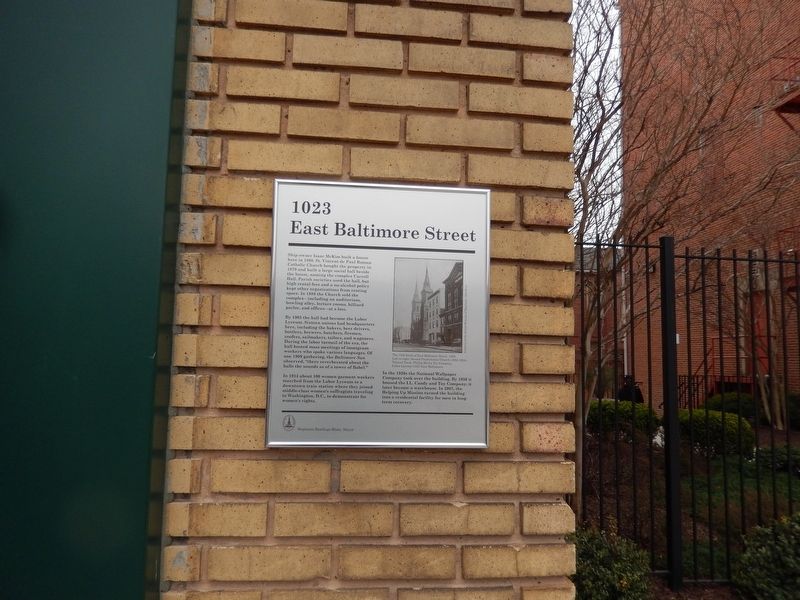
 Ship owner Isaac McKim built a house here in 1808. St. Vincent de Paul Roman Catholic Church bought the property in 1879 and built a large social hall beside the house, naming the complex Carroll Hall. Parish societies used the hall, but high rental fees and a no-alcohol policy kept other organizations from renting space. In 1888 the Church sold the complex-including an auditorium, bowling alley, lecture rooms, billiard parlor, and offices—at a loss.
By 1905, the hall became the Labor Lyceum. Sixteen unions had headquarters here, including the bakers, beer drivers, bottlers, brewers, butchers, firemen, roofers, sailmakers, tailors, and wagoners. During the labor turmoil of the era, the hall hosted mass meetings of immigrant workers who spoke various languages. Of one 1909 gathering, the Baltimore Sun observed, “there reverberated about the halls the sounds as of a tower of Babel.”
In 1913 about 100 women garment workers marched from the Labor Lyceum to a downtown train station where they joined middle-class women’s suffragists traveling to Washington, D.C., to demonstrate for women’s rights.
this page online
(Inscription under the image in the upper right)
The 1000 block of East Baltimore Street, 1909. Left to right: Second Presbyterian Church (1852-1924), Talmud Torah, Phillip Mirvis Tea Company, Labor Lyceum (1023 East Baltimore). Courtesy of the Jewish Museum of Maryland, 1985.90.14.
Erected by Stephanie Rawlings-Blake, Mayor.
Topics. This historical marker is listed in these topic lists: Charity & Public Work • Labor Unions. A significant historical year for this entry is 1808.
Location. 39° 17.434′ N, 76° 36.143′ W. Marker is in Baltimore, Maryland. It is in Jonestown. It is on E. Baltimore Street. Touch for map. Marker is at or near this postal address: 1023 E Baltimore Street, Baltimore MD 21202, United States of America. Touch for directions.
Regionally, this marker is in Central Maryland. It is also in the American Mid-Atlantic, in the Chesapeake Bay Region,

Other nearby markers. At least 8 other markers are within walking distance of this marker: 1029 East Baltimore Street (a few steps from this marker); 1017 - 1021 East Baltimore Street (within shouting distance of this marker); Lloyd Street Synagogue (about 300 feet away, measured in a direct line); a different marker also named Lloyd Street Synagogue (about 300 feet away); McKim Free School (about 400 feet away); B'nai Israel Synagogue (about 400 feet away); On to Yorktown (about 600 feet away); 1781 Friends Meeting House (about 600 feet away). Touch for a list and map of all markers in Baltimore.
Credits. This page was last revised on April 17, 2020. It was originally submitted on March 27, 2017, by Don Morfe of Baltimore, Maryland. This page has been viewed 575 times since then and 49 times this year. Photos: 1, 2. submitted on March 27, 2017, by Don Morfe of Baltimore, Maryland. • Bill Pfingsten was the editor who published this page.