
William Penn Annex East in Philadelphia in Philadelphia County, Pennsylvania — The American Northeast (Mid-Atlantic)
Washington's Death and a Renewed Hope for Freedom

Photographed by William Fischer, Jr., March 23, 2017
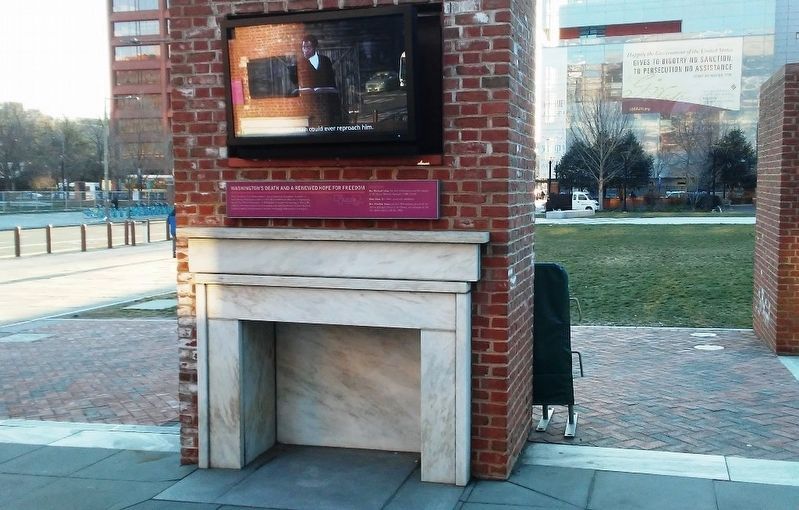
1. Washington's Death and a Renewed Hope for Freedom Marker
When President John Adams ordered a day of mourning throughout the nation to mark George Washington's death in 1799, Reverend Richard Allen saw an opportunity for the Free African Community of Philadelphia to expand the meaning of liberty. He called on Americans to honor the first president by imitating his will in which he freed his slaves, and by heeding the Free Africans' increasingly bold petitions to Congress.
Erected by National Park Service, U.S. Department of the Interior.
Topics and series. This historical marker is listed in these topic lists: Abolition & Underground RR • African Americans • Notable Events • Religion & Religious Structures. In addition, it is included in the Former U.S. Presidents: #01 George Washington, and the Former U.S. Presidents: #02 John Adams series lists. A significant historical year for this entry is 1799.
Location. This marker has been replaced by another marker nearby. It was located near 39° 57.026′ N, 75° 9.001′ W. Marker was in Philadelphia, Pennsylvania, in Philadelphia County. It was in William Penn Annex East. It was at the intersection of Market Street
this page online

Regionally, this marker was in Southeast Pennsylvania. It was also in the American Northeast and in the Mid-Atlantic. Globally, it was in North America, the Western Hemisphere, the Western World, and the Anglosphere. Historically, it found itself in what was once the Haudenosaunee (Iroquois) Confederacy, New Netherland, and one of the original Thirteen Colonies.
Other nearby markers. At least 6 other markers are within walking distance of this location: The President's House (here, next to this marker); William Howe (here, next to this marker); History Lost & Found (here, next to this marker); The Executive Mansion (here, next to this marker); John Adams (here, next to this marker); Commander in Chief (here, next to this marker). Touch for a list and map of all markers in Philadelphia.
Other markers no longer nearby. The Dirty Business of Slavery (was here, next to this marker
Photographed by Allen C. Browne, October 19, 2017
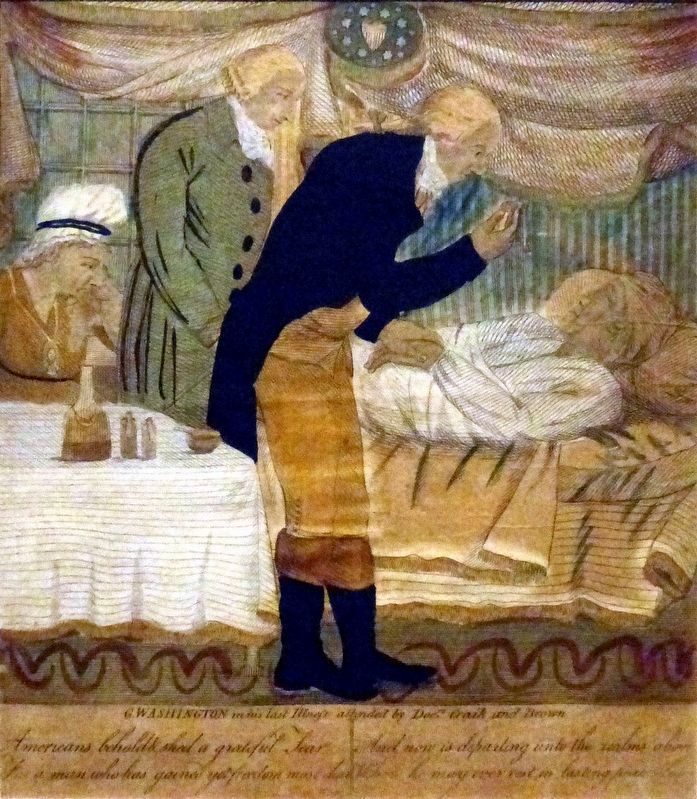
2. Washington's Last Illness
This 1800 hand water colored etching of “Washington in his last illness attended by Doc.rs Craik and Brown” by an unknown artist hangs in the Portrait Gallery in Washington, DC.
“American engravers enjoyed a steady market in the late eighteenth century with the booming demand for illustrations and popular prints. Following the Revolutionary War, George Washington’s status as a national icon spurred the fledgling industry into supplying inexpensive portraits to meet public demand. Washington’s death on December 14, 1799, would prompt an outpouring of oratorical and pictorial tributes. This deathbed scene, which alludes to published accounts of the president’s final moments, shows a physician taking Washington’s pulse with the aid of a stopwatch. Americans purchased souvenir handkerchiefs that featured this image on one side and a complementary mourning picture on the other.” – National Portrait Gallery
“American engravers enjoyed a steady market in the late eighteenth century with the booming demand for illustrations and popular prints. Following the Revolutionary War, George Washington’s status as a national icon spurred the fledgling industry into supplying inexpensive portraits to meet public demand. Washington’s death on December 14, 1799, would prompt an outpouring of oratorical and pictorial tributes. This deathbed scene, which alludes to published accounts of the president’s final moments, shows a physician taking Washington’s pulse with the aid of a stopwatch. Americans purchased souvenir handkerchiefs that featured this image on one side and a complementary mourning picture on the other.” – National Portrait Gallery
More about this marker. Marker is associated with a National Park Service audio-visual presentation
Photographed by William Fischer, Jr., March 23, 2017
3. Washington's Death and a Renewed Hope for Freedom Marker
Also see . . .
1. Washington’s Will: A Decision to Free His Slaves. (Submitted on March 31, 2017, by William Fischer, Jr. of Reynoldsburg, Ohio.)
2. Reverend Richard Allen Autobiography. (Submitted on March 31, 2017, by William Fischer, Jr. of Reynoldsburg, Ohio.)
3. Richard Allen Bio. (Submitted on March 31, 2017, by William Fischer, Jr. of Reynoldsburg, Ohio.)
Credits. This page was last revised on July 26, 2026. It was originally submitted on March 31, 2017, by William Fischer, Jr. of Reynoldsburg, Ohio. This page has been viewed 480 times since then and 141 times this year. Photos: 1. submitted on March 31, 2017, by William Fischer, Jr. of Reynoldsburg, Ohio. 2. submitted on November 2, 2017, by Allen C. Browne of Silver Spring, Maryland. 3. submitted on March 31, 2017, by William Fischer, Jr. of Reynoldsburg, Ohio.
