William Penn Annex East in Philadelphia in Philadelphia County, Pennsylvania — The American Northeast (Mid-Atlantic)
History Lost & Found
The President's House
| — | Freedom and Slavery in the Making of a New Nation | — |

Photographed by William Fischer, Jr., March 23, 2017
1. History Lost & Found Marker
Making History
History is not neat. It is complicated and messy. It is about people, places, and events that are both admirable and deplorable. Here at the site of the house where the first two presidents of the United States resided from 1790-1800, this definition comes into stark focus. The President's House exposes the core contradiction at the founding of this nation: enshrinement of liberty and the institution of slavery.
While important moments in the early history of the nation took place here, slavery casts a shadow over those accomplishments. For many, the fact that President George Washington transported enslaved African descendants to this house from Mount Vernon, his plantation in Virginia, is profoundly disturbing. As the new federal government embraced the lofty concept of liberty, slavery in the President's House, as in the new nation, undermined the meaning of freedom and mocked the nation's pretense to be a beacon of liberty.
If we are to understand how a nation founded on the principle that "all men are created equal" could also somehow embrace and justify slavery, we must examine the context and
this page online
Digging for History
One of the challenges of telling the story of Africans and their descendants in Philadelphia and elsewhere has been locating information about their lives. At first they were violently kidnapped and enslaved, torn from their homes and families, and deprived of their African names and way of life. After enduring a gruesome ocean crossing, they were sold and separated again. Despite these deprivations, they created new families and communities strengthened by deep spiritual beliefs and cultural practices that were passed down from generation to generation.
The lives of the enslaved differed by locations, labors, comforts, and owners. Often prohibited by owners, and sometimes by law, from learning to read and write in America, the enslaved left little in written documents. Much of what we know comes from treasured oral traditions, from records of sales, histories maintained by some plantation owners, advertisements
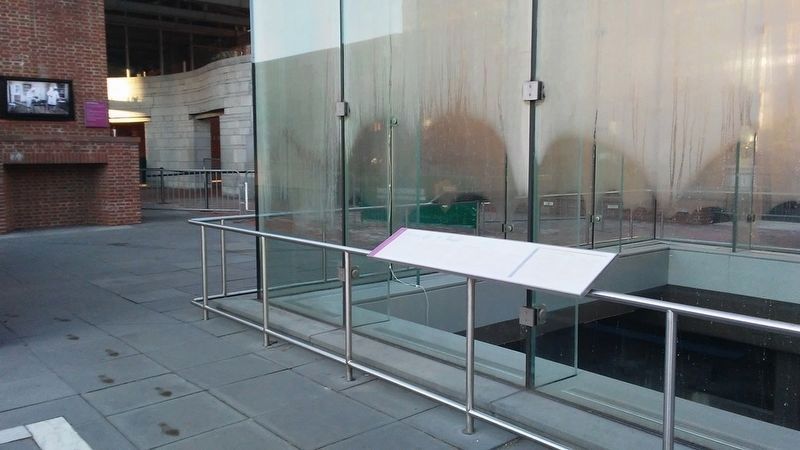
Photographed by William Fischer, Jr., March 23, 2017
2. History Lost & Found Marker
Conflict and Collaboration
At first the National Park Service minimized the importance of the President's House while it focused on the construction of the Liberty Bell Center. But, in the shadow of Independence Hall, another story——the one of slavery——had yet to be told. It was buried both literally and figuratively. Archeology at this house site in 2007 exposed the basement level where some of President George Washington's household servants carried out assigned duties in storerooms and cellar closets. At least nine of the servants were enslaved.
The National Park Service had agreed to a nominal interpretation for this site when the African American community, historians, scholars, and concerned citizens insisted on an expanded vision. Now this site has been transformed into a space that honors the lives of those enslaved——whose stories have just begun to be told——framed by the history of the new nation from 1790 to 1800 when Philadelphia was its temporary capital.
Erected by National
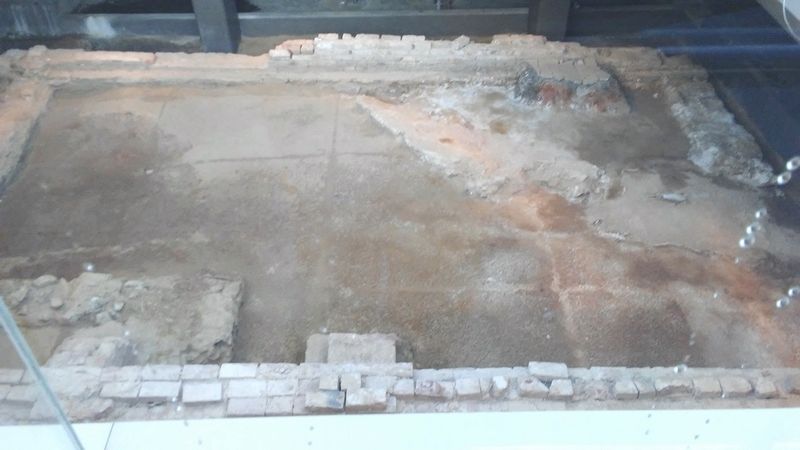
Photographed by William Fischer, Jr., March 23, 2017
3. View of President's House Foundations From Near History Lost & Found Marker
Topics and series. This historical marker is listed in these topic lists: Abolition & Underground RR • African Americans • Government & Politics. In addition, it is included in the Former U.S. Presidents: #01 George Washington series list. A significant historical year for this entry is 2007.
Location. This marker has been replaced by another marker nearby. It was located near 39° 57.023′ N, 75° 9.003′ W. Marker was in Philadelphia, Pennsylvania, in Philadelphia County. It was in William Penn Annex East. It was at the intersection of Market Street and South Independence Mall West (6th Street), on the right when traveling east on Market Street. Touch for map. Marker was at or near this postal address: 101 Market St, Philadelphia PA 19106, United States of America. Touch for directions.

Regionally, this marker was in Southeast Pennsylvania. It was also in the American Northeast and in the Mid-Atlantic. Globally, it was in North America, the Western Hemisphere, the Western World, and the Anglosphere. Historically, it found itself in what was once the Haudenosaunee (Iroquois) Confederacy, New Netherland, and one of the original Thirteen Colonies.
Other nearby markers. At least 8 other markers are within walking distance of this location: Enslaved People at the President's House (here, next to this marker); Slavery in the British Colonies (here, next to this marker); a different marker also named History Lost & Found (here, next to this marker); Memorial (here, next to this marker); Presidents Washington and Adams on Slavery (here, next to this marker); Independence Mall (here, next to this marker); a different marker also named History Lost & Found (here, next to this marker); a different marker also named History Lost & Found (a few steps from this marker). Touch for a list and map of all markers in Philadelphia.
Other markers no longer nearby. History Lost & Found (has been replaced with this marker); a different marker also named History Lost & Found (has been replaced with this marker); "…is hereby empowered to sieze such Fugitives" (was here, next to this marker but has been permanently removed); Awarding a Peace Medal (was here, next to this marker but has been replaced with another marker now near it); Washington's Death and a Renewed Hope for Freedom (was here, next to this marker but has been replaced with another marker now near it); "I and my household" (was here, next to this marker but has been replaced with another marker now near it).
Also see . . .
1. History of the President's House Site. (Submitted on April 1, 2017, by William Fischer, Jr. of Reynoldsburg, Ohio.)
2. President's House Site: Uncovering the Past through Archeology. (Submitted on April 1, 2017, by William Fischer, Jr. of Reynoldsburg, Ohio.)
3. Washington’s Will: A Decision to Free His Slaves. (Submitted on April 1, 2017, by William Fischer, Jr. of Reynoldsburg, Ohio.)
Credits. This page was last revised on July 28, 2026. It was originally submitted on April 1, 2017, by William Fischer, Jr. of Reynoldsburg, Ohio. This page has been viewed 822 times since then and 467 times this year. Photos: 1, 2, 3. submitted on April 1, 2017, by William Fischer, Jr. of Reynoldsburg, Ohio.
