Inner Harbor in Baltimore, Maryland — The American Northeast (Mid-Atlantic)
Port of Baltimore
Gwynns Falls Trail
Photographed by Don Morfe, April 14, 2017
1. Port of Baltimore Marker
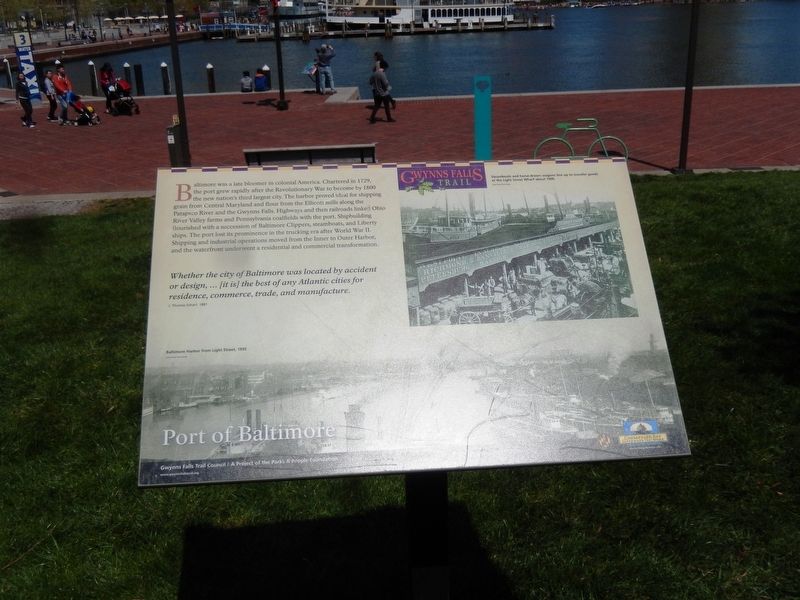
Baltimore was a late bloomer in colonial America. Chartered in 1729, the port grew rapidly after the Revolutionary War to become by 1800 the new nation’s third largest city. The harbor proved ideal for shipping grain from Central Maryland and flour from the Ellicott mills along the Patapsco River and the Gwynns Falls. Highways and then railroads linked Ohio River Valley farms and Pennsylvania coalfields with the port. Shipbuilding flourished with a succession of Baltimore Clippers, steamboats, and Liberty ships. The port lost its prominence in the trucking era after World War II. Shipping and industrial operations moved from the Inner to Outer Harbor, and the waterfront underwent a residential and commercial transformation.
Whether the city of Baltimore was located by accident or design,…(it is) the best of any Atlantic cities for residence, commerce, trade, and manufacture.
J. Thomas Scharf, 1881.
[Captions:]
Baltimore Harbor from Light Street, 1895.
Steamboats and horse-drawn wagons line up to transfer goods at the Light Street Wharf about 1900. Enoch Pratt Free Library.
Erected by Gwynns Falls Trail
this page online
Topics. This memorial is listed in these topic lists: Industry & Commerce • Railroads & Streetcars • Roads & Vehicles • Waterways & Vessels. A significant historical year for this entry is 1729.
Location. Memorial has been permanently removed. It was located near 39° 16.894′ N, 76° 36.672′ W. Memorial was in Baltimore, Maryland. It was in the Inner Harbor. It was on Key Highway. Touch for map. Memorial was in this post office area: Baltimore MD 21202, United States of America.
We have been informed that this memorial is no longer there and will not be replaced. This page is an archival view of what was.
Regionally, this memorial was in Central Maryland. It was also in the American Mid-Atlantic, in the Chesapeake Bay Region, and on the Eastern Seaboard. Globally, it was in the North Atlantic Region, North America, the Western Hemisphere, the Western World, and the Anglosphere. Historically, it found itself in what was once one of the original Thirteen Colonies and also the Antebellum South.

Other nearby markers. At least 8 other markers are within walking
Photographed by Don Morfe, April 14, 2017
2. Port of Baltimore Marker
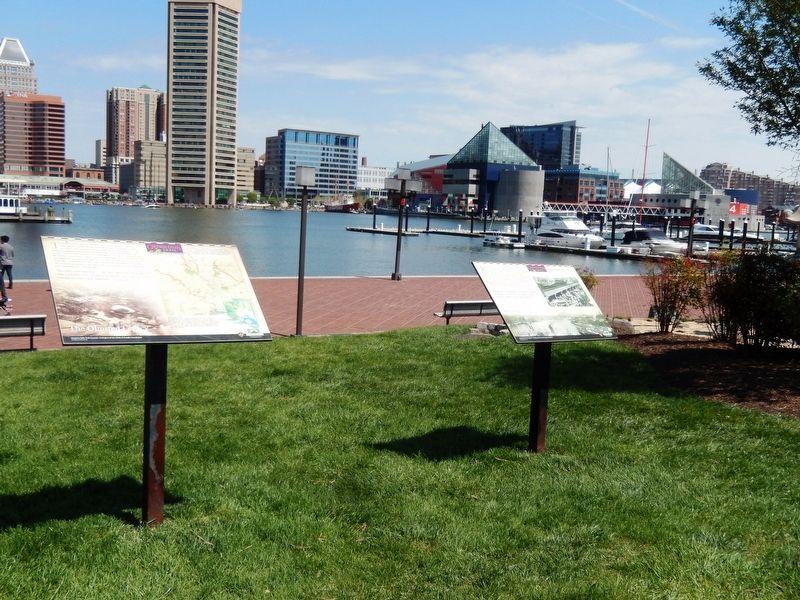
This marker is the one on the right of the two markers.
Other markers no longer nearby. The Olmsted Legacy (was here, next to this marker but has been permanently removed); Baltimore’s Part in Saving the Bay (was within shouting distance of this marker but has been permanently removed).
Photographed by Don Morfe, April 14, 2017
3. Port of Baltimore Marker
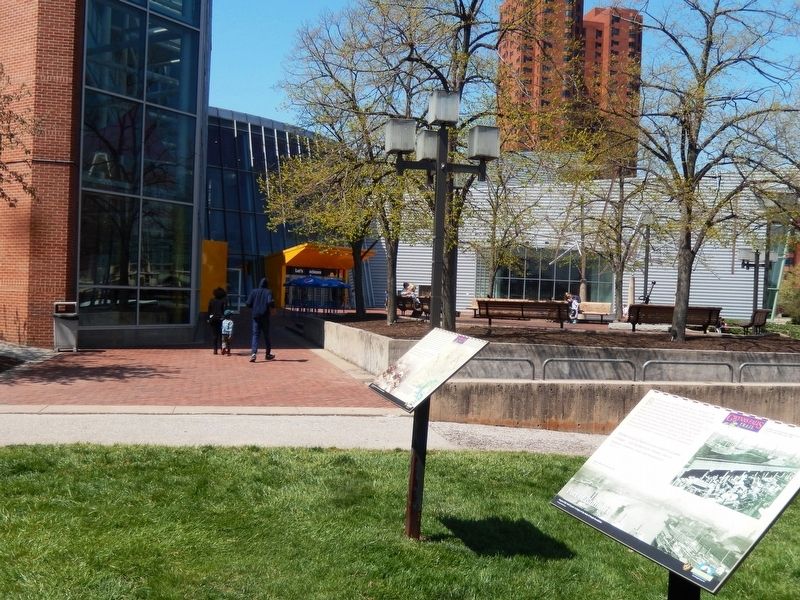
The Maryland Science Center is in the background.
Credits. This page was last revised on September 29, 2025. It was originally submitted on April 23, 2017, by Don Morfe of Baltimore, Maryland. This page has been viewed 1,938 times since then and 43 times this year. Last updated on August 18, 2025, by Evan Dwyer of Richmond, Virginia. Photos: 1, 2, 3. submitted on April 23, 2017, by Don Morfe of Baltimore, Maryland. • Devry Becker Jones was the editor who published this page.
