Covington in Newton County, Georgia — The American South (South Atlantic)
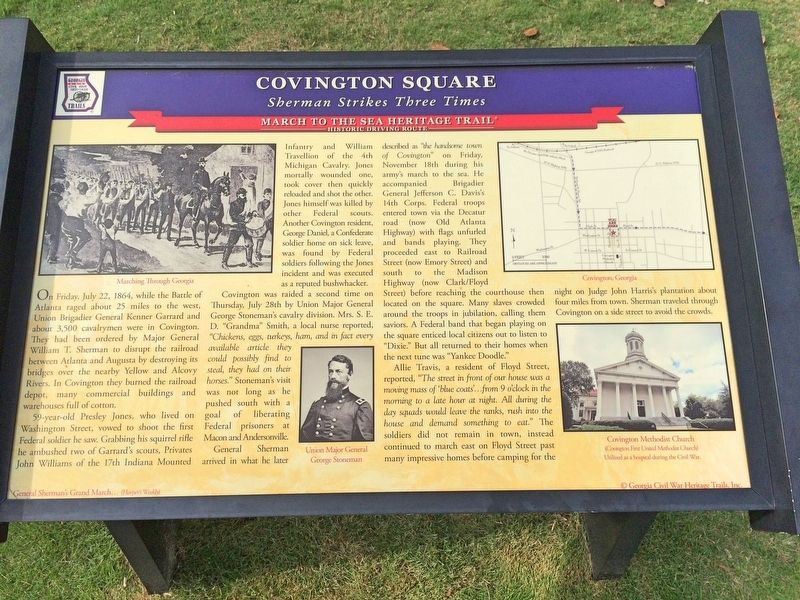
Covington Square
Sherman Strikes Three Times
| — | March to the Sea Heritage Trail | — |
Photographed by Mark Hilton, April 30, 2017
1. Covington Square Marker
59-year-old Presley Jones, who lived on Washington Street, vowed to shoot the first Federal soldier he saw. Grabbing his squirrel rifle he ambushed two of Garrard's scouts, Privates John Williams of the 17th Indiana Mounted Infantry and William Travellion of the 4th Michigan Cavalry. Jones mortally wounded one, took cover then quickly reloaded and shot the other. Jones himself was killed by other Federal scouts. Another Covington resident, George Daniel, a Confederate soldier home on sick leave, was found by Federal soldiers following the Jones incident and was executed as a reputed bushwhacker.
Covington was raided a second time on Thursday, July 28th by Union Major General
this page online
General Sherman arrived in what he later described as "the handsome town of Covington" on Friday, November 18th during his army's march to the sea. He accompanied Brigadier General Jefferson C. Davis's 14th Corps. Federal troops entered town via the Decatur road (now Old Atlanta Highway) with flags unfurled and bands playing. They proceeded east to Railroad Street (now Emory Street) and south to the Madison Highway (now Clark/Floyd Street) before reaching the courthouse then located on the square. Many slaves crowded around the troops in jubilation, calling them saviors. A Federal band that began playing on the square enticed local citizens out to listen to "Dixie." But all returned to their homes when the next tune was "Yankee Doodle."
Allie Travis, a resident of Floyd Street, reported, "The street in front of our house was a moving mass of blue coats...from 9 o'clock in the morning to a late hour at night. All during the day squads would leave the ranks, rush into the house and demand something to eat."
Photographed by Mark Hilton, April 30, 2017
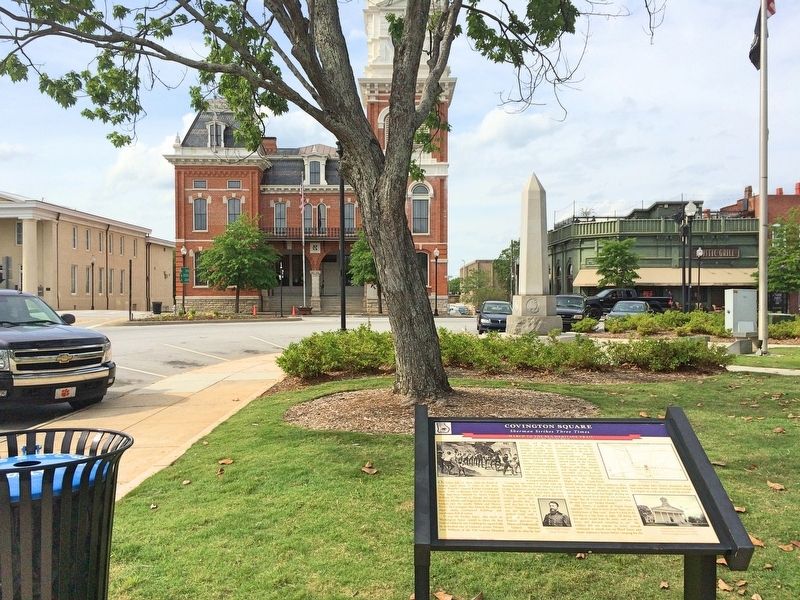
2. View from marker looking towards Newton County Courthouse.
The Newton County Courthouse is a historic county courthouse in Courthouse Square in Covington, Georgia, the county seat of Newton County, Georgia. The courthouse was designed by Bruce & Morgan in a Second Empire architecture style and built in 1884.
Erected by Georgia Civil War Heritage Trails, Inc. (Marker Number L4.)
Topics and series. This historical marker is listed in these topic lists: Bridges & Viaducts • Railroads & Streetcars • War, US Civil. In addition, it is included in the Sherman’s March to the Sea series list. A significant historical date for this entry is July 22, 1864.
Location. 33° 35.788′ N, 83° 51.608′ W. Marker is in Covington, Georgia, in Newton County. It is on Monticello Street SW south of Clark Street SW, on the left when traveling south. Touch for map. Marker is at or near this postal address: 1112 Monticello Street SW, Covington GA 30014, United States of America. Touch for directions.

Regionally, this marker is in Georgia’s Piedmont and in Metro Atlanta. It is also in the American South and specifically in the Deep South. Globally, it is in North America, the Western
Photographed by Mark Hilton, April 30, 2017
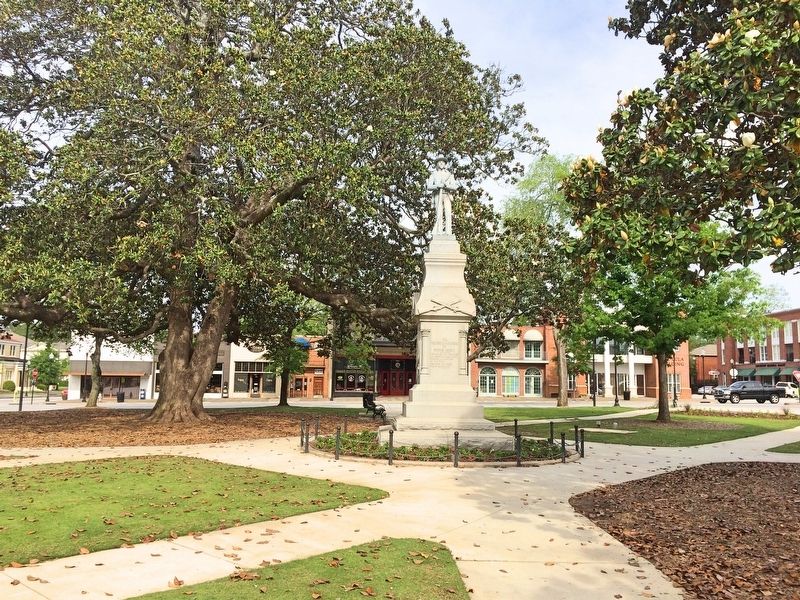
3. View from marker towards Confederate Monument.
Other nearby markers. At least 8 other markers are within walking distance of this marker: Newton County War Memorial (a few steps from this marker); To The Confederate Dead of Newton County (within shouting distance of this marker); Bicentennial of the United States Constitution (within shouting distance of this marker); Leon Cohen Building (within shouting distance of this marker); Swann Building (within shouting distance of this marker); Ramsey's Furniture (about 300 feet away, measured in a direct line); Lucius Q. C. Lamar (about 400 feet away); The Capture of Covington (about 700 feet away). Touch for a list and map of all markers in Covington.
Credits. This page was last revised on May 10, 2017. It was originally submitted on May 10, 2017, by Mark Hilton of Montgomery, Alabama. This page has been viewed 2,087 times since then and 131 times this year. Photos: 1, 2, 3. submitted on May 10, 2017, by Mark Hilton of Montgomery, Alabama.
