Coliseum Central in Hampton, Virginia — The American South (Mid-Atlantic)
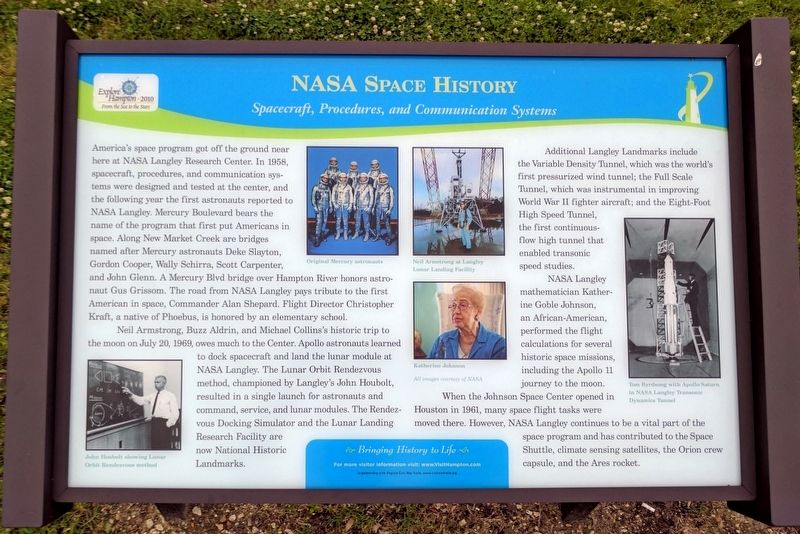
NASA Space History
Spacecraft, Procedures, and Communication Systems
Photographed by Bernard Fisher, May 28, 2017
1. NASA Space History Marker
America’s space program got off the ground near here at NASA Langley Research Center. In 1958, spacecraft, procedures, and communication systems were designed and tested at the center, and the follow year the first astronauts reported to NASA Langley. Mercury Boulevard bears the name of the program that first put Americans in space. Along New Market Creek are bridges named after Mercury astronauts Deke Slayton, Gordon Cooper, Wally Schirra, Scott Carpenter, and John Glenn. A Mercury Blvd bridge over Hampton River honors astronaut Gus Grissom. The road from NASA Langley pays tribute to the first American in space, Commander Alan Shepard. Flight Director Christopher Kraft, a native of Phoebus, is honored by an elementary school.
Neil Armstrong Buzz Aldrin, and Michael Collins’s historic trip to the moon on July 20, 1969, owes much to the Center. Apollo astronauts learned to dock spacecraft and land the lunar module at NASA Langley. The Lunar Orbit Rendezvous method, championed by Langley’s John Houbolt, resulted in a single launch for astronauts and command, service, and lunar modules. The Rendezvous Docking Simulator
this page online
Additional Langley Landmarks include the Variable Density Tunnel, which was the world’s first pressurized wind tunnel; the Full Scale Tunnel, which was instrumental in improving World War II fighter aircraft; and the Eight-Foot High Speed Tunnel, the first continuous-flow high tunnel that enabled transonic speed studies.
NASA Langley mathematician Katherine Goble Johnson, an African-American, performed the flight calculations for several historic space missions, including the Apollo 11 journey to the moon.
When the Johnson Space Center opened in Houston in 1961, many space flight tasks were moved there. However, NASA Langley continues to be a vital part of the space program and has contributed to the Space Shuttle, climate sensing satellites, the Orion crew capsule, and the Ares rocket.
Erected 2010 by Bring History to Life.
Topics. This historical marker is listed in these topic lists: African Americans • Air & Space • Exploration • Science & Medicine. A significant historical year for this entry is 1958.
Location. 37° 2.615′ N, 76° 21.991′ W.
Photographed by Bernard Fisher, May 28, 2017
2. NASA Space History Marker

Regionally, this marker is on Virginia’s Peninsula and in Coastal Virginia. It is also in the American South, specifically in the Upper South, in the Tidewater, and on the Eastern Seaboard. Globally, it is in the North Atlantic Region, North America, the Western Hemisphere, the Western World, and the Anglosphere. Historically, it finds itself in what was once the territory of the Mississippian Culture, one of the original Thirteen Colonies, one of the Confederate States of America, and the Antebellum South.
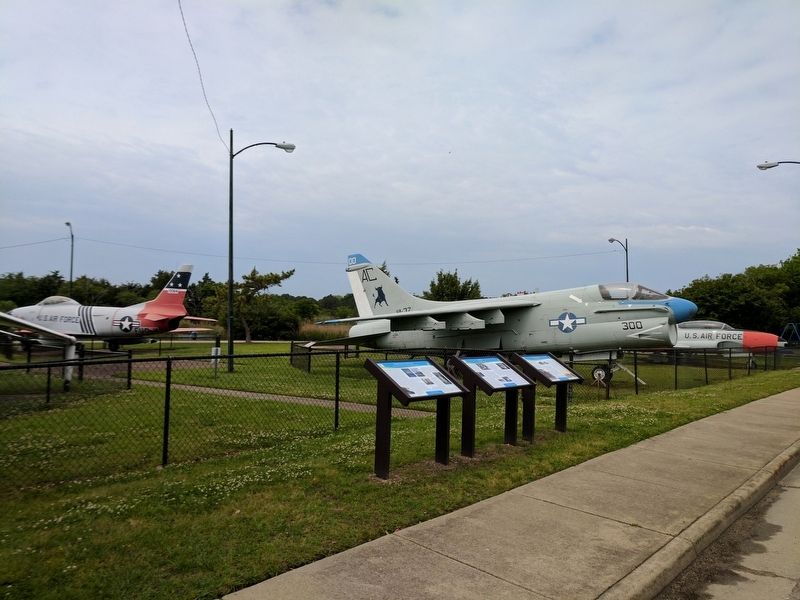
Other nearby markers. At least 8 other markers are within walking distance of this marker: NACA (here, next to this marker); Langley Field (here, next to this marker); F-86L Sabre/Mercury Test Capsule (here, next to this marker); MIM-3 Nike-Ajax/XV-6A Kestrel (a few steps from this marker); A-7E Corsair II / T-33A T-Bird (within shouting distance of this marker); F-100D Super Saber • Mercury/Little Joe Booster (within shouting distance of this marker); RF-4C Phantom II / M-2 (MGM-5) Corporal (within shouting distance of this marker); A-2 Polaris (within shouting distance of this marker). Touch for a list and map of all markers in Hampton.
Other markers no longer nearby. A-7E Corsair II (was a few steps from this marker but has been permanently removed); Mercury Test Capsule (was within shouting distance of this marker but has been confirmed missing); T-33A T-Bird (was within shouting distance of this marker but has been permanently removed); M-2 Corporal (was within shouting distance of this marker but has been permanently removed).
Credits. This page was last revised on February 1, 2023. It was originally submitted on May 30, 2017, by Bernard Fisher of Richmond, Virginia. This page has been viewed 985 times since then and 81 times this year. Photos: 1, 2. submitted on May 30, 2017, by Bernard Fisher of Richmond, Virginia.
