Coliseum Central in Hampton, Virginia — The American South (Mid-Atlantic)
NACA
Many Historic Firsts
Photographed by Bernard Fisher, May 28, 2017
1. NACA Marker
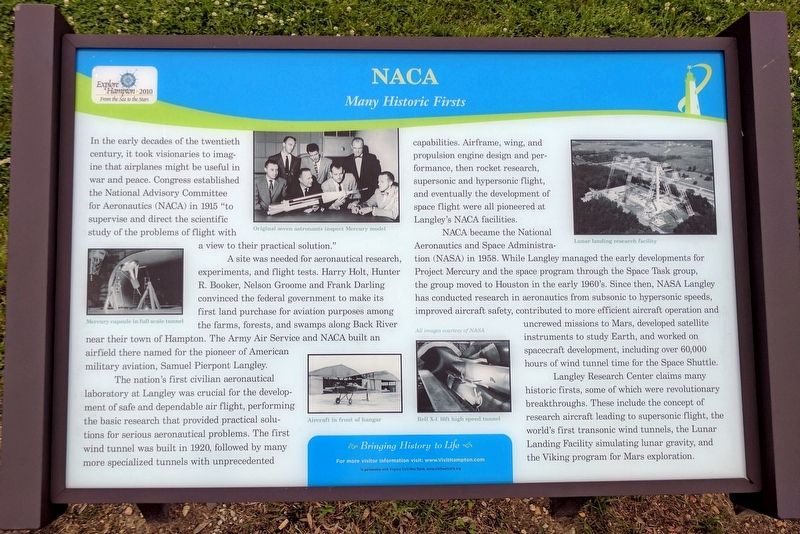
A site was needed for aeronautical research, experiments, and flight tests. Harry Holt, Hunter R. Booker, Nelson Groome and Frank Darling convinced the federal government to make its first land purchase for aviation purposes among the farms, forests, and swamps along Back River near their town of Hampton. The Army Air Service and NACA built an airfield there named for the pioneer of American military aviation, Samuel Pierpont Langley.
The nation’s first civilian aeronautical laboratory at Langley was crucial for the development of safe and dependable air flight, performing the basic research that provided practical solutions for serious aeronautical problems. The first wind tunnel was built in 1920, followed by many more specialized tunnels with unprecedented capabilities. Airframe,
this page online
NACA became the National Aeronautics and Space Administration (NASA) in 1958. While Langley managed the early developments for Project Mercury and the space program through the Space Task group, the group moved to Houston in the early 1960’s. Since then, NASA Langley has conducted research in aeronautics from subsonic to hypersonic speeds, improved aircraft safety, contributed to more efficient aircraft operation and uncrewed missions to Mars, developed satellite instruments to study Earth, and worked on spacecraft development, including over 60,000 hours of wind tunnel time for the Space Shuttle.
Langley Research Center claims many historic firsts, some of which were revolutionary breakthroughs. These include the concept of research aircraft leading to supersonic flight, the world’s first transonic wind tunnels, the Lunar Landing Facility simulating lunar gravity, and the Viking program for Mars exploration.
(captions)
Mercury
Photographed by Bernard Fisher, May 28, 2017
2. NACA Marker
Original seven astronauts inspect Mercury model
Aircraft in front of hangar
Bell X-1 16ft high speed tunnel
Lunar landing research facility
All images courtesy of NASA
Erected 2010 by Bring History to Life.
Topics. This historical marker is listed in these topic lists: Air & Space • Exploration • Science & Medicine. A significant historical year for this entry is 1915.
Location. 37° 2.615′ N, 76° 21.993′ W. Marker is in Hampton, Virginia. It is in Coliseum Central. It is on West Mercury Boulevard (U.S. 258) west of LaSalle Avenue (Virginia Route 167), on the right when traveling east. Located in Air Power Park. Touch for map. Marker is at or near this postal address: 413 W Mercury Blvd, Hampton VA 23666, United States of America. Touch for directions.

Regionally, this marker is on Virginia’s Peninsula and in Coastal Virginia. It is also in the American South, specifically in the Upper South, in the Tidewater, and on the Eastern Seaboard. Globally, it is in the North Atlantic Region, North America, the Western Hemisphere, the Western World, and the Anglosphere. Historically, it finds itself in what was once the territory of the Mississippian Culture, one of the original Thirteen Colonies, one of the Confederate States of America, and the Antebellum South.
Other nearby markers. At least 8 other markers are within walking distance of this marker: Langley Field (here, next to this marker); NASA Space History (here, next to this marker); F-86L Sabre/Mercury Test Capsule (here, next to this marker); MIM-3 Nike-Ajax/XV-6A Kestrel (a few steps from this marker); A-7E Corsair II / T-33A T-Bird (a few steps from this marker); F-100D Super Saber • Mercury/Little Joe Booster (within shouting distance of this marker); RF-4C Phantom II / M-2 (MGM-5) Corporal (within shouting distance of this marker); A-2 Polaris (within shouting distance of this marker). Touch for a list and map of all markers in Hampton.
Other markers no longer nearby. A-7E Corsair II (was a few steps from this marker but has been permanently removed); Mercury Test Capsule (was within shouting distance of this marker but has been confirmed missing); T-33A T-Bird (was within shouting distance of this marker but has been permanently removed); M-2 Corporal (was within shouting distance of this marker but has been permanently removed).
Credits. This page was last revised on February 1, 2023. It was originally submitted on May 30, 2017, by Bernard Fisher of Richmond, Virginia. This page has been viewed 343 times since then and 21 times this year. Photos: 1, 2. submitted on May 30, 2017, by Bernard Fisher of Richmond, Virginia.
