Southaven in Desoto County, Mississippi — The American South (East South Central)
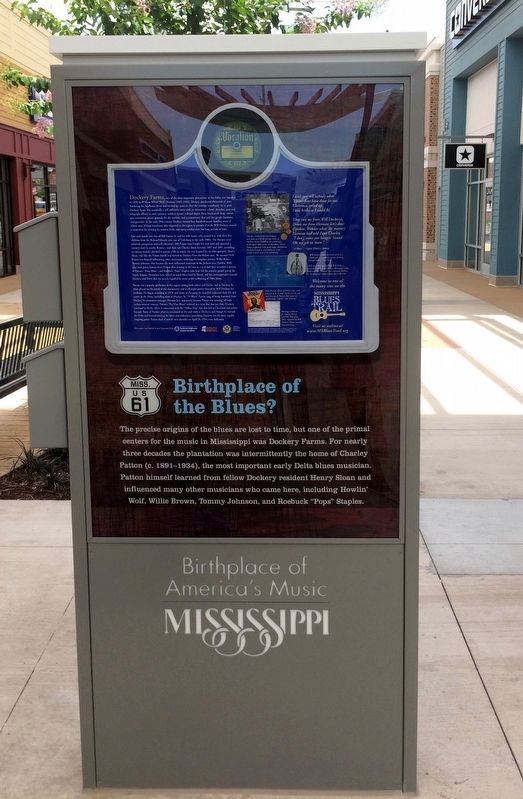
Birthplace of the Blues?
Photographed by Steve Masler, June 17, 2017
1. Dockery Farm Marker
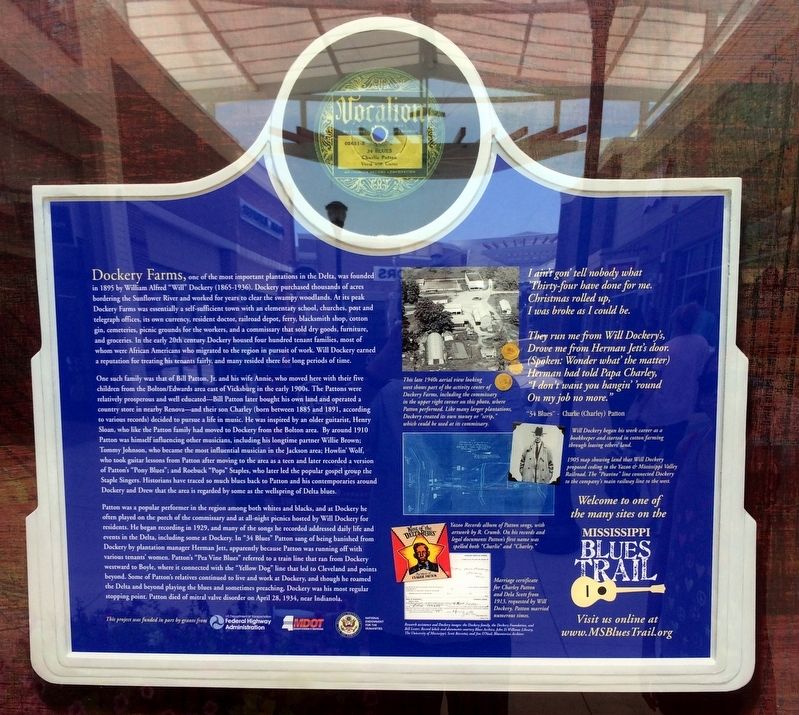
One such family was that of Bill Patton, Jr. and his wife Annie, who moved here with their five children from the Bolton/Edwards area east of Vicksburg in the early 1900s. The Pattons were relatively prosperous and well educated—Bill Patton later bought his own land and
this page online
Patton was a popular performer in the region among both whites and blacks, and at Dockery he often played on the porch of the commissary and at all-night picnics hosted by Will Dockery for residents. He began recording in 1929, and many of the songs he recorded
Photographed by Steve Masler
2. Dockery Farm Marker
Topics. This historical marker is listed in these topic lists: African Americans • Agriculture • Arts, Letters, Music • Entertainment.
Location. 34° 56.207′ N, 89° 59.487′ W. Marker is in Southaven, Mississippi, in Desoto County. It can be reached from Airways Boulevard north of Church Road West, on the left when traveling north. Located in Tanger Outlet. Touch for map. Marker is at or near this postal address: 5205 Airways Blvd, Southaven MS 38671, United States of America. Touch for directions.

Regionally, this marker is in the American South, specifically in the Deep South, in the Mississippi Delta, and in the Great River Road Region. Globally, it is in North America, a Gulf of Mexico state, the Western Hemisphere, the Western World, and the Anglosphere. Historically, it finds itself in what was once the territory of the Mississippian Culture, one of the Confederate States of America, and the Antebellum South.
Other nearby markers. At least 8 other markers are within 3 miles of this marker, measured as the crow flies: The Peavine Branch (here, next to this marker); Hubert Sumlin (within shouting distance of this marker); Charley Patton (within shouting distance of this marker); Documenting the Blues (about 300 feet away, measured in a direct line); Club Ebony (about 300 feet away); Po' Monkey's (about 400 feet away); Albert King (about 400 feet away); Big Walter Horton (approx. 2.7 miles away). Touch for a list and map of all markers in Southaven.
More about this marker. This is part of a display at the mall and not the original marker. It does not include the front of the marker, only the rear side.
Credits. This page was last revised on April 10, 2021. It was originally submitted on June 24, 2017, by Steve Masler of Memphis, Tennessee. This page has been viewed 701 times since then and 21 times this year. Photos: 1, 2. submitted on June 24, 2017, by Steve Masler of Memphis, Tennessee. • Bernard Fisher was the editor who published this page.
