Near Carthage in Panola County, Texas — The American South (West South Central)
International Boundary Marker
Photographed by Mark Hilton, June 28, 2017
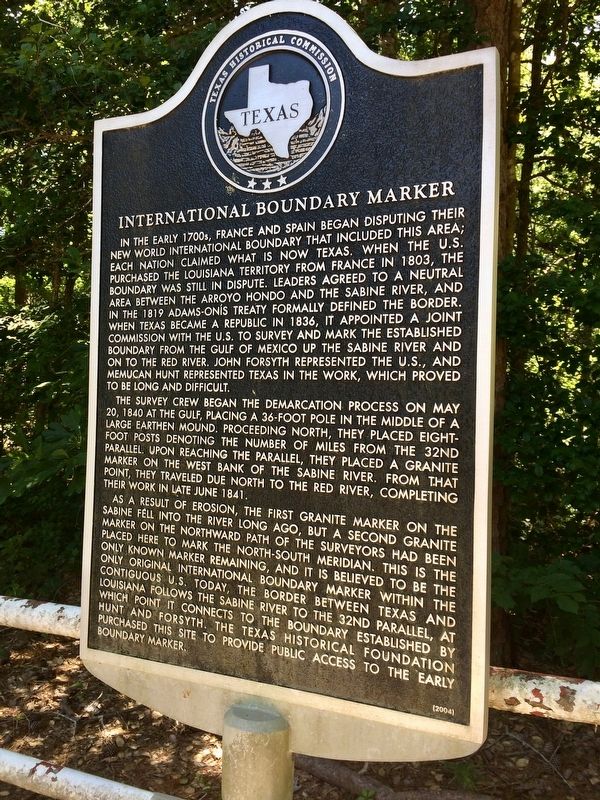
1. International Boundary Marker Marker
In the early 1700s, France and Spain began disputing their New World international boundary that included this area; each nation claimed what is now Texas. When the U.S. purchased the Louisiana Territory from France in 1803, the boundary was still in dispute. Leaders agreed to a neutral area between the Arroyo Hondo and the Sabine River, and the 1819 Adams-Onís Treaty formally defined the border. When Texas became a republic in 1836, it appointed a joint commission with the U.S. to survey and mark the established boundary from the Gulf of Mexico up the Sabine River and on to the Red River. John Forsyth represented the U.S., and Memucan Hunt represented Texas in the work, which proved to be long and difficult.
The survey crew began the demarcation process on May 20, 1840 at the Gulf, placing a 36-foot pole in the middle of a large earthen mound. Proceeding north, they placed eight-foot posts denoting the number of miles from the 32nd parallel. Upon reaching the parallel, they placed a granite marker on the west bank of the Sabine River. From that point, they traveled due north to the Red River, completing their work
this page online
As a result of erosion, the first granite marker on the Sabine fell into the river long ago, but a second granite marker on the northward path of the surveyors had been placed here to mark the north-south meridian. This is the only known marker remaining, and it is believed to be the only original international boundary marker within the contiguous U.S. Today, the border between Texas and Louisiana follows the Sabine River to the 32nd parallel, at which point it connects to the boundary established by Hunt and Forsyth. The Texas Historical Foundation purchased this site to provide public access to the early boundary marker.
Erected 2004 by Texas Historical Commission. (Marker Number 13056.)
Topics. This historical marker is listed in these topic lists: Exploration • Notable Places • Waterways & Vessels. A significant historical date for this entry is May 20, 1840.
Location. 32° 2.039′ N, 94° 2.567′ W. Marker is near Carthage, Texas, in Panola County. It can be reached from Farm to Market Road 31 0.4 miles south of County Road 4557, on the right when traveling north. Located in a very rural area of the county
Photographed by Mark Hilton, June 28, 2017
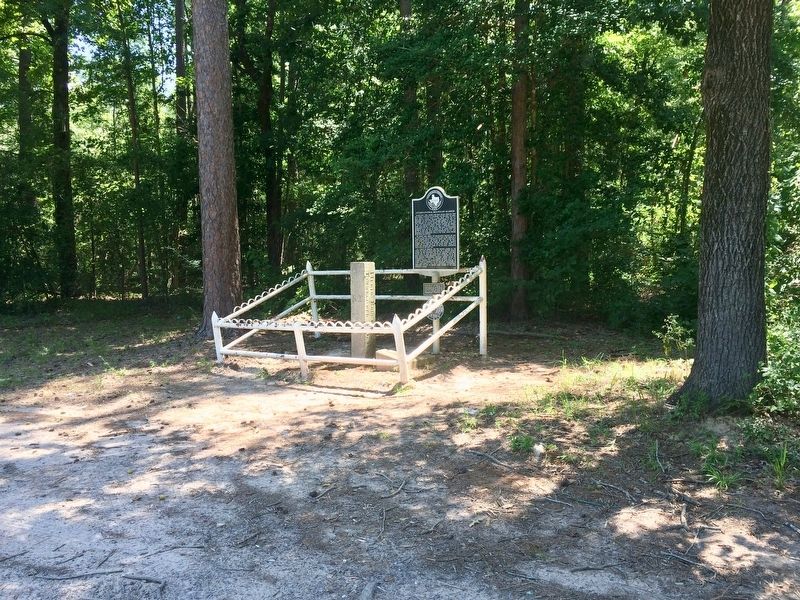
2. International Boundary marker and granite stone post.

Regionally, this marker is in the American South, specifically in the Deep South, and in the Piney Woods. Globally, it is in North America, a Gulf of Mexico state, the Western Hemisphere, the Western World, and the Anglosphere. Historically, it finds itself in what was once New Spain, the Republic of Texas, one of the Confederate States of America, and the Antebellum South.
Other nearby markers. At least 8 other markers are within 11 miles of this marker, measured as the crow flies: A different marker also named International Boundary Marker (here, next to this marker); Adams Cemetery (approx. 3½ miles away); Brookland Cemetery (approx. 4.7 miles away); B.F. Morris and the Town of Joaquin (approx. 4.7 miles away); Sholar Cemetery (approx. 6.7 miles away); Site of Truitt Community (approx. 8.4 miles away); Deadwood Cemetery (approx. 9.7 miles away); Lone Cedar Cemetery (approx. 10½ miles away). Touch for a list and map of all markers in Carthage.
Another
Photographed by Mark Hilton
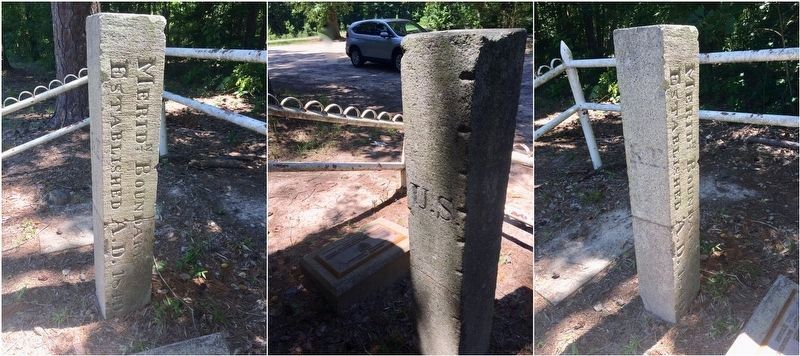
3. Granite stone post International Boundary Marker.
Sides read: Meridn Boundary Established A.D. 1840
U.S. = United States
RT = Republic of Texas
U.S. = United States
RT = Republic of Texas
Also see . . . Texas Escapes on the Last Remaining International Boundary for The Republic of Texas. (Submitted on July 9, 2017, by Mark Hilton of Montgomery, Alabama.)
Photographed by Mark Hilton, June 28, 2017
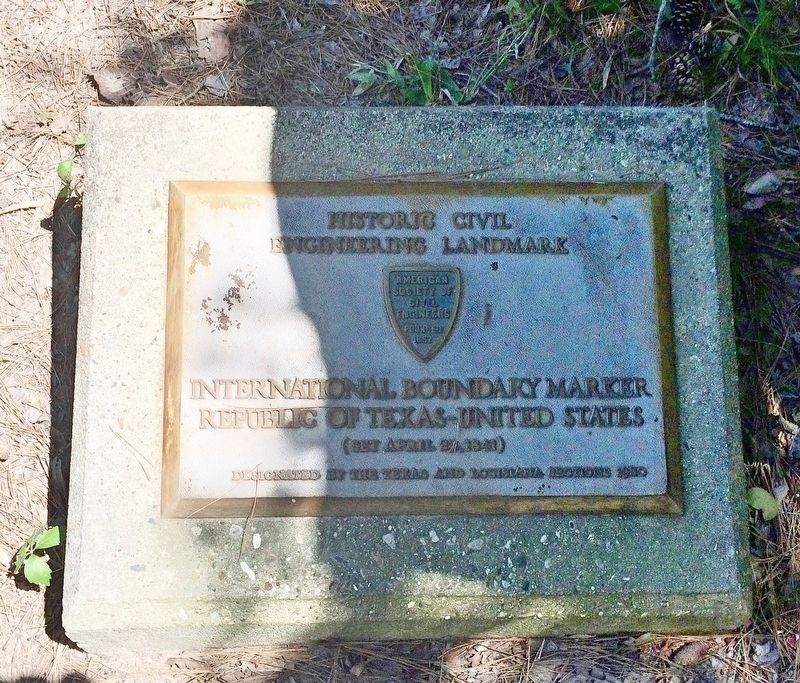
4. Historic Civil Engineering Landmark plaque.
Photographed by Mark Hilton, June 28, 2017
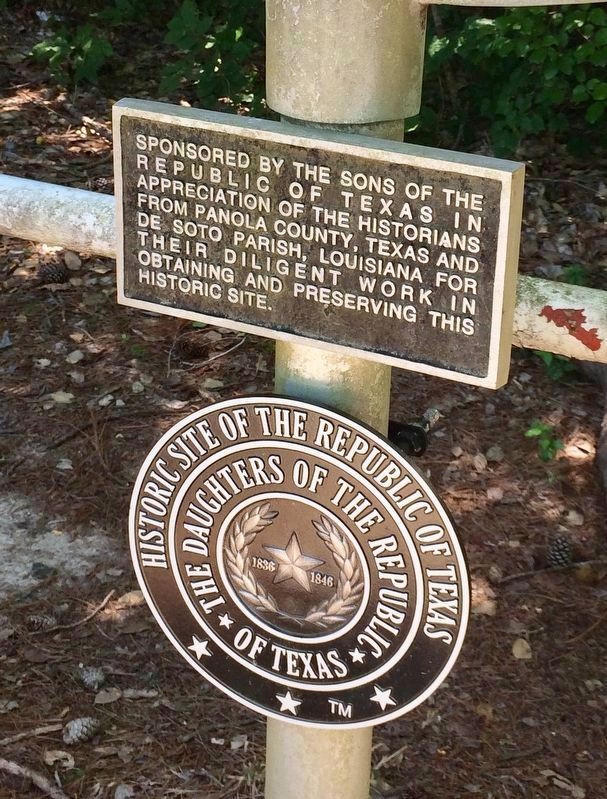
5. Lower plaques on this marker.
Rectangular plaque: Sponsored by the Sons of the Republic of Texas in appreciation of the historians from Panola County, Texas and De Soto Parish, Louisiana for their diligent work in obtaining and preserving this historic site.
Round plaque: Historic Site of the Republic of Texas, The Daughters of the Republic of Texas
Round plaque: Historic Site of the Republic of Texas, The Daughters of the Republic of Texas
Photographed by Mark Hilton, June 28, 2017
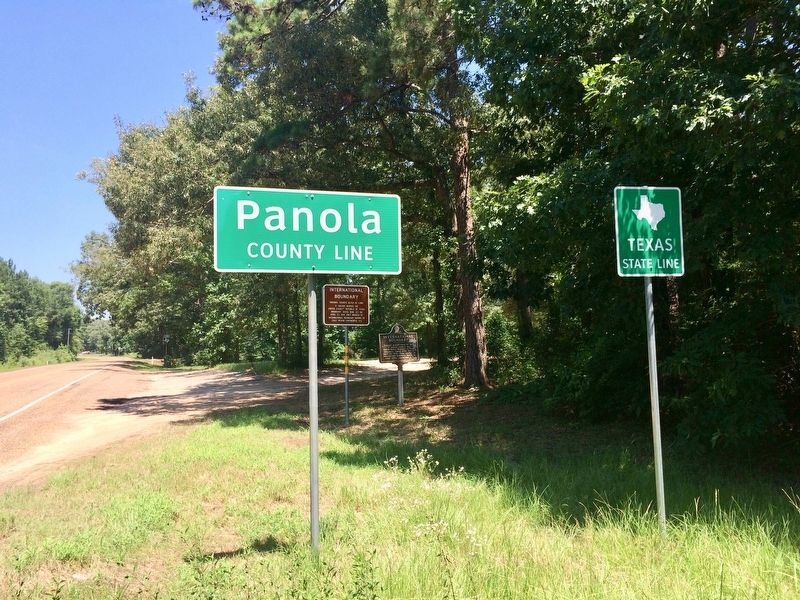
6. View from the Louisiana/Texas border into Texas.
Credits. This page was last revised on November 24, 2020. It was originally submitted on July 9, 2017, by Mark Hilton of Montgomery, Alabama. This page has been viewed 2,519 times since then and 120 times this year. Photos: 1, 2, 3, 4, 5, 6. submitted on July 9, 2017, by Mark Hilton of Montgomery, Alabama.
