
Santiago de Querétaro in Querétaro, Mexico — The Central Highlands (North America)
Fountain of the Capulines
Photographed by J. Makali Bruton, July 26, 2018
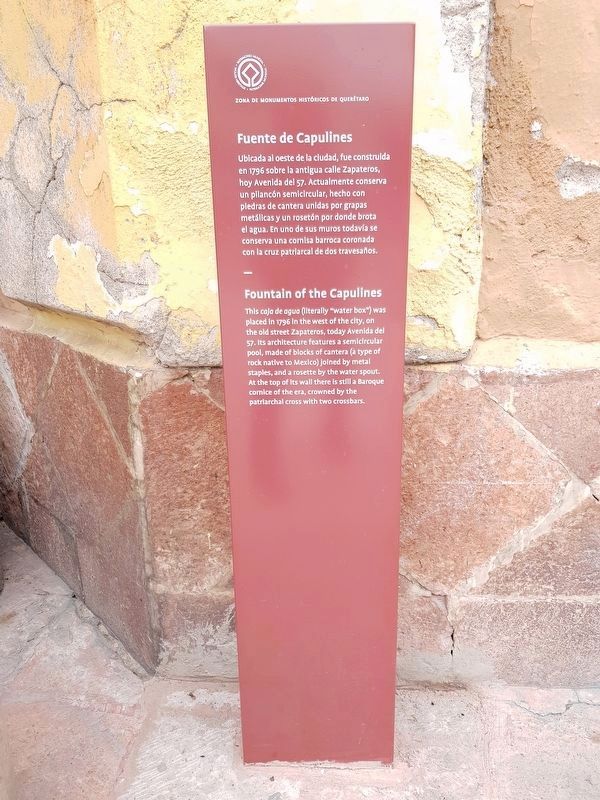
1. Fountain of the Capulines Marker
This marker replaced a previous marker in 2018.

Fuente de Capulines
Ubicada al oeste de la ciudad, fue construida en 1796 sobre la antigua calle Zapateros, hoy Avenida del 57. Actualmente conserva un pilancón semicircular, hecho con piedras de cantera unidas por grapas metálicas y un rosetón por donde brota el agua. En uno de sus muros todavía se conserva una cornisa barroca coronada con la cruz patriarcal de dos travesaños.
Fountain of the Capulines
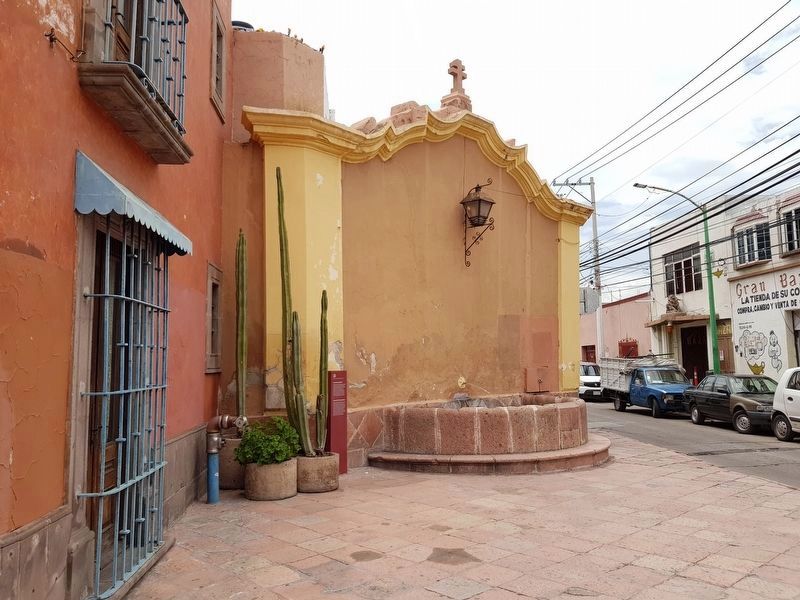
This caja de agua (literally "water box") was placed in 1796 in the west of the city, on the old street Zapateros, today Avenida del 57. Its architecture features a semicircular pool, made of blocks of cantera (a type of rock native to Mexico) joined by metal staples, and a rosette by the water spout. At the top of its wall there is still a Baroque cornice of the era, crowned by the patriarchal cross with two crossbars.
Erected 2018 by Municipalidad de Querétaro.
Topics. This historical marker is listed in these topic lists: Architecture • Industry & Commerce • Man-Made Features. A significant historical date for this entry is May 6, 1796.
Location. 20° 35.45′ N, 100° 23.986′ W. Marker is in Santiago de
this page online

Regionally, this marker is in Central Mexico and in the Bajío. Globally, it is in North America, specifically in Mesoamerica, on the Ring of Fire, and in the Western Hemisphere. Historically, it finds itself in what was once New Spain, a Spanish colony, and the Aztec Empire.
Other nearby markers. At least 8 other markers are within walking distance of this marker: Francisco I. Madero (about 210 meters away, measured in a direct line); Vecindad del Agua Limpia (about 210 meters away); Temple of San Felipe Neri (approx. 0.3 kilometers away); Birthplace of Manuel Montes Collantes (approx. 0.3 kilometers away); Temple and former Convent of the Carmelites (approx. 0.4 kilometers away); Benito Juárez in Querétaro (approx. 0.4 kilometers away); Ezequiel Montes Ledesma (approx. 0.4 kilometers away); Fountain of Santo Domingo (approx. 0.4 kilometers away). Touch for a list and map
Photographed by J. Makali Bruton, July 11, 2017
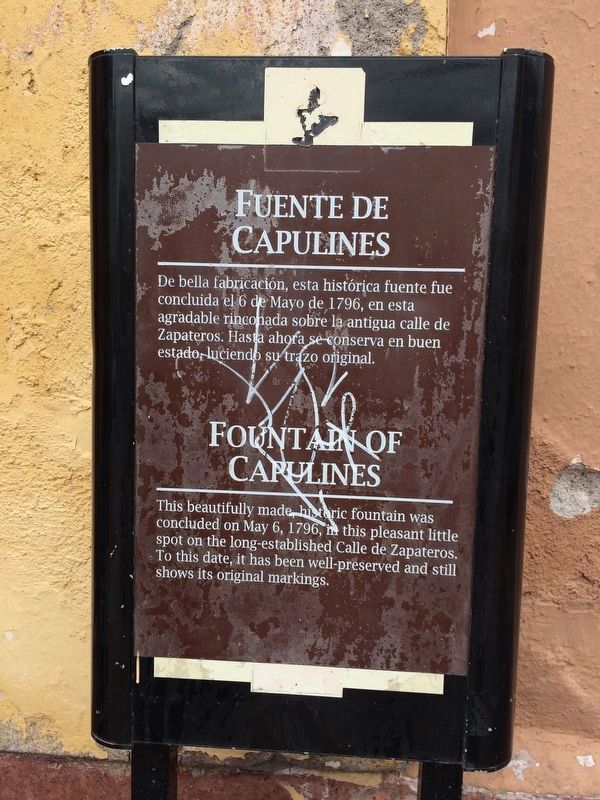
2. The previous Fountain of Capulines Marker
This marker was replaced in 2018. It read:
Fuente de Capulines
De bella fabricación, esta histórica fuente fue concluida el 6 de Mayo de 1796, en esta agradable rinconada sobre la antigua calle de Zapateros. Hasta ahora se conserva en buen estado, luciendo su trazo original.
Fountain of Capulines
This beautifully made historic fountain was concluded on May 6, 1796, in this pleasant little spot on the long-established Calle de Zapateros (Shoemakers’ Street). To this date, it has been well-preserved and still shows its original markings.
De bella fabricación, esta histórica fuente fue concluida el 6 de Mayo de 1796, en esta agradable rinconada sobre la antigua calle de Zapateros. Hasta ahora se conserva en buen estado, luciendo su trazo original.
This beautifully made historic fountain was concluded on May 6, 1796, in this pleasant little spot on the long-established Calle de Zapateros (Shoemakers’ Street). To this date, it has been well-preserved and still shows its original markings.
Regarding Fountain of the Capulines. A 'capulin' is a type of tree found in Mexico which gives fruit similar to small cherries.
Photographed by J. Makali Bruton, July 26, 2018
3. The Fountain of the Capulines and Marker
Photographed by J. Makali Bruton, July 11, 2017
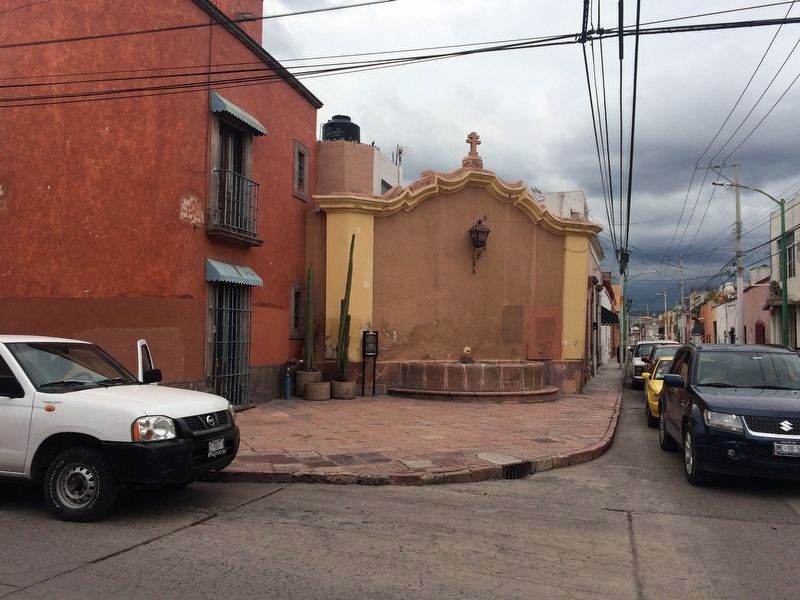
4. The Fountain of the Capulines and previous marker
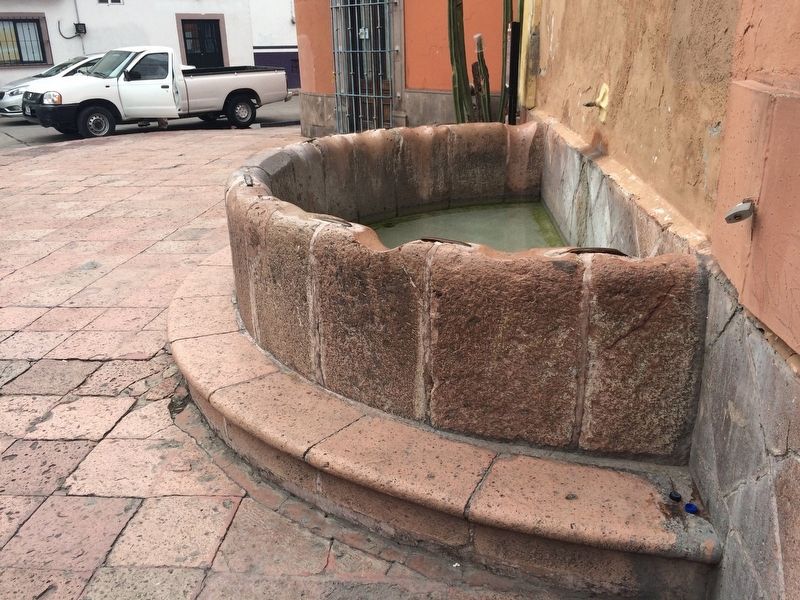
Photographed by J. Makali Bruton, July 11, 2017
5. A close-up view of the Fountain of Capulines
Credits. This page was last revised on August 6, 2018. It was originally submitted on July 12, 2017, by J. Makali Bruton of Washington, District of Columbia. This page has been viewed 358 times since then and 14 times this year. Photos: 1. submitted on August 6, 2018, by J. Makali Bruton of Washington, District of Columbia. 2. submitted on July 12, 2017, by J. Makali Bruton of Washington, District of Columbia. 3. submitted on August 6, 2018, by J. Makali Bruton of Washington, District of Columbia. 4, 5. submitted on July 12, 2017, by J. Makali Bruton of Washington, District of Columbia.
