Fredericksburg, Virginia — The American South (Mid-Atlantic)
The Canal Ditch
The City of Fredericksburg, Virginia
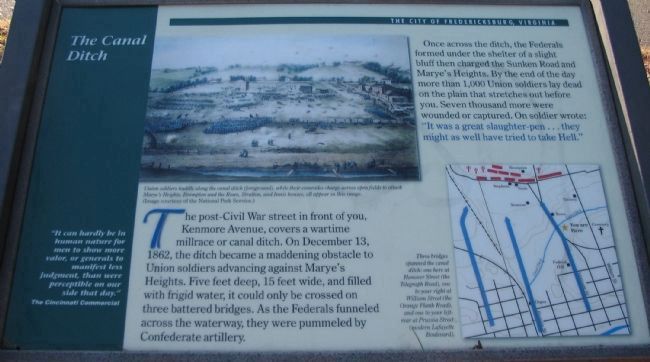
Photographed by Craig Swain, December 13, 2008
1. The Canal Ditch Marker
Once across the ditch, the Federals formed in the shelter of a slight bluff, then charged the Sunken Road and Marye’s Heights. By the end of the day more than 1,000 Union soldiers lay dead on the plain that stretches out before you. Seven thousand more were wounded or captured. “It was a great slaughter-pen...they might as well have tried to take Hell.”
(Sidebar Quote):
"It can hardly be in human nature for men to show more valor, or generals to manifest less judgment, than were perceptible on our side that day.”
—The Cincinnati Commercial
Topics. This historical marker is listed in this topic list: War, US Civil. A significant historical month for this entry is December 1864.
Location. This marker has been replaced by another marker nearby.
this page online

Regionally, this marker was in the Washington Metropolitan Area and in Northern Virginia. It was also in the American South and specifically in the Upper South. Globally, it was in North America, the Western Hemisphere, the Western World, and the Anglosphere. Historically, it found itself in what was once the territory of the Mississippian Culture, one of the original Thirteen Colonies, one of the Confederate States of America, and the Antebellum South.
Other nearby markers. At least 10 other markers are within walking distance of this location: A different marker also named Ravaged Town (a few steps from this marker); a different marker also named Marye's Heights (a few steps from this marker); a different marker also named The Canal Ditch (a few steps
Photographed by Craig Swain, December 13, 2008
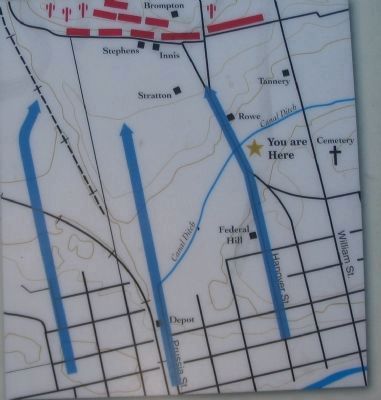
2. Close Up of the Map
Other markers no longer nearby. Marye’s Heights (was here, next to this marker but has been replaced with another marker now near it); Ravaged Town (was here, next to this marker but has been replaced with another marker now near it); Fredericksburg Campaign (was a few steps from this marker but has been confirmed missing).
More about this marker. In the upper center of the marker is a painting captioned, Union soldiers huddle along the canal ditch (foreground), while their comrades charge across open fields to attack Marye's Heights. Brompton and the Rowe, Stratton, and Innis houses all appear in this image.
On the lower right is a map showing unit movements at this stage of
Photographed by Dawn Bowen, June 2, 2007
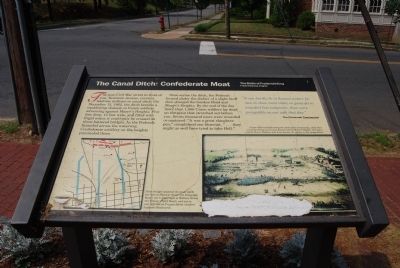
3. The Canal Ditch: Confederate Moat Marker
The "old" version of the marker.
Regarding The Canal Ditch. This marker was repaired and revised in 2008. The Original Marker Text Read:
The Canal Ditch: Confederate Moat
The post-Civil War street in front of you, Kenmore Avenue, covers a wartime millrace or canal ditch. On December 13, 1862, the ditch became a maddening obstacle to Union soldiers advancing against Marye’s Heights. Five feet deep, 15 feet wide, and filled with frigid water, it could only be crossed on three battered bridges. As the Federals funneled across the waterway, Confederate artillery on the heights pummeled them.
Once across the ditch, the Federals formed in the shelter of a slight bluff, then charged the Sunken Road and Marye’s Heights. By the end of the day more than 1,000 Union soldiers lay dead on the plain that stretched before you. Seven thousand more were wounded or captured. “It was a great slaughter-pen,” complained one bluecoat. “…
Photographed by Kevin W., September 15, 2007
4. The Canal Ditch: Confederate Moat Marker
“It can hardly be in human nature for men to show more valor, or generals to manifest less judgment, than were perceptible on our side that day.” —The Cincinnati Commercial
Related marker. Click here for another marker that is related to this marker. This marker has been replaced by the linked marker.
Photographed by Craig Swain, December 13, 2008
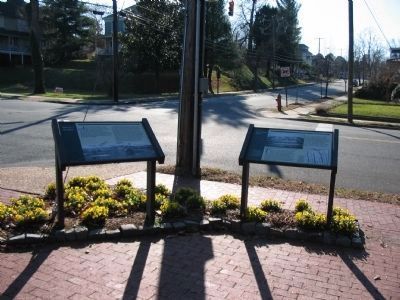
5. Looking past the Markers up Hanover Street
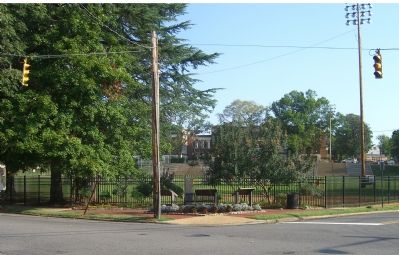
At the time of the battle, this was known as Telegraph Road. The ditch was in the foreground where Kenmore Avenue passes. Ahead in the distance up the street is the Rowe House.
Credits. This page was last revised on February 2, 2023. It was originally submitted on June 2, 2007, by Dawn Bowen of Fredericksburg, Virginia. This page has been viewed 2,374 times since then and 26 times this year. Photos: 1, 2. submitted on December 15, 2008, by Craig Swain of Leesburg, Virginia. 3. submitted on June 2, 2007, by Dawn Bowen of Fredericksburg, Virginia. 4. submitted on September 15, 2007, by Kevin W. of Stafford, Virginia. 5. submitted on December 15, 2008, by Craig Swain of Leesburg, Virginia. • J. J. Prats was the editor who published this page.
