Near Encampment in Carbon County, Wyoming — The American West (Mountains)
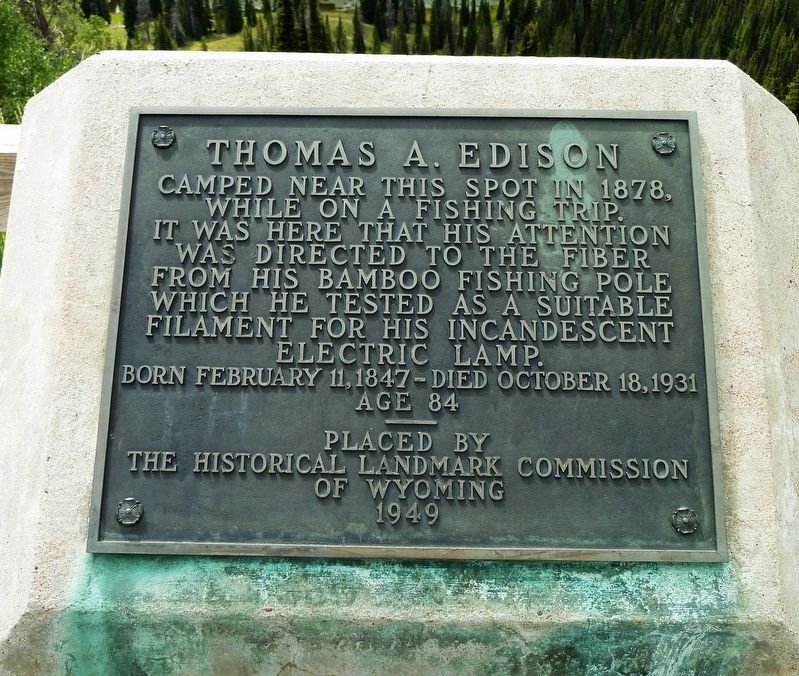
Thomas A. Edison
Photographed by Roger W. Sinnott, August 22, 2017
1. Thomas A. Edison Marker
while on a fishing trip.
It was here that his attention
was directed to the fiber
from his bamboo fishing pole
which he tested as a suitable
filament for his incandescent
electric lamp.
Born February 11, 1847 -- Died October 18, 1931
Age 84
Erected 1949 by the Historical Landmark Commission of Wyoming.
Topics. This historical marker is listed in these topic lists: Industry & Commerce • Science & Medicine. A significant historical year for this entry is 1878.
Location. 41° 9.517′ N, 107° 0.583′ W. Marker is near Encampment, Wyoming, in Carbon County. It is on Wyoming 70 (State Highway 70), on the left when traveling west. Marker is about 14 miles west of Encampment, WY, at elevation 9,490 feet on a stretch of road closed in the winter. Touch for map. Marker is in this post office area: Saratoga WY 82331, United States of America. Touch for directions.

Regionally, this marker is in Wyoming’s Westward Expansion Trails Region. It is also in the American Mountain West. Globally, it is in North America, the Rocky Mountains, the Western Hemisphere, the Western World,
this page online
Other nearby markers. At least one other marker is within 2 miles of this marker, measured as the crow flies: The Sierra Madre Range (approx. 1½ miles away).
Regarding Thomas A. Edison. What was the workaholic 31-year-old Wizard of Menlo Park doing on a fishing trip in the Rocky Mountains? Already famous for the invention of the phonograph in 1877, Edison had joined the expedition of astronomer Henry Draper to observe the total solar eclipse of July 29, 1878, from Rawlins, Wyoming. During that eclipse, with the Moon blocking direct sunlight, he tried (unsuccessfully) to measure the heat of the Sun’s atmosphere with a highly sensitive thermometer of his own design. Afterward, members of the expedition explored other places in the Rockies, and it was in this period that Edison camped at Battle Lake, Wyoming, before returning to New Jersey to begin work on the incandescent lamp. Carbonized bamboo fiber wasn’t the first material his laboratory tested for use as a lamp filament, but it proved the key to making the light bulb a commercial success.
Also see . . . Edison's Lightbulb.
Photographed by Roger W. Sinnott, August 22, 2017
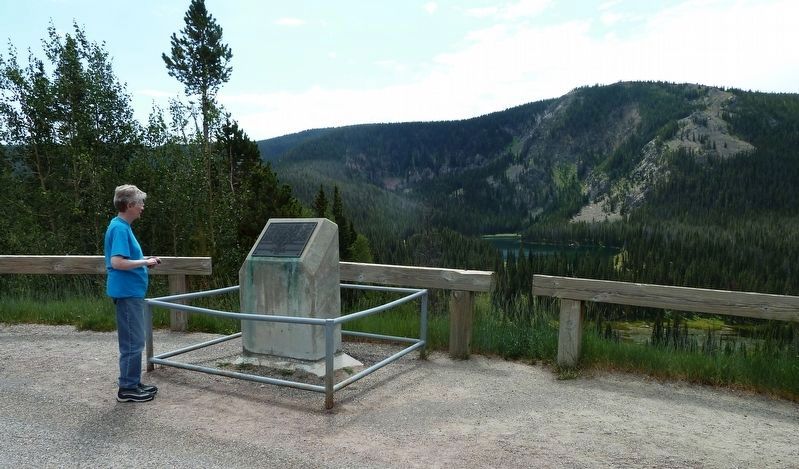
2. Wider View Including the Marker
Additional keywords. light bulb
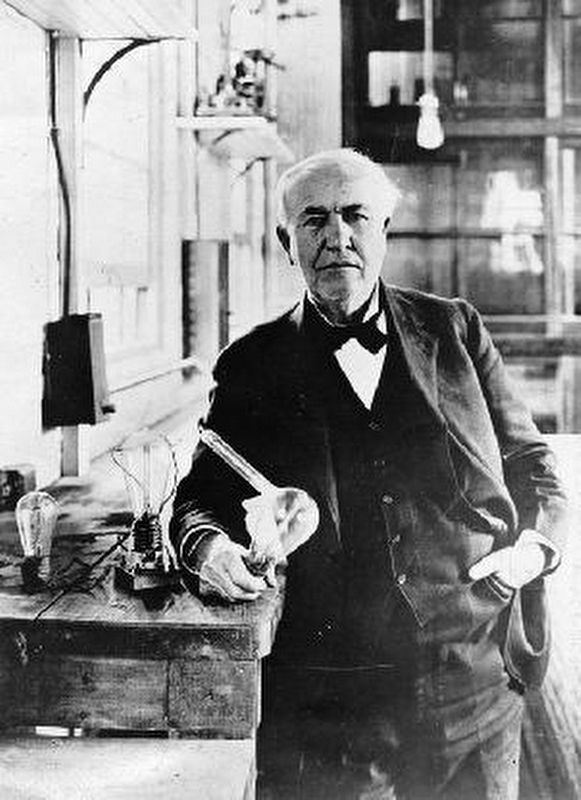
Image from Wikimedia Commons
3. Thomas A. Edison
Credits. This page was last revised on December 12, 2023. It was originally submitted on August 27, 2017, by Roger W. Sinnott of Norwell, Massachusetts. This page has been viewed 1,942 times since then and 153 times this year. Photos: 1, 2, 3. submitted on August 27, 2017, by Roger W. Sinnott of Norwell, Massachusetts. • Bill Pfingsten was the editor who published this page.
