History of Camp Salmen
Preserving Yesterday's Heritage
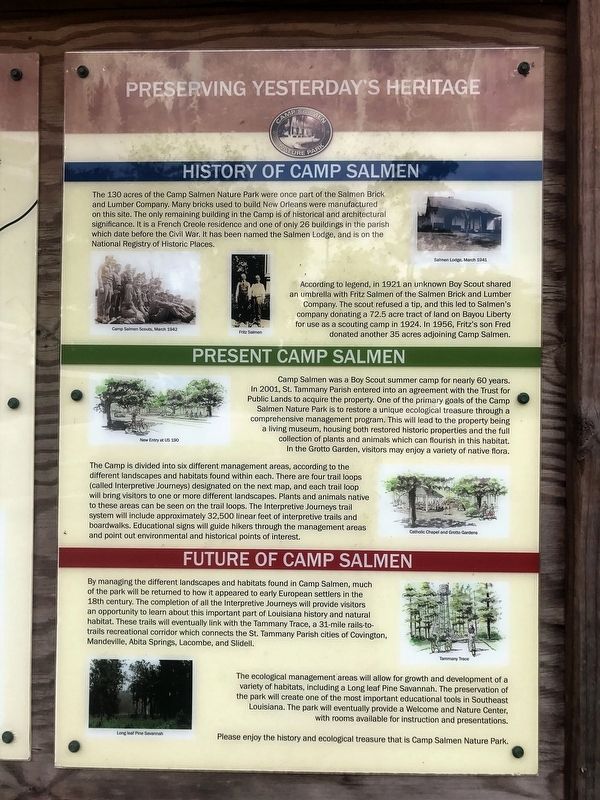
The 130 acres of the Camp Salmen Nature Park were once part of the Salmen Brick and Lumber Company. Many bricks used to build New Orleans were manufactured on this site. The only remaining building in the camp is of historical and architectural significance. It is a French Creole residence and one of only 26 buildings in the parish which date before the Civil War. It has been named the Salmen Lodge, and is on the National Register of Historic Places.
According to legend, in 1921 an unknown Boy Scout shared an umbrella with Fritz Salmen of the Salmen Brick and Lumber Company. The scout refused a tip, and this led to Salmen's company donating a 72.5 acre tract of land on Bayou Liberty for use as a scouting camp in 1924. In 1956, Fritz's son Fred donated another 35 acres adjoining Camp Salmen.
Camp Salmen was a Boy Scout summer camp for nearly 60 years. In 2001, St. Tammany Parish entered into an agreement with the Trust for Public Lands to acquire the property. One of the primary goals of the Camp Salmen Nature Park is to restore a unique ecological treasure through a comprehensive management program. This
this page online
The camp is divided into six different management areas, according to the different landscapes and habitats found within each. There are four trail loops (called Interpretive Journeys) designated on the next map, and each trail loop will bring visitors to one or more different landscapes. Plants and animals native to these areas can be seen on the trail loops. The Interpretive Journey trail system will include approximately 32,500 linear feet of interpretive trails and boardwalks. Educational signs will guide hikers through the management areas and point out environmental and historical points of interest.
By managing the different landscapes and habitats found in Camp Salmen, much of the park will be returned to how it appeared to early European settlers in the 18th century. The completion of all the Interpretive Journeys will provide visitors an opportunity to learn about this
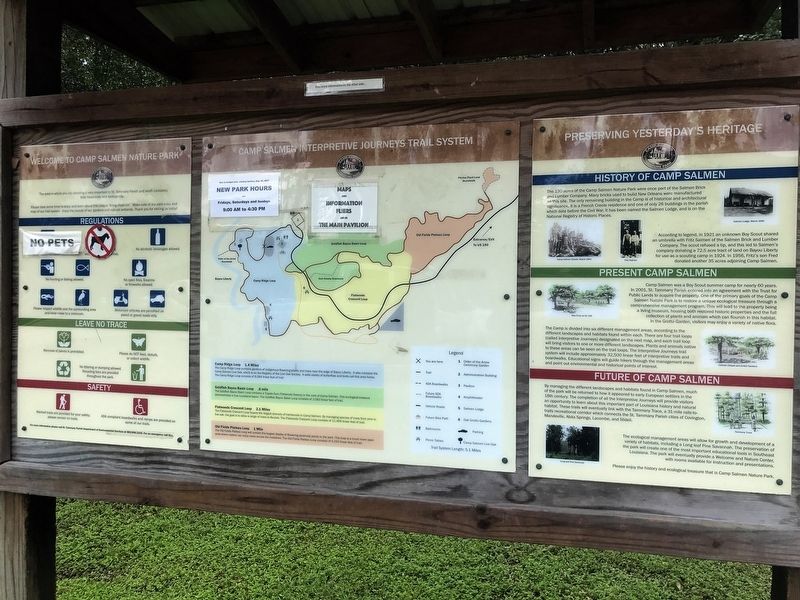
The ecological management areas will allow for growth and development of a variety of habitats, including a Long Leaf Pine Savannah. The preservation of the park will create one of the most important educational tools in Southeast Louisiana. The park will eventually provide a Welcome and Nature Center, with rooms available for instruction and presentations.
Please enjoy the history and ecological treasure that is Camp Salmen Nature Park.
Topics. This historical marker is listed in these topic lists: Education • Environment • Fraternal or Sororal Organizations.
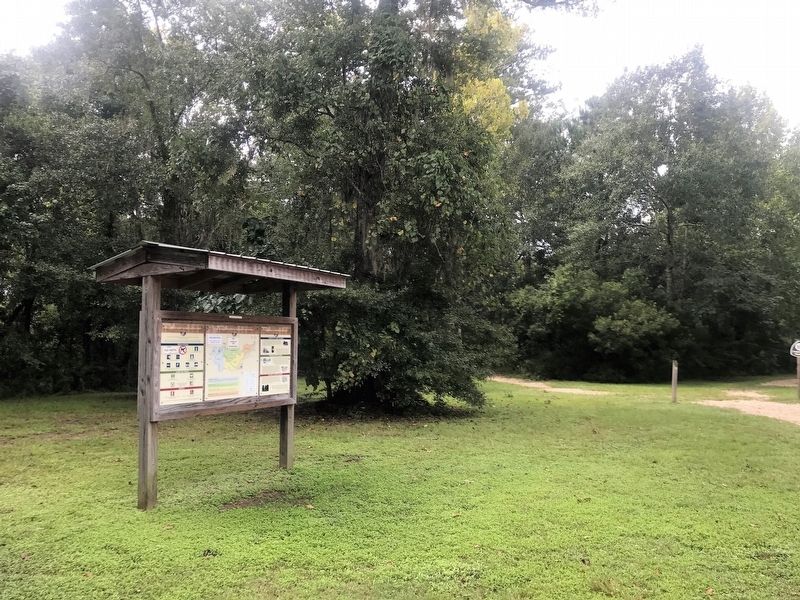
Location. 30° 17.554′ N, 89° 49.512′ W. Marker is in Slidell, Louisiana, in St. Tammany Parish. It can be reached from Parish Parkway one mile south of Gause Boulevard (U.S. 190), on the right when traveling east. Touch for map. Marker is at or near this postal

Regionally, this marker is in the Florida Parishes and in Greater New Orleans. It is also in the American South, specifically in the Deep South, and on the Gulf Coast. Globally, it is in North America, a Gulf of Mexico state, the Western Hemisphere, the Western World, and the Anglosphere. Historically, it finds itself in what was once New Spain, the territory of the Mississippian Culture, the Louisiana Purchase, one of the Confederate States of America, and the Antebellum South.
Other nearby markers. At least 8 other markers are within 3 miles of this marker, measured as the crow flies: Fritz Salmen (about 300 feet away, measured in a direct line); Salmen Lodge (about 700 feet away); September 11, 2001 Never Forgotten (approx. 2.7 miles away); Slidell: An Overview (approx. 2.7 miles away); John Slidell (approx. 2.7 miles away); Slidell Town Hall and Jail (approx. 2.8 miles away); a different marker also named John Slidell (approx. 2.8 miles away); City of Slidell Centennial (approx. 2.9 miles away). Touch for a list and map of all markers in Slidell.
Credits. This page was last revised on September 5, 2023. It was originally submitted on September 8, 2017, by Cajun Scrambler of Assumption, Louisiana. This page has been viewed 1,108 times since then and 47 times this year. Photos: 1, 2, 3. submitted on September 8, 2017.
