Oregon Hill in Richmond, Virginia — The American South (Mid-Atlantic)
Oregon Hill
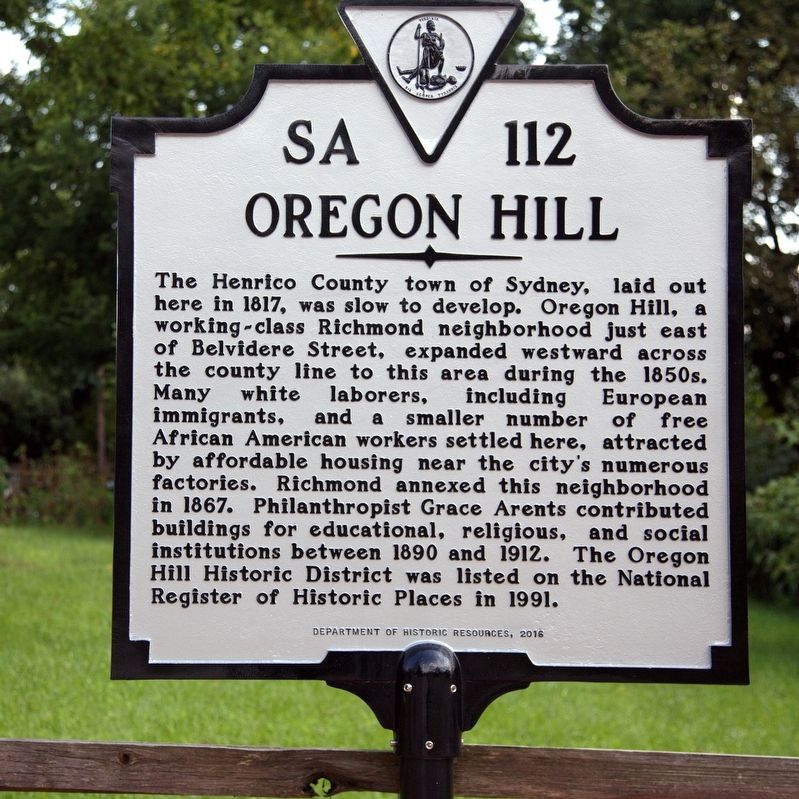
Photographed by J. J. Prats, September 3, 2017
1. Oregon Hill Marker
Erected 2016 by Department of Historic Resources. (Marker Number SA-112.)
Topics and series. This historical marker is listed in these topic lists: Industry & Commerce • Political Subdivisions. In addition, it is included in the Virginia Department of Historic Resources (DHR) series list. A significant historical year for this entry is 1850.
Location. 37° 32.506′ N, 77° 27.211′ W. Marker is in Richmond, Virginia. It is in Oregon
this page online

Regionally, this marker is in Central Virginia. It is also in the American South and specifically in the Upper South. Globally, it is in North America, the Western Hemisphere, the Western World, and the Anglosphere. Historically, it finds itself in what was once the territory of the Mississippian Culture, one of the original Thirteen Colonies, one of the Confederate States of America, and the Antebellum South.
Other nearby markers. At least 8 other markers are within walking distance of this marker: Grace Evelyn Arents (within shouting distance of this marker); St. Andrew's Church (about 500 feet away); John Marshall High School Cadet War Memorial (about 600 feet away); Confederate Memorial Pyramid (about 700 feet away); In Memory of Distinguished Persons Buried in Hollywood (about 700 feet away); Jacob House (approx. ¼ mile away); John B. Fenn (approx. ¼ mile away); Samuel Pleasants Parsons House
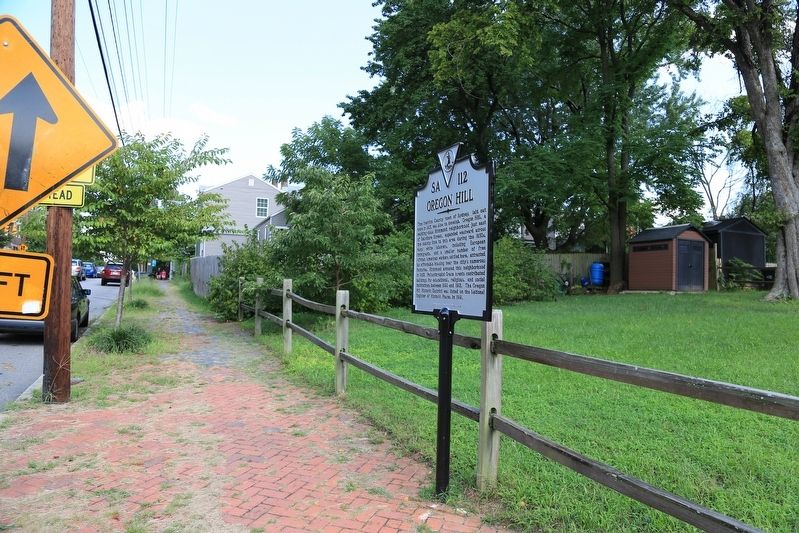
Photographed by J. J. Prats, September 3, 2017
2. Oregon Hill Marker
Another marker is no longer nearby. Grace Evelyn Arents (was about 300 feet away, measured in a direct line but has been replaced with another marker now near it).
Also see . . .
1. Wikipedia Entry. “Oregon Hill is a historic working-class neighborhood in Richmond, Virginia. Oregon Hill overlooks the James River and Belle Isle, and provides access to Hollywood Cemetery. Due to the neighborhoods proximity to the Monroe Park Campus of Virginia Commonwealth University, the neighborhood is sometimes referred to as a student quarter because of its high college student population. William Byrd III established a rural estate on the property in 1758. Wealthy heiress Grace Arents helped build many institutions to serve the community” (Submitted on September 10, 2017.)
2. 1991 National Register of Historic Places Nomination Form. Statement of Significance. In the first half of the nineteenth century in the vicinity of Tredegar Iron Works, Oregon Hill began to develop as a working-class neighborhood. During the second
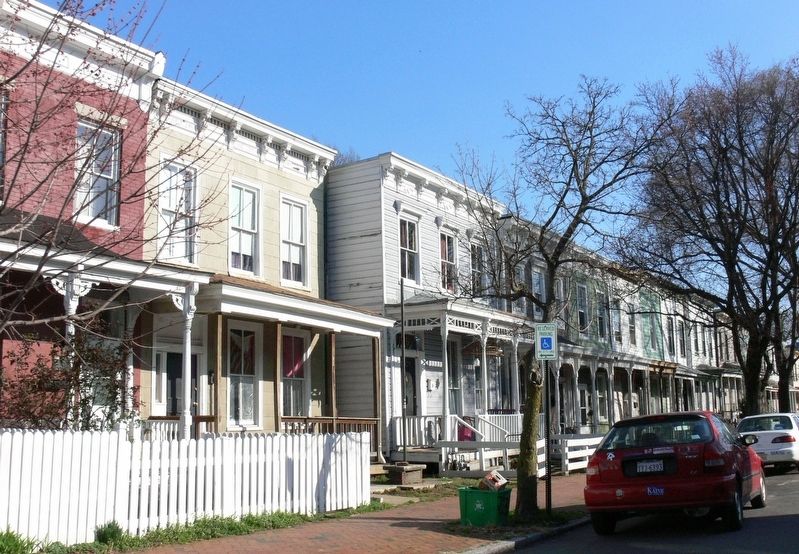
Morgan Riley, via Wikipedia Commons, March 12, 2011
3. Laurel Street in Oregon Hill, Richmond, Virginia
The development of the neighborhood on the west side of Belvidere Street, from the 1818 construction of the Parsons House to the early twentieth century, provided residents with a place to live that was both affordable and within easy walking distance of the main manufacturing and commercial areas of the city. The early settlement of the neighborhood is also a part of the chronicle of the westward expansion of the city’s residential areas.
With very cohesive unified streetscapes that authentically echo its period of significance, Oregon Hill presents an unusual survival of a vernacular architecture and way of life of a social class not often the subject of historic preservation efforts. Examples of Federal, Greek Revival, Victorian Italianate, Second Empire, Victorian Gothic, Queen Anne, Colonial Revival, and Spanish Colonial Revival architectural styles can also be found in Oregon Hill.
A significant figure in the history of Oregon Hill was Grace Evelyn Arents, niece of Lewis Ginter and heiress to his tobacco fortune. She was financially and personally involved in providing educational, social, and religious institutions and programs that served the working-class residents of Oregon Hill. Many of the significant landmarks in the neighborhood such as Saint Andrew’s Episcopal Church and School, the Arents Free Library, the Instructive Visiting Nurse Association Building, the Grace Arents Public Housing and the Grace Arents School are the direct result of her beneficence. (Submitted on September 10, 2017.)
Credits. This page was last revised on February 1, 2023. It was originally submitted on September 10, 2017, by J. J. Prats of Powell, Ohio. This page has been viewed 1,837 times since then and 164 times this year. Photos: 1, 2, 3. submitted on September 10, 2017, by J. J. Prats of Powell, Ohio.
Editor’s want-list for this marker. Photos of the neighborhood • Can you help?
