They Passed This Way
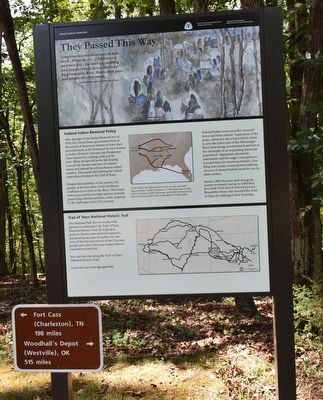
Long time we travel on way to new land… Womens cry…Children cry and men cry…but they say nothing and just put heads down and keep on go towards West. Many days pass and people die very much.
Recollection of a survivor of the Trail of Tears
Federal Indian Removal Policy
After passage of the Indian Removal Act of 1830, the United States government forced thousands of American Indians to leave their ancestral lands in the Southeast for new homes in Indian Territory (present-day Oklahoma).
They traveled by existing roads and by river. Many groups left in the fall, hoping to avoid the disease and heat of summer travel, and instead faced treacherous winter weather. Thousands died during the ordeal - remembered today as the Trail of Tears.
Despite the hardships of the journey, the people of the five tribes of the Southeast established new lives in the West. They stand now as successful sovereign nations, proudly preserving cultural traditions, while adapting to the changes of the 21st century.
Federal Indian removal policy aroused fierce and bitter debate. Supporters of the policy claimed it was a benevolent action
this page online
Opponents described its inhumanity and the tragic consequences it would have for American Indians. One thing was certain: removal freed millions of acres of desired Indian lands for use by white settlers.
Nearly 1,000 Cherokee died during the journey westward and up to 4,000 died as a result of the forced removal process. Remember those who traveled the Trail of Tears by walking in their footsteps.
Caption:
In the 1830s, the federal government forcibly removed approximately 15,000 Cherokee, 21,000 Muscogee (Creek), 9,000 Choctaw, 6,000 Chickasaw, and 4,000 Seminole from their ancestral homes in the southeastern United States.
Trail of Tears National Historic Trail
The National Park Service works with partners to administer the Trail of Tears National Historic Trail. By helping to preserve historic sites and trail segments, and developing areas for public use, the story of the forced removal of the Cherokee people and the American Indian tribes is remembered and told.
You can visit
Learn more at: www.nps.gov/trte
Erected by David Crockett State Park, Trail of Tears National Historic Trail, National Park Service, National Park Foundation, MTSU Center for Historic Preservation.
Topics and series. This historical marker is listed in this topic list: Indigenous Peoples and Communities. In addition, it is included in the Trail of Tears series list. A significant historical year for this entry is 1830.
Location. 35° 14.879′ N, 87° 21.171′ W. Marker is in Lawrenceburg, Tennessee, in Lawrence County. It is on David Crockett State Park Road. Marker is just south of Campground #1. Touch for map. Marker is in this post office area: Lawrenceburg TN 38464, United States of America. Touch for directions.

Regionally, this marker is in Middle Tennessee and in the Highland Rim. It is also in the American South, specifically in the Upper South, in Appalachia, and specifically in Southern Appalachia. Globally, it is in North America, the Western Hemisphere, the Western World, and the Anglosphere. Historically, it finds itself in what was once the territory of the Mississippian Culture, one of the Confederate States of America, and the Antebellum South.
Other nearby markers. At least 8 other markers are within 2 miles of this marker, measured as the crow flies: Retracing the Trail of Tears (here, next to this marker); Pioneers in Textiles (approx. 0.4 miles away); Museum Honoring David Crockett (approx. one mile away); Courthouse - Lawrence County Tennessee (approx. 1.1 miles away); Skirmish at Lawrenceburg (approx. 1.1 miles away); Mexican War Monument (approx. 1.1 miles away); Lawrence County War Memorial (approx. 1.1 miles away); Col. David Crockett (approx. 1.1 miles away). Touch for a list and map of all markers in Lawrenceburg.
Credits. This page was last revised on February 22, 2018. It was originally submitted on August 25, 2017, by Sandra Hughes Tidwell of Killen, Alabama, USA. This page has been viewed 521 times since then and 20 times this year. Last updated on September 11, 2017, by Byron Hooks of Sandy Springs, Georgia. Photos: 1. submitted on August 25, 2017, by Sandra Hughes Tidwell of Killen, Alabama, USA. 2. submitted on February 21, 2018, by J. Makali Bruton of Washington, District of Columbia. • Bill Pfingsten was the editor who published this page.
