Miamiville in Clermont County, Ohio — The American Midwest (Great Lakes)
Miamiville
Fighting at the Bridges
| — | John Hunt Morgan Heritage Trail | — |
Photographed by Mark Hilton, September 9, 2017
1. Miamiville Marker
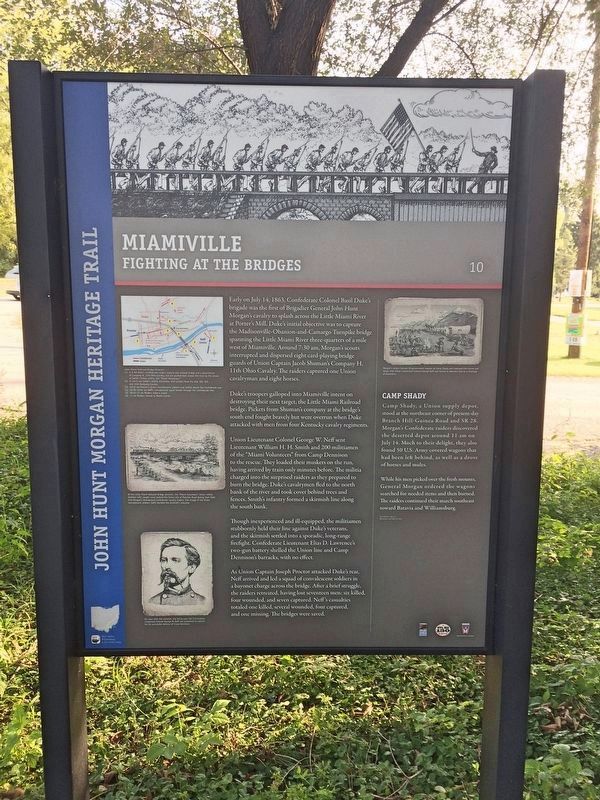
Duke's troopers galloped into Miamiville intent on destroying their next target, the Little Miami Railroad bridge. Pickets from Shuman's company at the bridge's south end fought bravely but were overrun when Duke attacked with men from four Kentucky cavalry regiments.
Union Lieutenant Colonel George W. Neff sent Lieutenant William H. H. Smith and 200 militiamen of the "Miami Volunteers" from Camp Dennison to the rescue. They loaded their muskets on the run, having arrived by train only minutes before. The militia charged into the surprised raiders as they prepared to burn the bridge. Duke's cavalrymen fled to the north bank of the river and took cover behind trees and fences. Smith's infantry formed a skirmish line along the south bank.
Though inexperienced and ill-equipped, the militiamen stubbornly held their line against
this page online
As Union Captain Joseph Proctor attacked Duke's rear, Neff arrived and led a squad of convalescent soldiers in a bayonet charge across the bridge. After a brief struggle, the raiders retreated, having lost seventeen men: six killed, four wounded, and seven captured. Neff's casualties totaled one killed, several wounded, four captured, and one missing. The bridges were saved.
Camp Shady
Camp Shady, a Union supply depot, stood at the northeast corner of present-day Branch Hill-Guinea Road and SR 28. Morgan's Confederate raiders discovered the deserted depot around 11 am on July 14. Much to their delight, they also found 50 U.S. Army covered wagons that had been left behind, as well as a drove of horses and mules.
While his men picked over the fresh mounts General Morgan ordered the wagons searched for needed items and then burned. The raiders continued their march southeast toward Batavia and Williamsburg.
[Photo captions]
Top left: Little Miami Railroad Bridge Skirmish:
(1) 8-9 AM Duke's Confederate raiders capture the railroad bridge and a detachment of Company H, 11th Ohio Cavalry, but are pushed back across the river by the attack of Smith's Union militia, the "Miami Volunteers";
(2) 9-10:45 am Smith's militia skirmishes with pickets from the 2nd, 5th, 6th and 14th Kentucky Cavalry;
(3) 10:30 am Proctor's Union convalescent soldiers and militia attack the Confederate rear;
(4) 10:30-10:45 am Neff's convalescent squad breaks through the Confederate line;
(5) 10:45-11 am Raiders make a stand;
(6) 11 am Raiders retreat to Ward's Corner.
Middle left: At the Little Miami Railroad Bridge skirmish, the "Miami Volunteers" Union militia (bottom left) sought cover behind the fence rails of Fletcher Road during their fight with Morgan's dismounted Confederate cavalry (right). The charge of the Union convalescent soldiers (left) decided the skirmish's outcome.
Bottom left: Six days after the skirmish, the thirty-year-old Cincinnatian Lieutenant Colonel George W. Neff was promoted to colonel for his successful defense of Camp Dennison.
Top right: Morgan's raiders burned 50 government wagons at Camp Shady and captured the horses and mules that Union Lieutenant Colonel George Neff was forced to abandon due to a shortage of teamsters.
Photographed by Mark Hilton, September 9, 2017
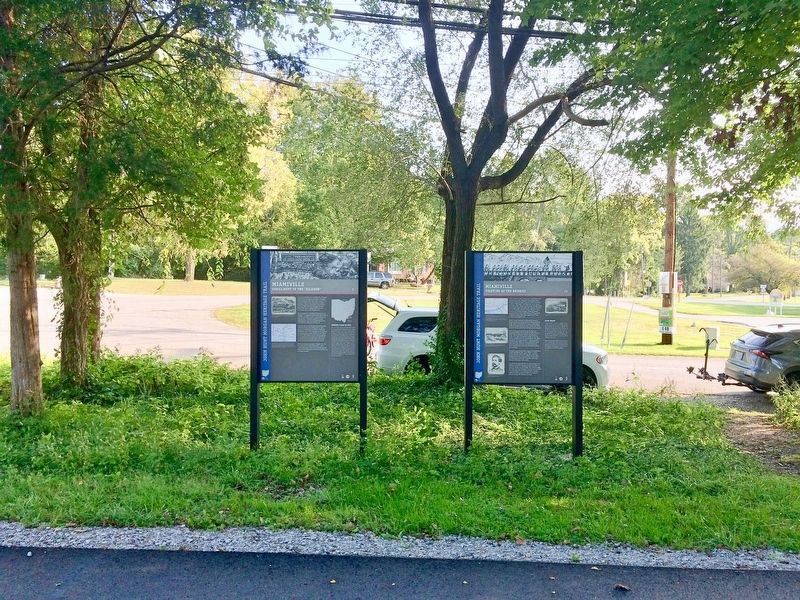
2. Miamiville Marker (on right)
Illustrations and Map: Bev Kirk
Erected 2013 by the Ohio Department of Transportation, the Ohio History Connection, and the Ohio Civil War Trail Commission. (Marker Number 10.)
Topics and series. This historical marker is listed in these topic lists: Bridges & Viaducts • War, US Civil • Waterways & Vessels. In addition, it is included in the John Hunt Morgan Heritage Trail in Ohio series list. A significant historical date for this entry is July 14, 1863.
Location. 39° 12.776′ N, 84° 17.765′ W. Marker is in Miamiville, Ohio, in Clermont County. It is on Glendale Milford Road (Ohio Route 126) east of Wards Corner Road, on the right when traveling east. Located just off the road on the Little Miami Scenic Trail. Touch for map. Marker is in this post office area: Miamiville OH 45147, United States of America. Touch for directions.

Regionally, this marker is in Greater Cincinnati. It is also in the American Midwest, in the Ohio River Valley, in Appalachia, and specifically in Northern Appalachia. Globally, it is in North America, the Western Hemisphere, the Western World, and the Anglosphere. Historically, it finds itself in what was once the Haudenosaunee (Iroquois) Confederacy, the territory of the Mississippian Culture, and the Northwest Territory.
Other nearby markers. At least 8 other markers are within 2 miles of this marker, measured as the crow flies: A different marker also named
Photographed by Mark Hilton, September 9, 2017
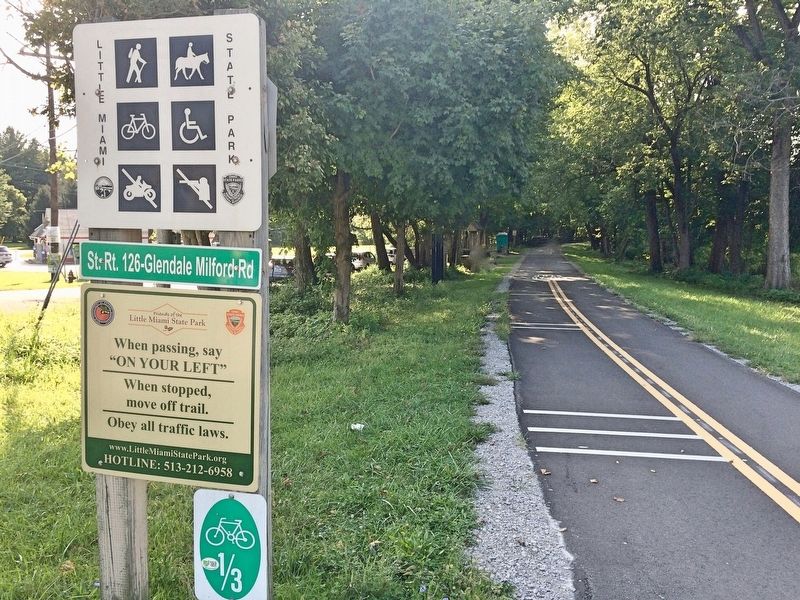
3. Marker is to the left of trail, where double yellow lines end.
This trail is part of the Little Miami State Park and is called the Little Miami Scenic Trail. It is the third longest paved trail in the United States, running 78.1 miles though five southwestern counties in the state.
Credits. This page was last revised on September 13, 2017. It was originally submitted on September 12, 2017, by Mark Hilton of Montgomery, Alabama. This page has been viewed 1,812 times since then and 106 times this year. Photos: 1, 2, 3. submitted on September 12, 2017, by Mark Hilton of Montgomery, Alabama.
