Chapelle Site
⎯⎯⎯
Chapel Site
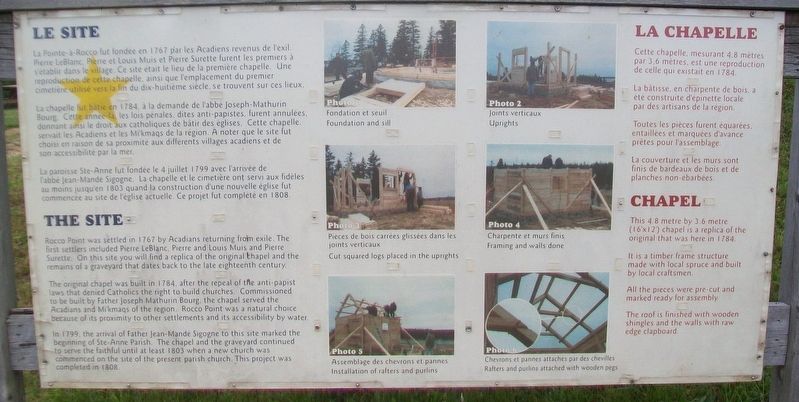

Le Site
La chapelle fut bâtie en 1784, à la demande de l'abbé Joseph-Mathurin Bourg. Cette année-là, les lois pénales, dites anti-papistes, furent annulées, donnant ainsi le droit aux catholiques de bâtir des églises. Cette chapelle, servait les Acadiens et les Mi'kmaqs de la région. À noter que le site fut choisi en raison de sa proximité aux différents villages acadiens et de son accessibilité par la mer.
La paroisse Ste-Anne fut fondée le 4 juillet 1799 avec l'arrivée de l'abbé Jean-Mandé Sigogne. La chapelle et le cimetière ont servi aux fidèles au moins jusqu'en 1803 quand la construction d'une nouvelle église fut commencée au site d l'église actuelle. Ce projet fut complété en 1808.
La Chapelle
La bâtisse, en charpente de bois, a été construite d'épinette locale par des artisans de la région.
Toutes les pièces furent équarées, entaillés et marquées d'avance prëtes pour l'assemblage.
La couverture et les murs sont finis de bardeaux de bois et de planches non-ébarbées.
The original chapel was built in 1784, after the repeal of the anti-papist laws that denied Catholics the right to build churches. Commissioned to be built by Father Joseph Mathurin Bourg, the chapel served the Acadians and Mi'kmaqs of the region. Rocco Point was a natural choice because of its proximity to other settlements and its accessibility by water.
In 1799, the arrival of Father Jean-Mandé
Chapel
It is a timber frame structure made with local spruce and built by local craftsmen.
All the pieces were pre-cut and marked ready for assembly.
The roof is finished with wooden shingles and the walls with raw edge clapboard.
Photo 2
Photo 3
Photo 4
Photo 5
Photo 6
Cette chapelle, mesurant 4,8 mètres par
this page online
Rocco Point was settled in 1767 by Acadians returning from exile. The first settlers included Pierre LeBlanc, Pierre and Louis Muis and Pierre Surette. On this site you will find a replica of the original chapel and the remains of a graveyard that dates back to the late eighteenth century.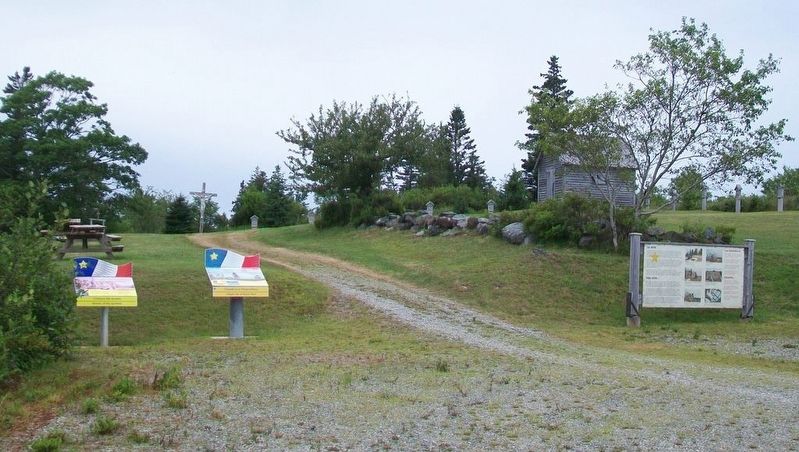
This 4.8 metre by 3.6 metre (16'x12') chapel is a replica of the original that was here in 1784.
Photo 1
Fondation et seuil
Foundation and sill
Joints verticaux
Uprights
Pièces de bois carrées glissées dans les joints verticaux
Cut squared logs placed in the uprights
Charpente et murs finis
Framing and walls done
Assemblage des chevrons et pannes
Installation of rafters and purlins
Chevrons et pannes attachés par des chevilles
Rafters and purlins attached with wooden pegs
Topics and series. This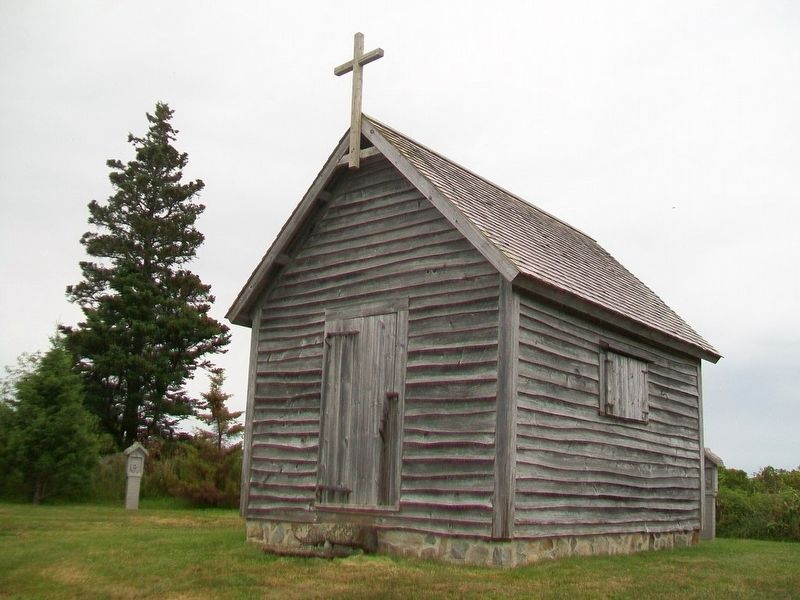
Location. 43° 49.674′ N, 65° 55.626′ W. Marker is in Rocco Point, Nova Scotia, in Yarmouth County. It can be reached from Rocco Point Road 1.2 kilometers south of the Lighthouse Route (Nova Scotia Route 3). Touch for map. Marker is at or near this postal address: 259 Rocco Point Road, Rocco Point NS B0W 2X0, Canada. Touch for directions.
Regionally, this marker is in Yarmouth and the Acadian Shores. It is also in the Maritimes and in Atlantic Canada. Globally, it is in the North Atlantic Region, North America, the Western Hemisphere, the Western World, and the Anglosphere. Historically, it finds itself in what was once a British colony, the Viceroyalty of New France, and Acadia.
Other nearby markers. At least 8 other markers are within 5 kilometers of this marker, measured as the crow flies: Chapelle de la Pointe-à-Rocco / Chapel site at Rocco Point (a few steps from this marker); L'histoire des Surette / History of the Surettes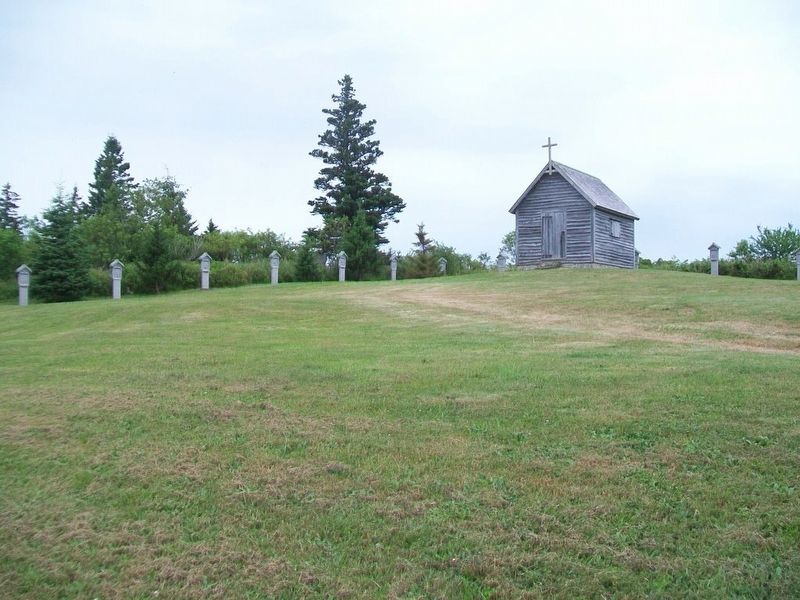
Credits. This page was last revised on September 28, 2017. It was originally submitted on September 24, 2017, by William Fischer, Jr. of Reynoldsburg, Ohio. This page has been viewed 312 times since then and 29 times this year. Photos: 1, 2. submitted on September 26, 2017, by William Fischer, Jr. of Reynoldsburg, Ohio. 3, 4. submitted on September 24, 2017, by William Fischer, Jr. of Reynoldsburg, Ohio.
