Marylebone in City of Westminster in Greater London, England, United Kingdom — Northwestern Europe (the British Isles)
Michael Faraday
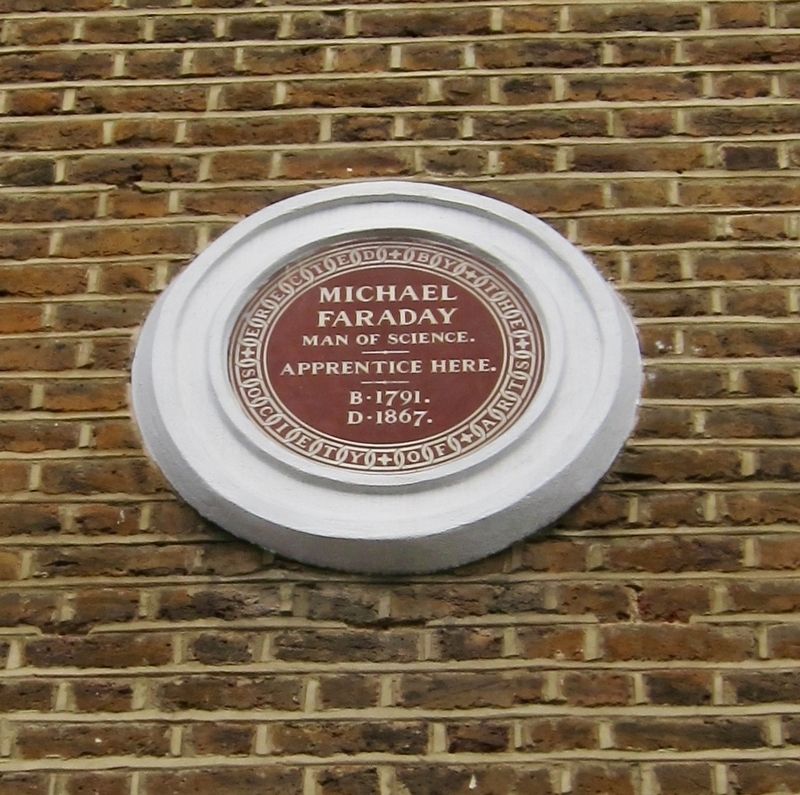
Photographed by Andrew Ruppenstein, October 15, 2017
1. Michael Faraday Marker
Faraday
Man of Science
—————
Apprentice here.
—————
B · 1791.
D · 1867.
Erected 1876 by Royal Society of Arts.
Topics. This historical marker is listed in this topic list: Science & Medicine. A significant historical year for this entry is 1791.
Location. 51° 31.108′ N, 0° 9.255′ W. Marker is in City of Westminster, England, in Greater London. It is in Marylebone. It is on Blandford Street just east of Chiltern Street, on the left when traveling east. Touch for map. Marker is at or near this postal address: 48 Blandford Street, City of Westminster, England W1U 7HU, United Kingdom. Touch for directions.

Regionally, this marker is in London and in the Greater South East. Globally, it is on the Atlantic Ocean, in the North Atlantic Region, in Europe, in Atlantic Europe, on one of the British Isles, in the Western World, and in the Anglosphere. Historically, it finds itself in what was once the Roman Empire.
Other nearby markers. At least 8 other markers are within walking distance of this marker: The Gardens · Paddington Street (about 210 meters away, measured in a direct line);
this page online
Also see . . .
1. Michael Faraday (BBC). "Faraday was a British chemist and physicist who contributed significantly to the study of electromagnetism and electrochemistry....In 1831, Faraday discovered electromagnetic induction, the principle behind the electric transformer and generator. This discovery was crucial in allowing electricity to be transformed from a curiosity into a powerful new technology. During the remainder of the decade he worked on developing his ideas about electricity. He was partly responsible for coining many familiar words including 'electrode', 'cathode' and 'ion'. Faraday's scientific knowledge was harnessed for practical use through various official appointments, including
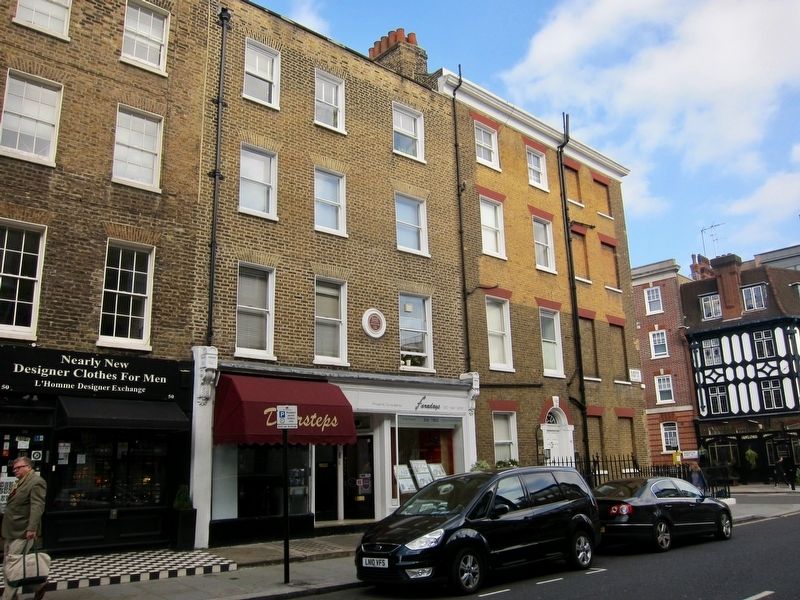
Photographed by Andrew Ruppenstein, October 15, 2017
2. Michael Faraday Marker - Wide View
2. Michael Faraday (Wikipedia). "Michael Faraday FRS (22 September 1791 – 25 August 1867) was an English scientist who contributed to the study of electromagnetism and electrochemistry. His main discoveries include the principles underlying electromagnetic induction, diamagnetism and electrolysis.... Although Faraday received little formal education, he was one of the most influential scientists in history. It was by his research on the magnetic field around a conductor carrying a direct current that Faraday established the basis for the concept of the electromagnetic field in physics. Faraday also established that magnetism could affect rays of light and that there was an underlying relationship between the two phenomena. He similarly discovered the principles of electromagnetic induction and diamagnetism, and the laws of electrolysis. His inventions of electromagnetic rotary devices formed the foundation of electric motor technology, and it was largely
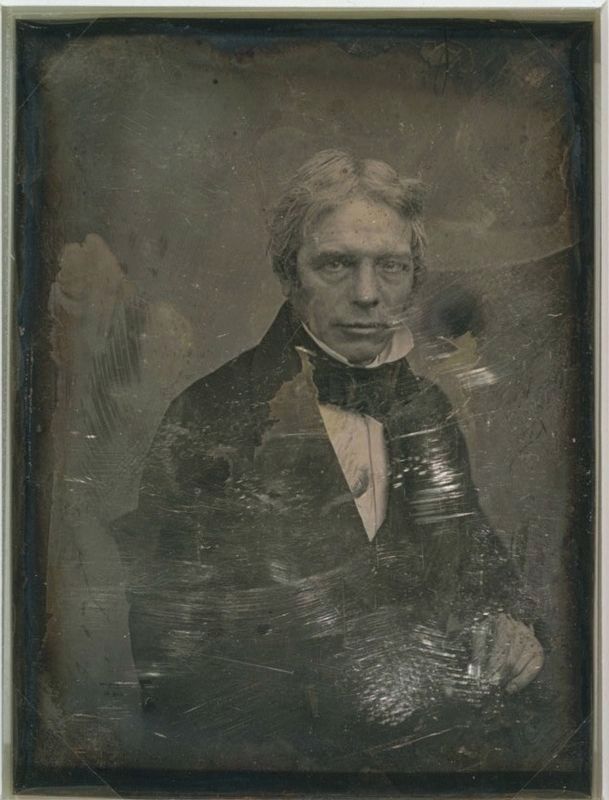
Matthew Brady (daguerreotype image courtesy of the Library of Congress), circa 1850
3. Michael Faraday
3. Michael Faraday Biography (YouTube, CloudBiography, 2 min.). (Submitted on October 27, 2017.)
Additional keywords. electricity physics chemistry
Credits. This page was last revised on March 4, 2026. It was originally submitted on October 27, 2017, by Andrew Ruppenstein of Lamorinda, California. This page has been viewed 344 times since then and 18 times this year. Photos: 1, 2, 3. submitted on October 27, 2017, by Andrew Ruppenstein of Lamorinda, California.
