Near Tendoy in Lemhi County, Idaho — The American West (Mountains)
From Route ... To Road
Lemhi Pass : A Well-worn Travel Way
Photographed by Barry Swackhamer, June 24, 2017
1. From Route ... To Road Marker
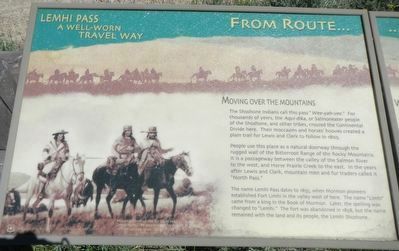
Captions: (left panel) Mountain men of the fur trade era. Detail from "The Beavermen" by Robert F. Morgan.; (bottom center) From very near this spot 100 years ago, you could have watched this stagecoach from Montana follow a freight wagon to the summit of Lemhi Pass. Part of the old stage road is still open. Today it is the road to Sacajawea Memorial Area. The growth of trees and newer roads have changed the view.; (bottom right) Climbing to the top of Lemhi Pass from Agency Creek in Idaho. 1907
The Shoshone Indians call this pass " Wee-yah-vee." For thousands of years, the Aqui-dika, or Salmoneater people of the Shoshone, and other tribes, crossed the Continental Divide here. Their moccasins and horses' hooves created a plain trail for Lewis and Clark to follow in 1805.
People use this place as a natural doorway through the rugged wall of the Bitterroot Range of the Rocky Mountains. It is a passageway between the valley of the Salmon River to the west, and Horse Prairie Creek to the east. In the years after Lewis and Clark, mountain men and fur traders called it "North Pass."
The name Lemhi Pass dates to 1855, when Mormon pioneers established Fort Limhi in the valley west of here. The name "Limhi" came from a king in the Book of Mormon. Later the spelling was changed to "Lemhi." The fort was abandoned in 1858, but the name remained with the land and its people, the Lemhi Shoshone.
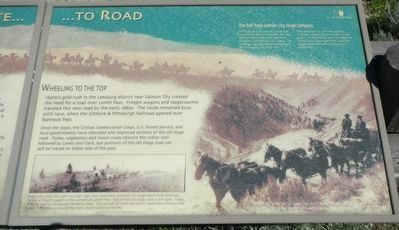
Idaho's gold rush in the Leesburg district near Salmon City created the need for a road over Lemhi Pass. Freight wagons and stagecoaches
this page online
Since the 1930s, the Civilian Conservation Corps, U.S. Forest Service, and local governments have relocated and improved sections of the old stage road. Today, vegetation and newer roads obscure the Indian trail followed by Lewis and Clark, but portions of the old stage road can still be traced on either side of the pass.
This stage line was on of several that covered the 68-miles between the Utah & Northern Railroad at Red Rock, Montana and Salmon City, Idaho. The company ran eight stagecoaches daily. $8.00 bought a one-way fare.
They employed 14 Concord coaches, 12 freight wagons, 80 horses and 35-40 people. In one banner year, the stage line carried 3,000 passengers and 1,000,000 pounds of freight and U.S. mail over Lemhi Pass.
Erected by Beaverhead-Deerlodge & Salmon-Chaillis National Forest.
Topics. This historical marker is listed in this topic list: Roads & Vehicles. A significant historical year for this entry is 1805.
Location. 44° 58.505′ N, 113° 26.675′ W.
Photographed by Barry Swackhamer, June 24, 2017
2. From Route ... To Road Marker
Captions: (left panel) Mountain men of the fur trade era. Detail from "The Beavermen" by Robert F. Morgan.; (bottom center) From very near this spot 100 years ago, you could have watched this stagecoach from Montana follow a freight wagon to the summit of Lemhi Pass. Pat of the old stage road is still open. Today it is the road to Sacajawea Memorial Area. The growth of trees and newer roads have changed the view.; (bottom right) Climbing to the top of Lemhi Pass from Agency Creek in Idaho. 1907

Regionally, this marker is in Central Idaho — Sawtooth Range. It is also in the American Mountain West and in the Lewis & Clark Corridor. Globally, it is in North America, the Rocky Mountains, the Western Hemisphere, the Western World, and the Anglosphere.
Other nearby markers. At least 8 other markers are within walking distance of this marker: Crossing the Great Divide (a few steps from this marker); "Most Distant Fountain" of the Mighty Missouri (approx. 0.3 miles away in Montana); The Beginning of the "Endless Missouri" (approx. 0.3 miles away in Montana); Lemhi Pass (approx. 0.3 miles away); Agency Creek (approx. 0.3 miles away); Sacajawea Memorial Area (approx. 0.3 miles away); Sacajawea (Memorial Area) (approx. 0.3 miles away); A Communication Across the Continent by Water (approx. 0.4 miles away). Touch for a list and map of all markers
Photographed by Barry Swackhamer, June 24, 2017
3. From Route ... To Road Marker
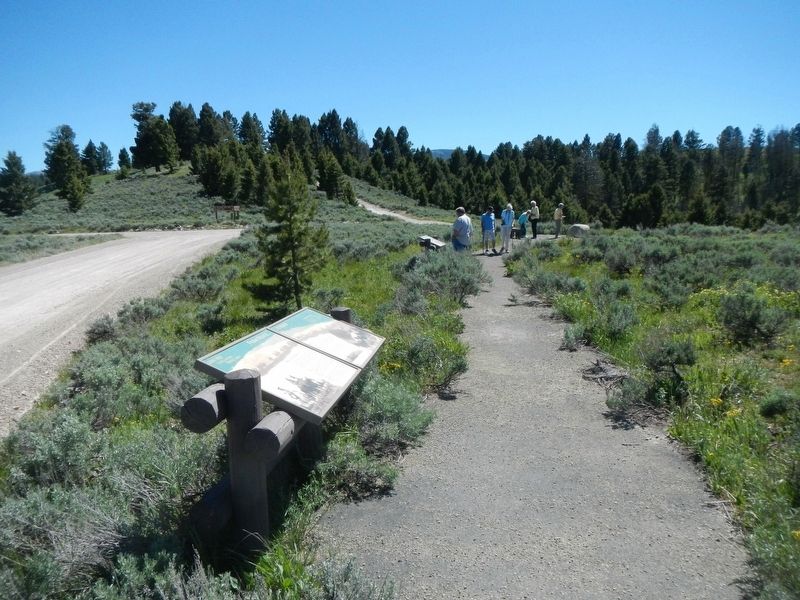
More about this marker. This marker is at the Lemhi Pass summit on a short trail paralleling Lemhi Pass Road.
This marker is on the Lewis and Clark National Back Country Byway and Adventure Road. The Byway is a 36 mile loop from Tendoy, Idaho to Lemhi Pass and back to Tendoy over gravel roads with a 4000 foot gain and loss in elevation. There are 10 designated stops with pullouts on the Byway and over two dozen information panels and markers on route. Estimated travel time is about 3 hours.
Photographed by Barry Swackhamer, June 24, 2017
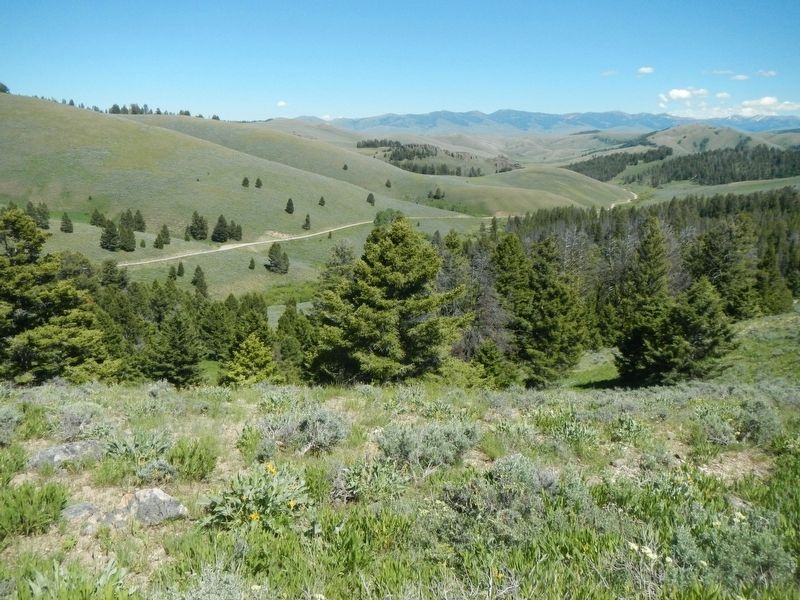
4. From Lemhi Pass looking east to Montana
Credits. This page was last revised on November 2, 2017. It was originally submitted on November 2, 2017, by Barry Swackhamer of Brentwood, California. This page has been viewed 856 times since then and 82 times this year. Photos: 1, 2, 3, 4. submitted on November 2, 2017, by Barry Swackhamer of Brentwood, California.
