Near Karnack in Harrison County, Texas — The American South (West South Central)
Old Town of Port Caddo
(Site located in and around Caddo State Park)
Photographed by Cosmos Mariner, May 24, 2014
1. Old Town of Port Caddo Marker
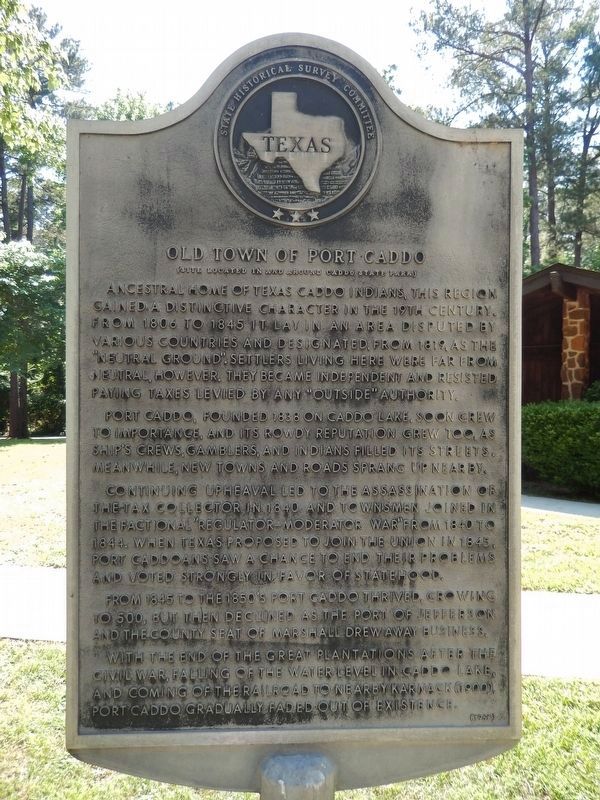
Ancestral home of Texas Caddo Indians, this region gained a distinctive character in the 19th century. From 1806 to 1845 it lay in an area disputed by various countries and designated, from 1819, as the “neutral ground.” Settlers living here were far from neutral, however. They became independent and resisted paying taxes levied by any “outside” authority.
Port Caddo, founded 1838 on Caddo Lake, soon grew to importance, and its rowdy reputation grew too, as ship’s crews, gamblers, and Indians filled its streets. Meanwhile, new towns and roads sprang up nearby.
Continuing upheaval led to the assassination of the tax collector in 1840 and townsmen joined in the factional “Regulator–Moderator War” from 1840 to 1844. When Texas proposed to join the Union in 1845, Port Caddoans saw a chance to end their problems and voted strongly in favor of statehood.
From 1845 to the 1850’s Port Caddo thrived, growing to 500, but then declined as the Port of Jefferson and the County Seat of Marshall drew away business.
With the end of the great plantations after the Civil War, falling of the water level in Caddo Lake, and coming
this page online
Erected 1968 by State Historical Survey Committee. (Marker Number 10207.)
Topics. This historical marker is listed in these topic lists: Indigenous Peoples and Communities • Notable Places • Settlements & Settlers.
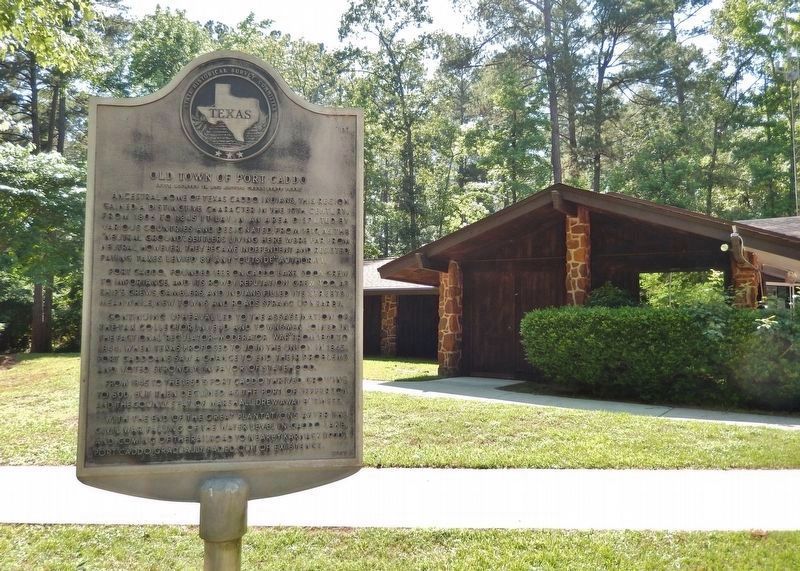
Location. 32° 40.814′ N, 94° 10.565′ W. Marker is near Karnack, Texas, in Harrison County. It can be reached from Park Road 2 0.1 miles north of Farm to Market Road 2198, on the right when traveling north. Marker is located inside Caddo Lake State Park, in front of the Park Recreation Hall. Touch for map. Marker is at or near this postal address: 245 Park Road 2, Karnack TX 75661, United States of America. Touch for directions.

Regionally, this marker is in the American South, specifically in the Deep South, and in the Piney Woods. Globally, it is in North America, a Gulf of Mexico state, the Western Hemisphere, the Western World, and the Anglosphere. Historically, it finds itself in what was once New Spain, the Republic of Texas, one of the Confederate States
Photographed by Cosmos Mariner, May 24, 2014
2. Old Town of Port Caddo Marker
Other nearby markers. At least 8 other markers are within 11 miles of this marker, measured as the crow flies: Home Town of Mrs. Lyndon B. Johnson (approx. one mile away); Longhorn Army Ammunition Plant (approx. one mile away); Marshall-Shreveport Stagecoach Road (approx. 7.9 miles away); Potter's Point (approx. 9½ miles away); Town of Scottsville (approx. 10.3 miles away); New Hope Missionary Baptist Church (approx. 10.4 miles away); Jefferson (approx. 10.6 miles away); Trammel's Trace (approx. 10.7 miles away). Touch for a list and map of all markers in Karnack.
More about this marker. Marker is severely weathered and difficult to read
Related markers. Click here for a list of markers that are related to this marker.
Also see . . .
1. Port Caddo, Texas.
Port Caddo was established when a native of San Augustine, Obediah Hendrick, Jr., was granted 660 acres of land by the Republic of Texas on July 7, 1838. By 1839 wagons were arriving at Port Caddo from the east, and boats were bringing people and goods. From its beginning Port Caddo was a typical boisterous frontier
Photographed by Cosmos Mariner, May 24, 2014
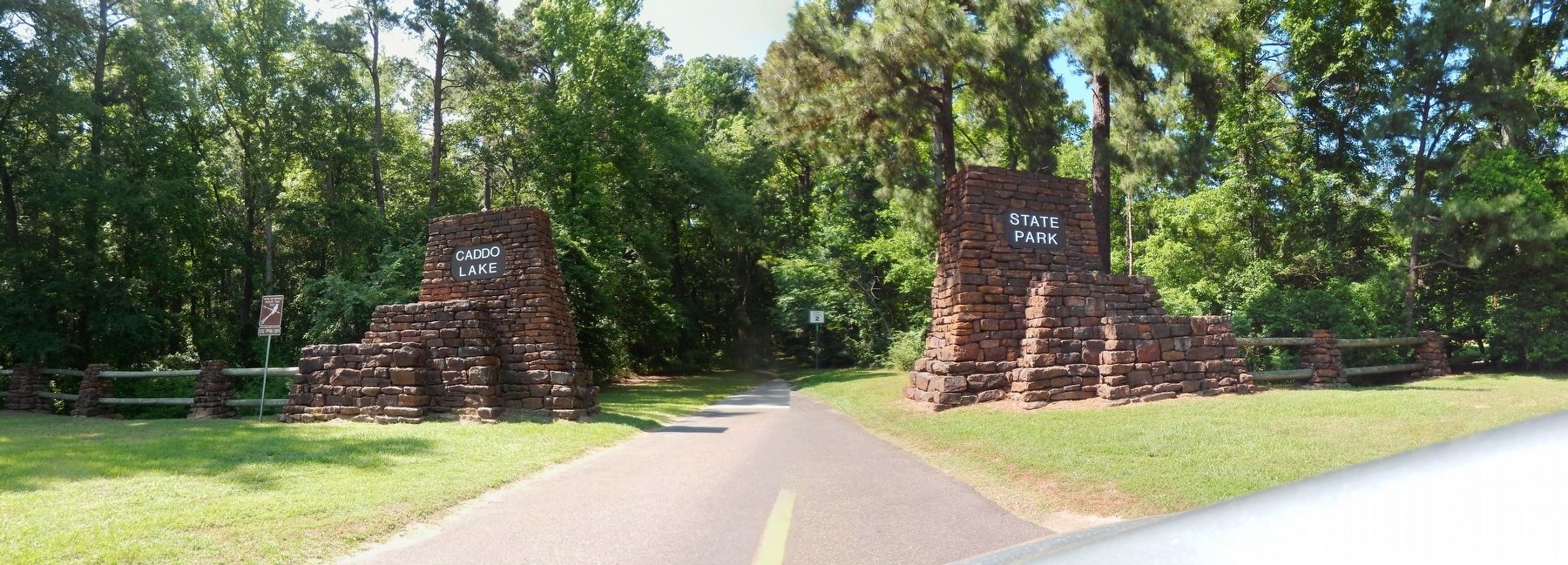
3. Caddo Lake State Park Entrance
2. Caddo Lake State Park History.
The park’s rich history includes the presence of the Caddo Indians of the 18th and 19th centuries, although it is believed that people have inhabited this East Texas area for nearly 12,000 years. When the Caddos first arrived, they continued their semi-nomadic style of hunting and gathering. With
Photographed by Cosmos Mariner, May 24, 2014
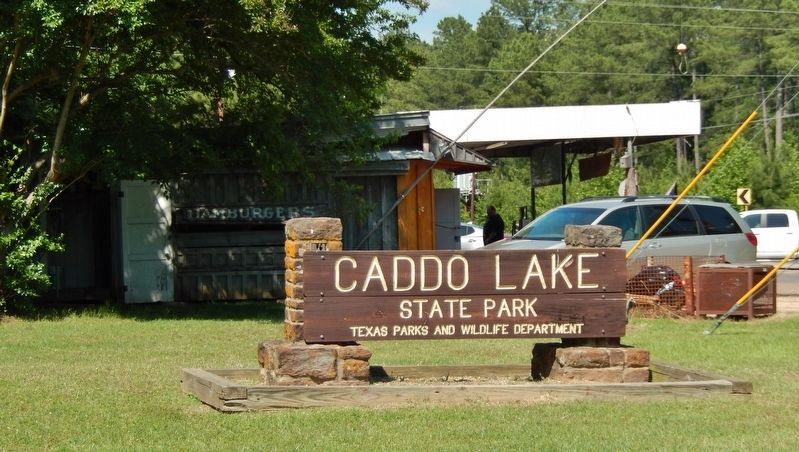
4. Caddo Lake State Park Sign
3. Caddo Indians.
Caddo peoples lived on the Red River and in East Texas. European populations-living in missions, ranches, and trading posts-increased throughout the eighteenth and into the early nineteenth century in the Red River valley and in the vicinity of Natchitoches and Nacogdoches. Epidemics between 1691 and 1816 greatly reduced Caddo populations. Settlements were between the Sabine River and Caddo Lake, generally along the boundary between the territory of Louisiana and the province of Texas. Most remained in the Caddo Lake area until about 1842, although with the cession of Caddoan lands in Louisiana in 1835 and increased Texas settlement, some
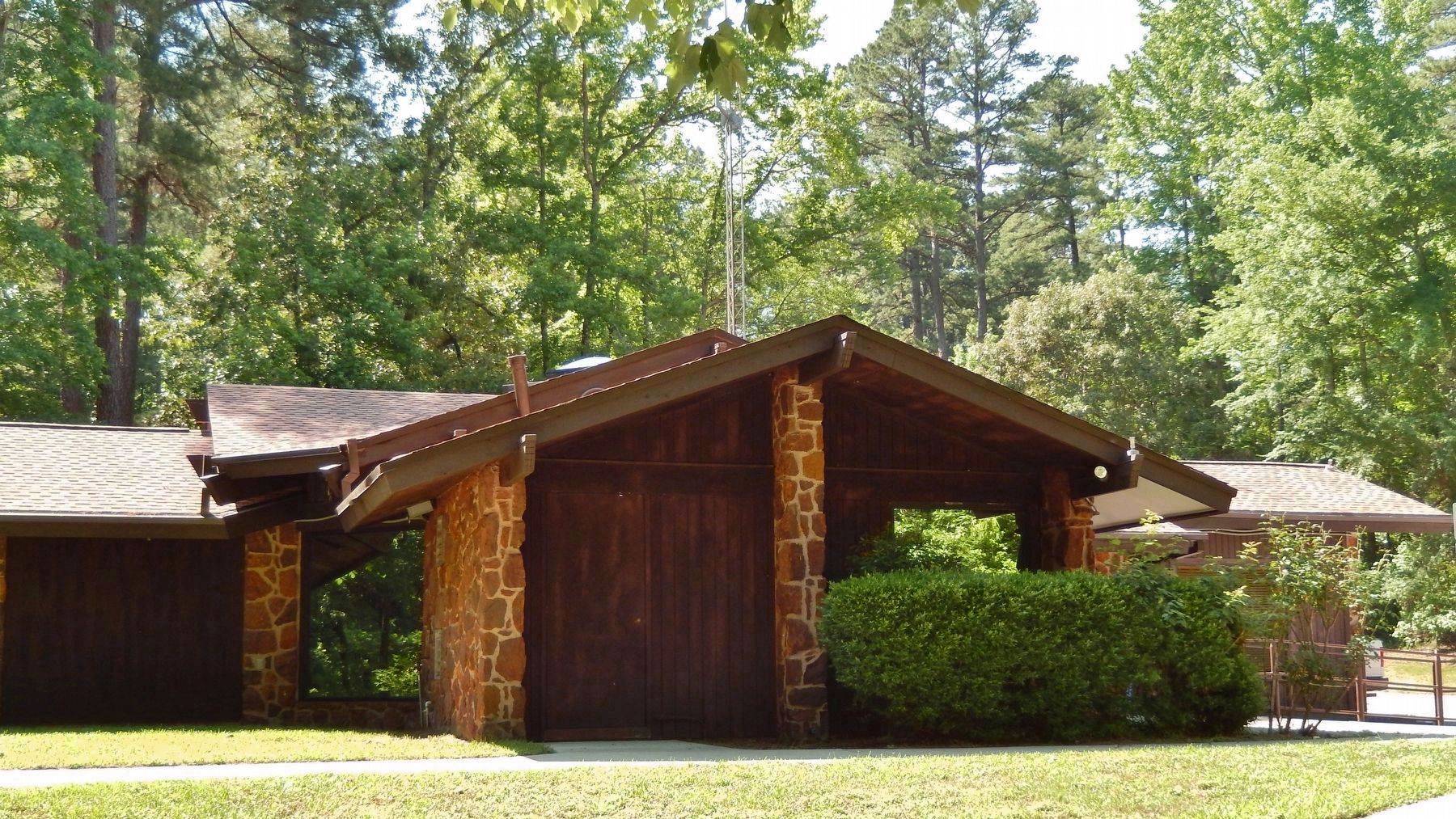
Photographed by Cosmos Mariner, May 24, 2014
5. Caddo Lake State Park 1970 Headquarters and Interpretive Center
Credits. This page was last revised on June 8, 2024. It was originally submitted on November 30, 2017, by Cosmos Mariner of Cape Canaveral, Florida. This page has been viewed 1,929 times since then and 137 times this year. Photos: 1, 2, 3, 4, 5. submitted on November 30, 2017, by Cosmos Mariner of Cape Canaveral, Florida. • Bernard Fisher was the editor who published this page.
