Chickasaw in Mobile County, Alabama — The American South (East South Central)
City of Chickasaw
Photographed by Mark Hilton, December 10, 2017
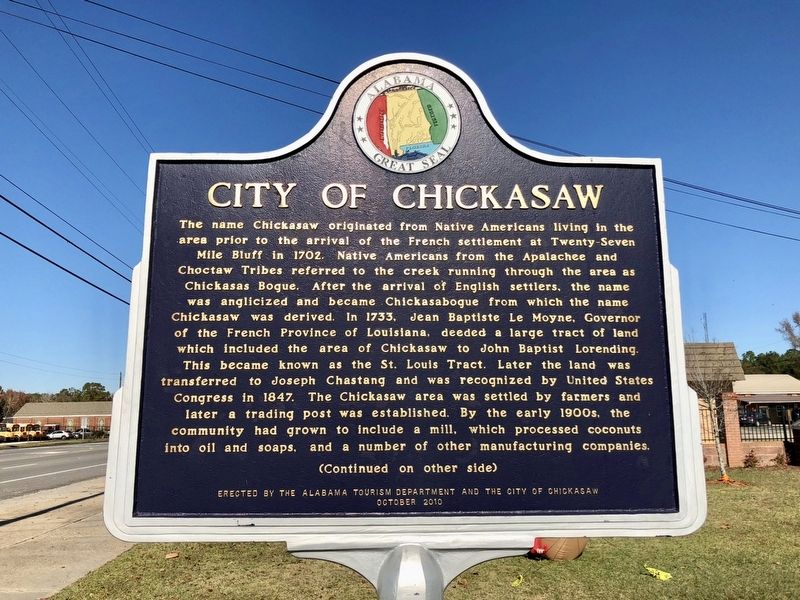
1. City of Chickasaw Marker (Front)
The name Chickasaw originated from Native Americans living in the area prior to the arrival of the French settlement at Twenty-Seven Mile Bluff in 1702. Native Americans from the Apalachee and Choctaw Tribes referred to the creek running through the area as Chickasas Bogue. After the arrival of English settlers, the name was anglicized and became Chickasabogue from which the name Chickasaw was derived. In 1733, Jean Baptiste Le Moyne, Governor of the French Province of Louisiana, deeded a large tract of land which included the area of Chickasaw to John Baptist Lorending. This became known as the St. Louis Tract. Later the land was transferred to Joseph Chastang and was recognized by United States Congress in 1847. The Chickasaw area was settled by farmers and later a trading post was established. By the early 1900s, the community had grown to include a mill, which processed coconuts into oil and soaps, and a number of other manufacturing companies.
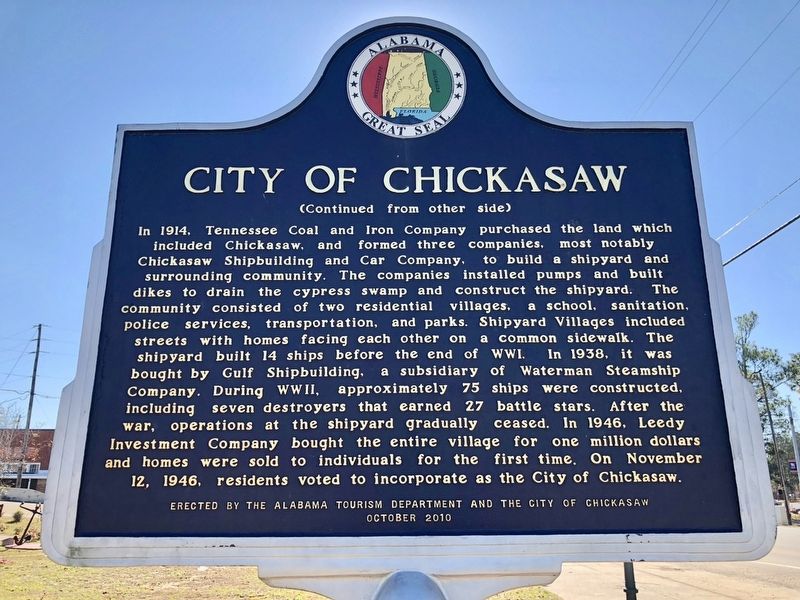
In 1914, Tennessee Coal and Iron Company purchased the land which included Chickasaw, and formed three companies, most notably Chickasaw Shipbuilding and Car Company, to
this page online
Erected 2010 by the Alabama Tourism Department and the City of Chickasaw.
Topics and series. This historical marker is listed in these topic lists: Indigenous Peoples and Communities • Industry & Commerce • Settlements & Settlers • War, World II.
Photographed by Mark Hilton, December 10, 2017
2. City of Chickasaw Marker (Rear)
Location. 30° 45.843′ N, 88° 4.466′ W. Marker is in Chickasaw, Alabama, in Mobile County. It is at the intersection of North Craft Highway (U.S. 43) and Viaduct Road, on the right when traveling north on North Craft Highway. Located at Chickasaw Maritime Park. Touch for map. Marker is at or near this postal address: 200 North Craft Highway, Mobile AL 36611, United States of America. Touch for directions.

Regionally, this marker is on Alabama’s Gulf Coast, in the Mobile Bay area, and specifically in the Mobile Metropolitan Area. It is also in the American South, specifically in the Deep South, and on the Gulf Coast. Globally, it is in North America, a Gulf of Mexico state, the Western Hemisphere, the Western World, and the Anglosphere. Historically, it finds itself in what was once New Spain, the Viceroyalty of New France, the territory of the Mississippian Culture, one of the Confederate States of America, and the Antebellum South.
Other nearby markers. At least 8 other markers are within
Photographed by Mark Hilton, December 10, 2017
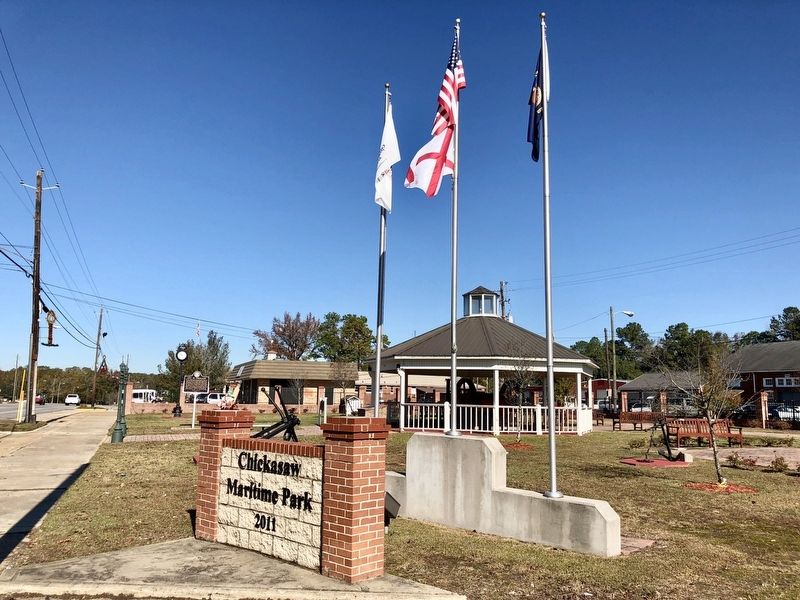
3. City of Chickasaw Marker at the Chickasaw Maritime Park.
Also see . . . The Encyclopedia of Alabama article on the City of Chickasaw. (Submitted on December 10, 2017, by Mark Hilton of Montgomery, Alabama.)
Photographed by Mark Hilton, December 10, 2017
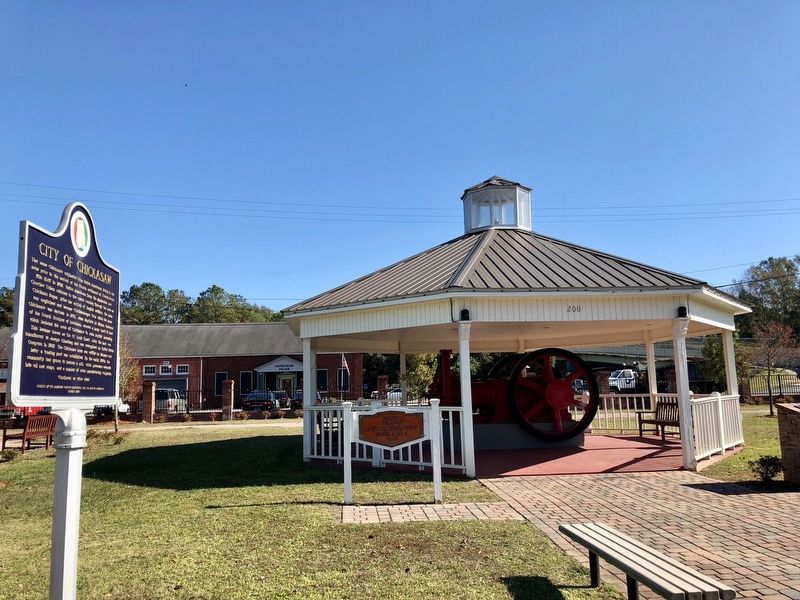
4. Marker in front of an engine built by the Gulf Shipbuilding Corporation in 1945.
Credits. This page was last revised on May 31, 2024. It was originally submitted on December 10, 2017, by Mark Hilton of Montgomery, Alabama. This page has been viewed 1,365 times since then and 95 times this year. Photos: 1, 2, 3, 4. submitted on December 10, 2017, by Mark Hilton of Montgomery, Alabama.
