Westminster in City of Westminster in Greater London, England, United Kingdom — Northwestern Europe (the British Isles)
The Burghers of Calais
Photographed by Andrew Ruppenstein, October 13, 2017
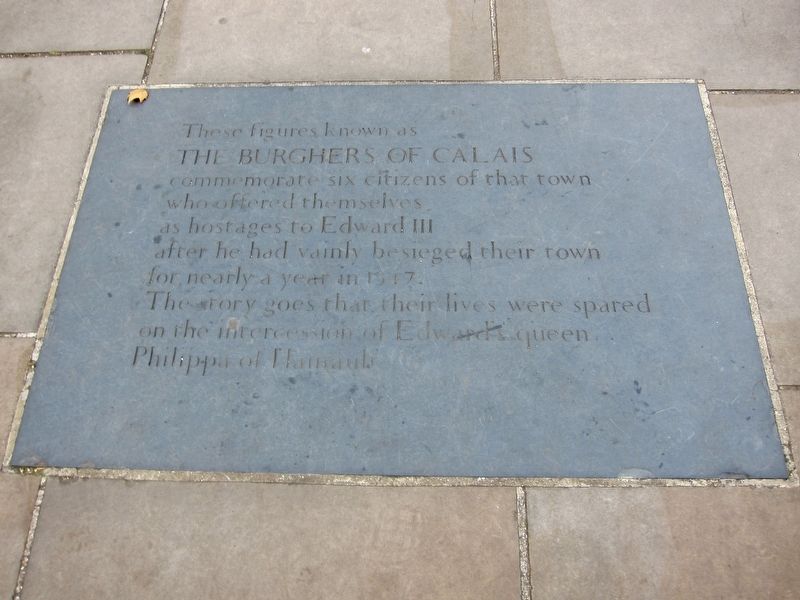
1. The Burghers of Calais Marker
These figures known as
The Burghers of Calais
commemorate six citizens of that town
who offered themselves
as hostages to Edward III
after he had vainly besieged their town
for nearly a year in 1317.
The story goes that their lives were spared
on the intercession of Edward's queen
Philippa of Hainault.
Topics. This historical marker is listed in these topic lists: Arts, Letters, Music • Wars, Non-US. A significant historical year for this entry is 1317.
Location. 51° 29.846′ N, 0° 7.494′ W. Marker is in City of Westminster, England, in Greater London. It is in Westminster. It can be reached from the intersection of Millbank and Great College Street. Touch for map. Marker is at or near this postal address: 1 Millbank, City of Westminster, England SW1P 3LX, United Kingdom. Touch for directions.

Regionally, this marker is in London and in the Greater South East. Globally, it is on the Atlantic Ocean, in the North Atlantic Region, in Europe, in Atlantic Europe, on one of the British Isles, in the Western World, and in the Anglosphere. Historically, it finds itself in what was once the Roman Empire.
this page online
Other nearby markers. At least 8 other markers are within walking distance of this marker: Emmeline Pankhurst (within shouting distance of this marker); Sir Thomas Peirson Frank (about 120 meters away, measured in a direct line); The Jewel Tower (about 150 meters away); The Buxton Memorial (about 150 meters away); Sir John Gielgud (about 180 meters away); Lord Reith (about 180 meters away); W.T. Stead (about 210 meters away); T.E. Lawrence (about 210 meters away). Touch for a list and map of all markers in City of Westminster.
More about this marker. The marker and sculpture are located in the northern section of Victoria Tower Gardens South, and are easily visible once within the park.
Regarding The Burghers of Calais. There are twelve original castings of this sculpture. The initial, cast in 1895, stands in Calais. This version was cast in 1908 and unveiled on July 19, 1915.
Also see . . .
1. The Burghers of Calais (Wikipedia). "In 1346, England's Edward III, after a victory in the Battle of Crécy, laid siege to Calais, while Philip VI of France ordered the city to hold out at all costs. Philip failed to lift
Photographed by Andrew Ruppenstein, October 13, 2017
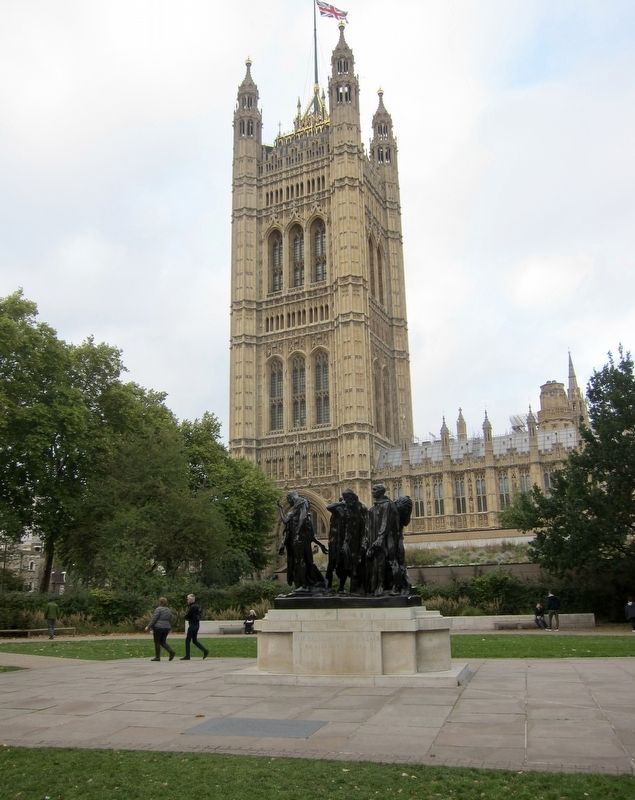
2. The Burghers of Calais Marker - Wide View
The marker is visible here in the foreground, the Houses of Parliament in the background, and the Burghers of Calais is between them.
2. Rodin Works: The Burghers of Calais (Rodin-web).
Photographed by Andrew Ruppenstein, October 13, 2017
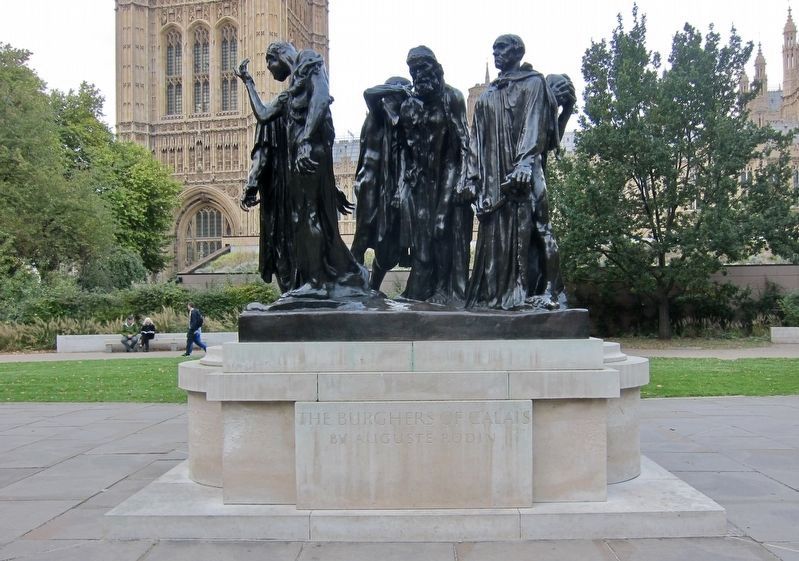
3. The Burghers of Calais by Auguste Rodin
"Les Bourgeois de Calais is one of the most famous sculptures by Auguste Rodin. It commemorates an occurrence during the Hundred Years' War, when Calais, an important French port on the English Channel, was under siege by the English for over a year. Calais commissioned Rodin to create the sculpture in 1884, and the work was completed in 1889." - Wikipedia
Engraved by John Sartain (1861) after a painting by H.C. Selous (1847), 1347
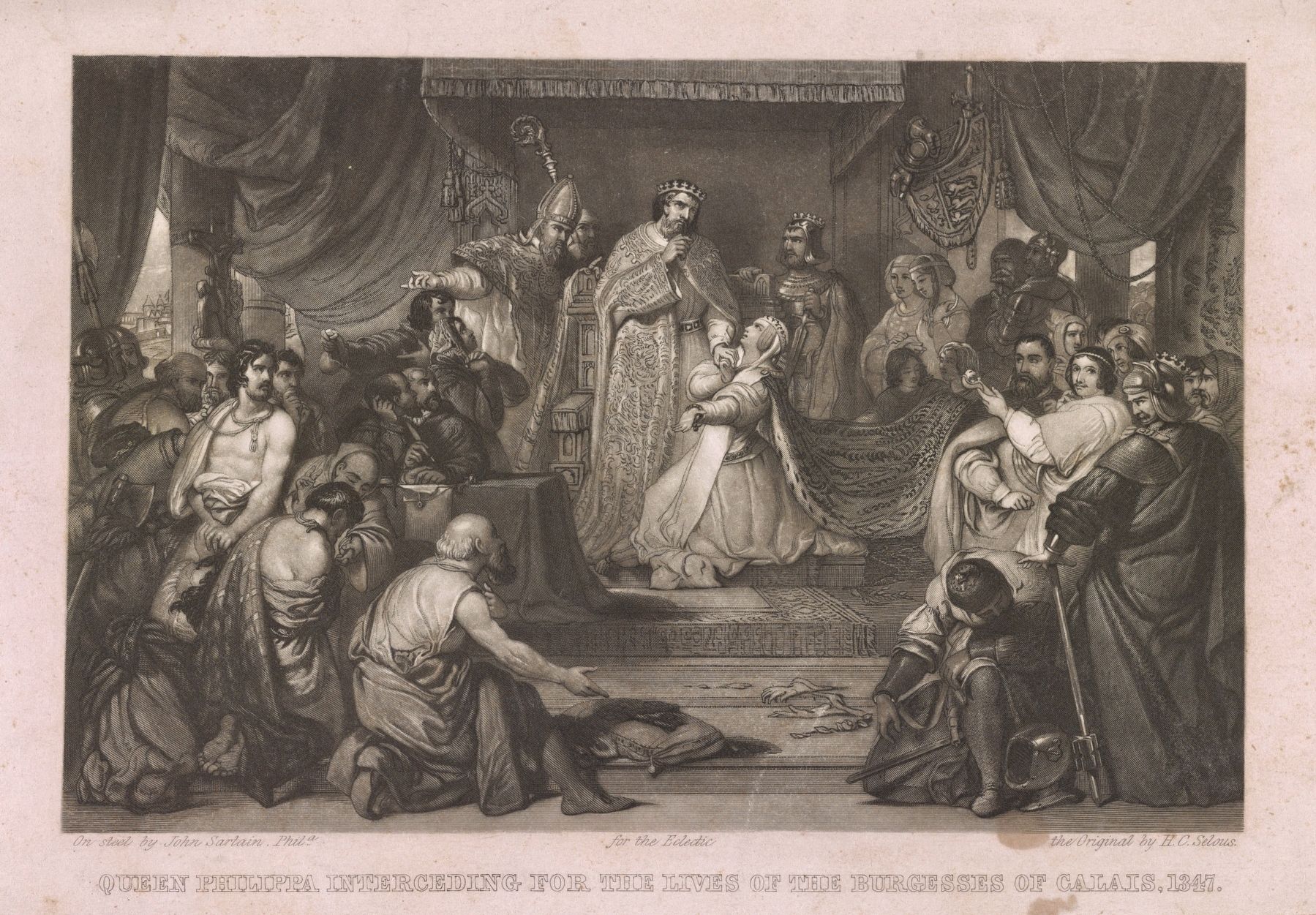
4. Queen Philippa interceding for the lives of the burgesses of Calais, 1347
"Print shows Philippa, Queen, consort of Edward III, kneeling before her husband, King Edward III, begging him to spare the lives of the six burghers of Calais who have sacrificed themselves by complying with his demands, so that the citizens of Calais may be spared the English siege of the city. It is a lavish scene filled with members of the King's court, a bishop, the Queen's ladies in waiting, the condemned burghers, and a man with an ax on the lower left who is possibly the executioner...." - Library of Congress
Credits. This page was last revised on January 27, 2022. It was originally submitted on December 13, 2017, by Andrew Ruppenstein of Lamorinda, California. This page has been viewed 360 times since then and 26 times this year. Photos: 1, 2, 3, 4. submitted on December 13, 2017, by Andrew Ruppenstein of Lamorinda, California.
