Smithsonian National Zoo in Northwest Washington in Washington, District of Columbia — The American Northeast (Mid-Atlantic)
A Capital Bird
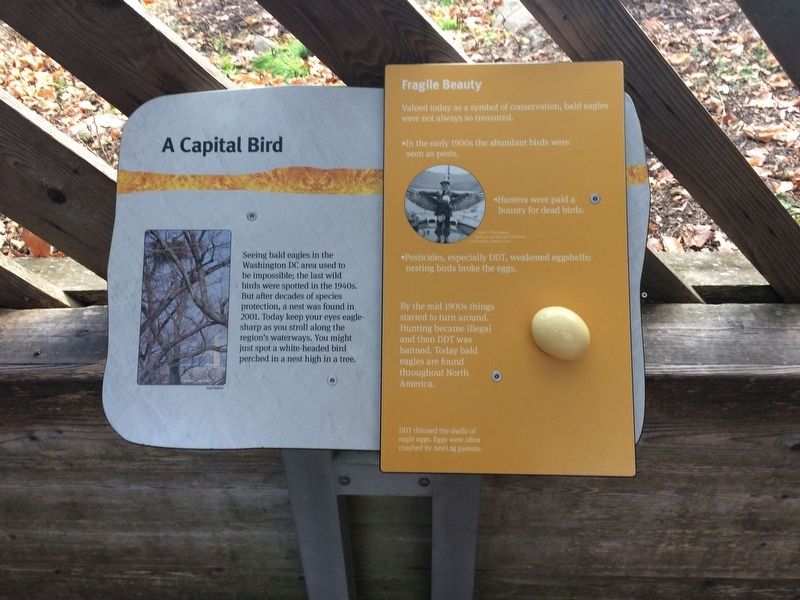
Seeing bald eagles in the Washington DC area used to be impossible; the last wild birds were spotted in the 1940s. But after decades of species protection, a nest was found in 2001. Today keep you eyes eagle-sharp as you stroll along the region's waterways. You might spot a white-headed bird perched in a nest high in a tree.
Fragile Beauty
Valued today as a symbol of conservation, bald eagles were not always so treated.
• In the early 1900s the abundant birds were seen as pests.
• Hunters were paid a bounty for dead birds.
• Pesticides, especially DDT, weakened eggshells; nesting birds broke the eggs.
By the mid 1900s, things started to turn around. Hunting became illegal and then DDT was banned. Today bald eagles are found throughout North America.
Erected by Smithsonian Institution.
Topics. This historical marker is listed in these topic lists: Animals • Environment. A significant historical year for this entry is 1900.
Location. 38° 55.784′ N, 77° 2.968′ W. Marker is in Northwest Washington in Washington, District of Columbia. It is in Smithsonian National Zoo. It can be reached from Connecticut Avenue
this page online

Regionally, this marker is in the Washington Metropolitan Area. It is also in the American Northeast, in the Upper South, in the Mid-Atlantic, in the Tidewater, and in the Chesapeake Bay Region. Globally, it is in North America, the Western Hemisphere, the Western World, and the Anglosphere.
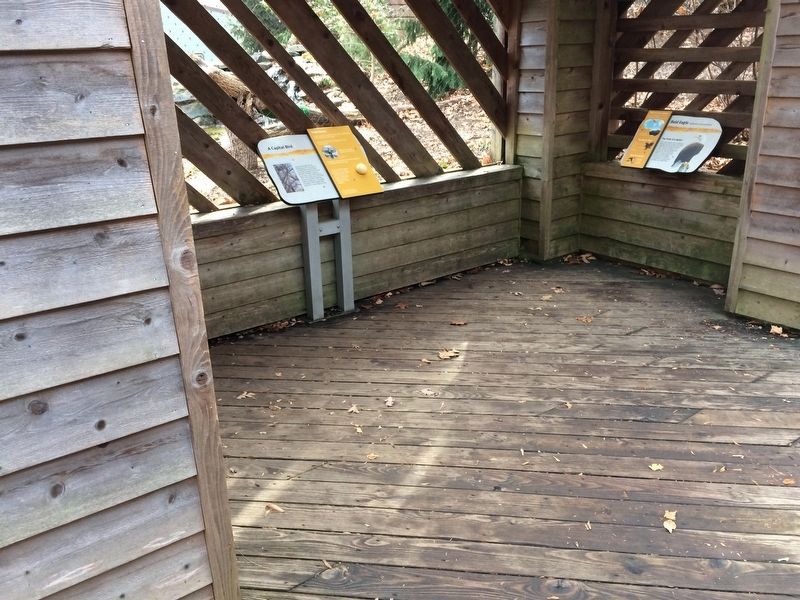
Other nearby markers. At least 8 other markers are within walking distance of this marker: Bald Eagle (here, next to this marker); A Trail Transformed (within shouting distance of this marker); Pelicans in Peril (within shouting distance of this marker); Smithsonian Conservation Biology Institute (about 300 feet away, measured in a direct line); Working for Whoopers (about 400 feet away); Kori Bustard (about 400 feet away); Whooping Crane (about 400 feet away); a different marker also named Rebuilding in the Wild (about 400 feet away).
Another marker is no longer nearby. Rebuilding in the Wild (was about 400 feet away but has been replaced with another marker now near it).
Credits. This page was last revised on January 30, 2023. It was originally submitted on December 17, 2017, by Devry Becker Jones of Washington, District of Columbia. This page has been viewed 262 times since then and 13 times this year. Photos: 1, 2. submitted on December 17, 2017, by Devry Becker Jones of Washington, District of Columbia. • Bill Pfingsten was the editor who published this page.
