Puebla, Mexico — The Central Highlands (North America)
The Church of Guadalupe
Photographed by J. Makali Bruton, December 1, 2017
1. The Church of Guadalupe Marker

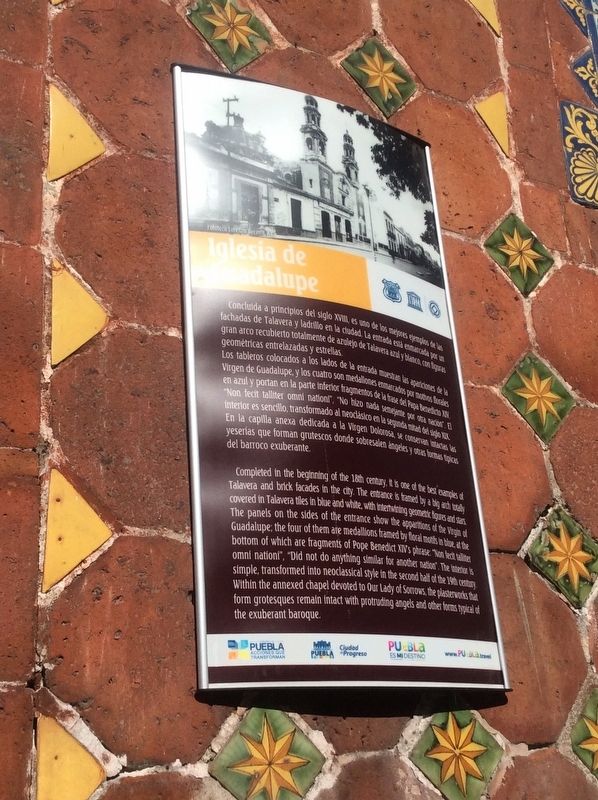
lglesia de Guadalupe
Concluida a principios del sigo XVIl, es uno de los mejores ejemplos de Talavera y ladrillo en la ciudad. La entrada está enmarcada por un gran arco recubierto totalmente de azulejo de Talavera azul y blanco, con figuras geométricas entrelazadas y estrellas.
Los tableros colocados a los lados de la entrada muestran las apariciones de la Virgen de Guadalupe, y los cuatro son medallones enmarcados por motivos florales en azul y portan en la parte inferior fragmentos de la frase del Papa Benedicto XIV, “Non fecit talliter omni nationi”, “No hizo nada semejante por otra nación”. El interior es sencillo, transformado al neoclásico en la segunda mitad del siglo XIX. En la capilla anexa dedicada a la Virgen Dolorosa, se conservan intactas las yeserías que forman grutescos donde sobresalen ángeles y otras formas típicas del barroco exuberante.
Pie de dibujo: Fototeca Lorenzo Becerril, A.C.
The Church of Guadalupe
Completed in the beginning of the 18th century, it is one of the best examples of Talavera and brick facades in the city. The entrance is framed by a big arch totally covered in
this page online
Caption: Lorenzo Becerril, A.C. photo collection
Erected by Gobierno Municipal de Puebla.
Topics. This historical marker is listed in these topic lists: Architecture • Religion & Religious Structures.
Location. 19° 2.917′ N, 98° 12.396′ W. Marker is in Puebla. It is on Avenida de la Reforma just west of Calle 11 Norte, on the right when traveling west. Touch for map. Marker is in this post office area: Puebla 72090, Mexico.
Photographed by J. Makali Bruton, December 1, 2017
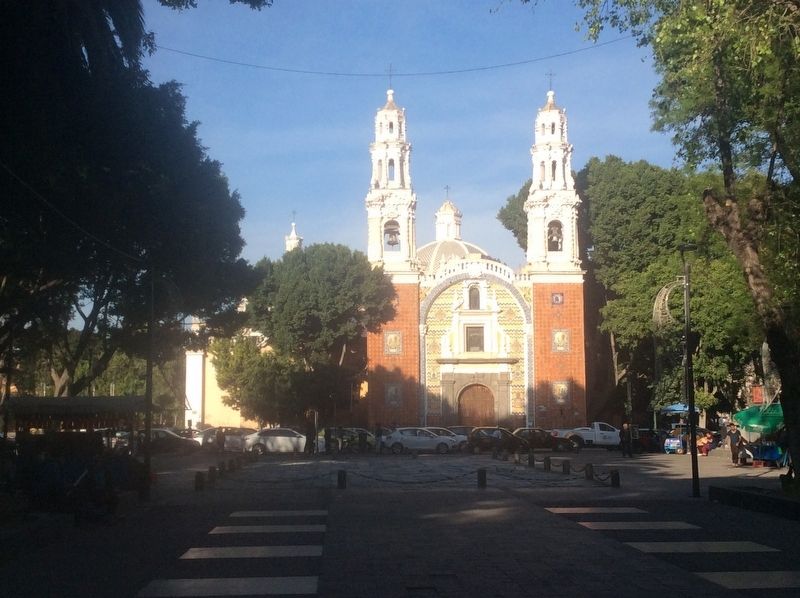
2. The Church of Guadalupe and Marker
The marker is to the right of the church's main entrance.

Regionally, this marker is in Central Mexico. Globally, it is in North America, specifically in Mesoamerica, on the Ring of Fire, and in the Western Hemisphere. Historically, it finds itself in what was once New Spain, a Spanish colony, and the Aztec Empire.
Other nearby markers. At least 8 other markers are within walking distance of this marker: The Museum of the Mexican Army and Air Force (about 120 meters away, measured in a direct line); The Old College of San Javier (about 120 meters away); The "Paseo Bravo" as a Civic Space (approx. 0.3 kilometers away); Nicolás Bravo (approx. 0.3 kilometers away); The House of the Little Heads (approx. half a kilometer away); Mail Car NM 2555 (approx. half a kilometer away); Diesel-Electric Locomotives DH-19 and DH-17 (approx. half a kilometer away); Electric Locomotive FCM 1001 (approx. 0.6 kilometers away). Touch for a list and map of all markers in Puebla.
Photographed by J. Makali Bruton, December 1, 2017
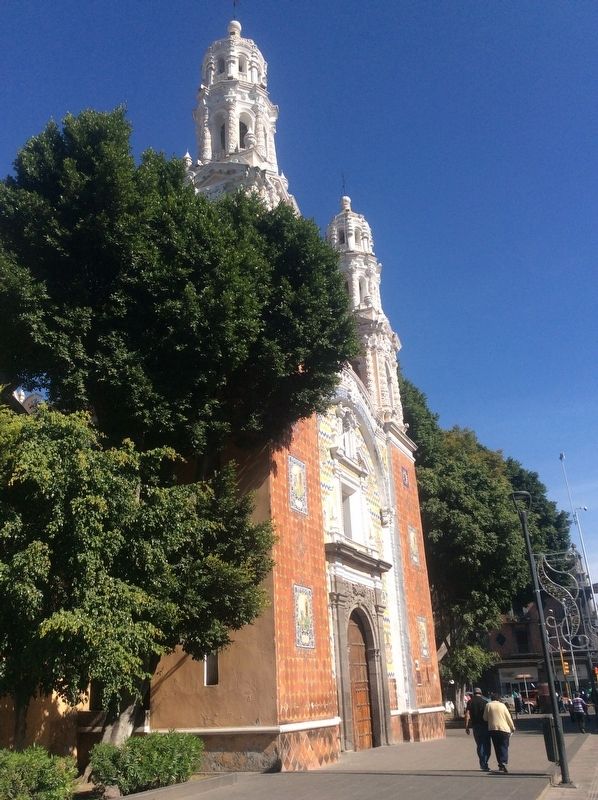
3. The Church of Guadalupe and marker
Photographed by J. Makali Bruton, December 1, 2017
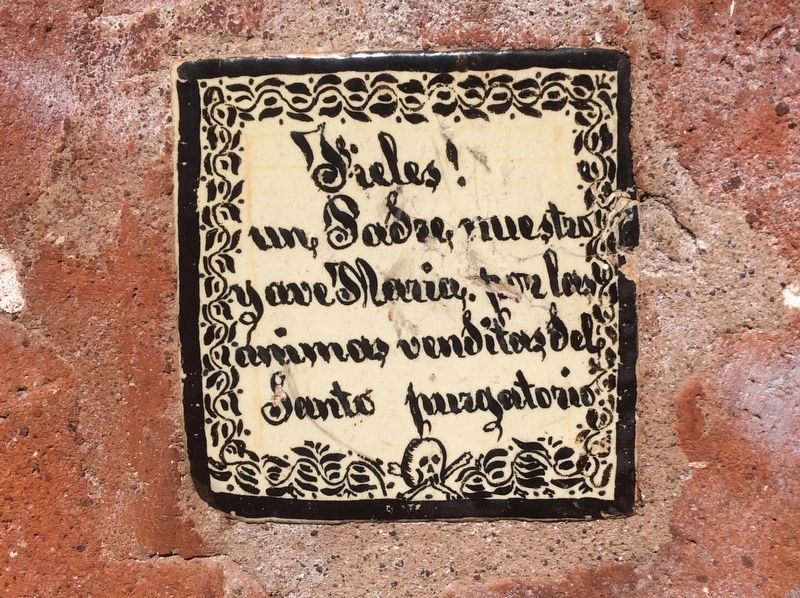
4. A ceramic tile on The Church of Guadalupe
This ceramic tile on the church’s facade reads:
Fieles! un Padre nuestro y ave Maria. Por las animas venditas del Santo purgatorio
English translation:
Faithful! An Our Father and a Hail Mary for the blessed souls of Holy Purgatory
Credits. This page was last revised on October 3, 2022. It was originally submitted on December 19, 2017, by J. Makali Bruton of Washington, District of Columbia. This page has been viewed 180 times since then and 18 times this year. Photos: 1, 2, 3, 4. submitted on December 19, 2017, by J. Makali Bruton of Washington, District of Columbia.
