Darien in McIntosh County, Georgia — The American South (South Atlantic)
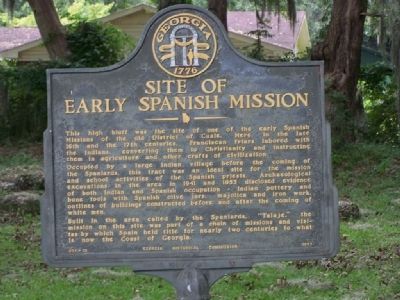
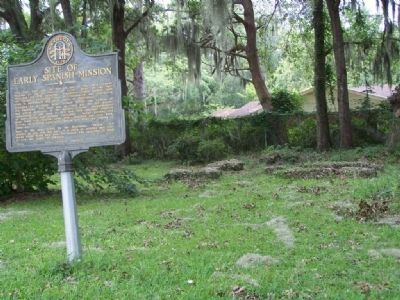
Site of Early Spanish Mission
Photographed by Mike Stroud, August 2008
1. Site of Early Spanish Mission Marker
Occupied by a large Indian village before the coming of the Spaniards, this tract was an ideal site for the mission and school activities of the Spanish priests. Archaeological excavations in the area in 1941 and 1953 disclosed evidence of both Indian and Spanish occupation- Indian pottery and bone tools with Spanish olive jars, majolica and iron work, outline of buildings constructed before and after the coming of white men.
Built in the area called by the Spaniards, "Talaje," the mission on this site was part of the chain of missions and visitas by which Spain held title for nearly two centuries to what is now the Coast of Georgia.
Erected 1957 by Georgia Historical Commission. (Marker Number 095-10.)
Topics and series. This historical marker is listed in these topic lists: Colonial Era • Exploration • Notable Buildings
this page online
Location. 31° 21.86′ N, 81° 25.051′ W. Marker is in Darien, Georgia, in McIntosh County. It can be reached from Ft. King George Drive. At Fort King George State Historic site. Touch for map. Marker is in this post office area: Darien GA 31305, United States of America. Touch for directions.

Regionally, this marker is on the Coastal Plain, on the Georgia Coast and the Golden Isles, and on the Sea Islands. It is also in the American South, specifically in the Deep South, and on the Eastern Seaboard. Globally, it is in the North Atlantic Region, North America, the Western Hemisphere, the Western World, and the Anglosphere. Historically, it finds itself in what was once New Spain, the territory of the Mississippian Culture, one of the original Thirteen Colonies, one of the Confederate States of America, and the Antebellum South.
Other nearby markers. At least 8 other markers are within walking distance of this marker:
Photographed by Mike Stroud, 2008
2. Site of Early Spanish Mission Marker
Also see . . . James A. Ford and the Growth of Americanist Archaeology By Michael John O'Brien, R. Lee Lyman. pages 60-61 Santo Domingo de Talaje ? (Submitted on September 7, 2008, by Mike Stroud of Bluffton, South Carolina.)
Photographed by Mike Stroud, 2008
3. Site of Early Spanish Mission Marker
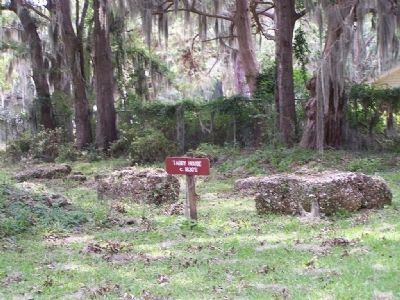
Tabby House c. 1830s
Photographed by Mike Stroud, August 27, 2008
4. Site of Early Spanish Mission Marker "Tabby"
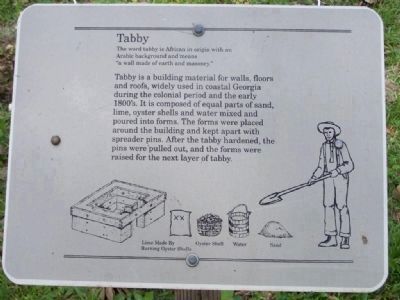
Tabby
The word tabby is African in origin with an
Arabic background and means
" a wall made of earth and masonary."
Tabby is a building material for walls, floors and roofs, widely used in coastal Georgia during the colonial period and the early 1800's. It is composed of equal parts of sand, lime, oyster shells and water mixed and poured into forms. The forms were placed around the building and kept apart with spreader pins. After the tabby hardened, the pins were pulledout, and the forms were raised for the next layer of tabby.
Lime made by burning Oyster Shells
Tabby is a building material for walls, floors and roofs, widely used in coastal Georgia during the colonial period and the early 1800's. It is composed of equal parts of sand, lime, oyster shells and water mixed and poured into forms. The forms were placed around the building and kept apart with spreader pins. After the tabby hardened, the pins were pulledout, and the forms were raised for the next layer of tabby.
Lime made by burning Oyster Shells
Photographed by Mike Stroud, August 27, 2008
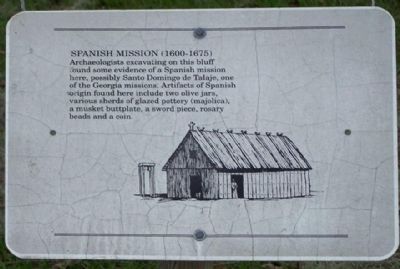
5. Site of Early Spanish Mission Marker
Spanish Mission (1600-1675)
Archaeologists excavating on this bluff
found some evidence of a Spanish mission
here, possibly Santo Domingo de Talaje, one
of the Georgia missions. Artifacts of Spanish
origin found here include two olive jars,
various sherds of glazed pottery (majolica),
a musket buttplate, a sword piece, rosary
beads and a coin. ( at the museum)
Credits. This page was last revised on October 12, 2021. It was originally submitted on September 7, 2008, by Mike Stroud of Bluffton, South Carolina. This page has been viewed 3,989 times since then and 99 times this year. Photos: 1, 2, 3, 4, 5. submitted on September 7, 2008, by Mike Stroud of Bluffton, South Carolina. • Kevin W. was the editor who published this page.
