Highlands/Perkins in Baton Rouge in East Baton Rouge Parish, Louisiana — The American South (West South Central)
18th Century Style Sugar House
Photographed by Cajun Scrambler, December 28, 2017
1. 18th Century Style Sugar House Marker
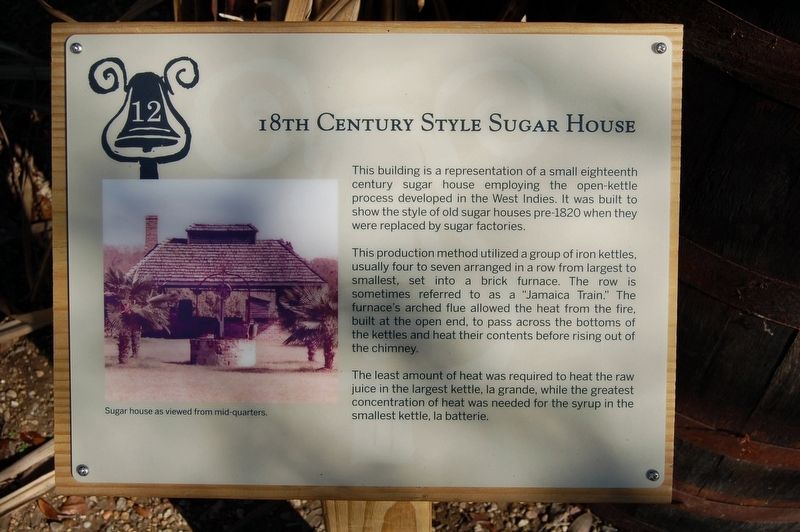
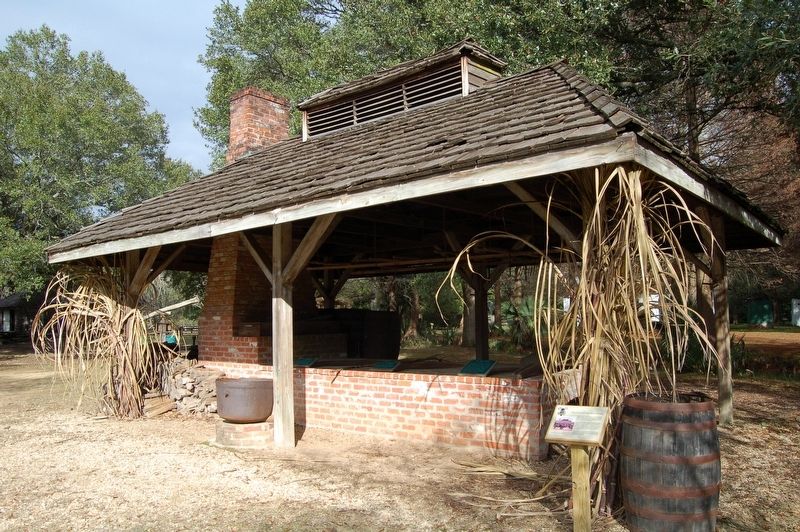
Inscription. This building is a representation of a small eighteenth century sugar house employing the open-kettle process developed in the West Indies. It was built to show the style of old sugar houses pre-1820 when they were replaced by sugar factories.
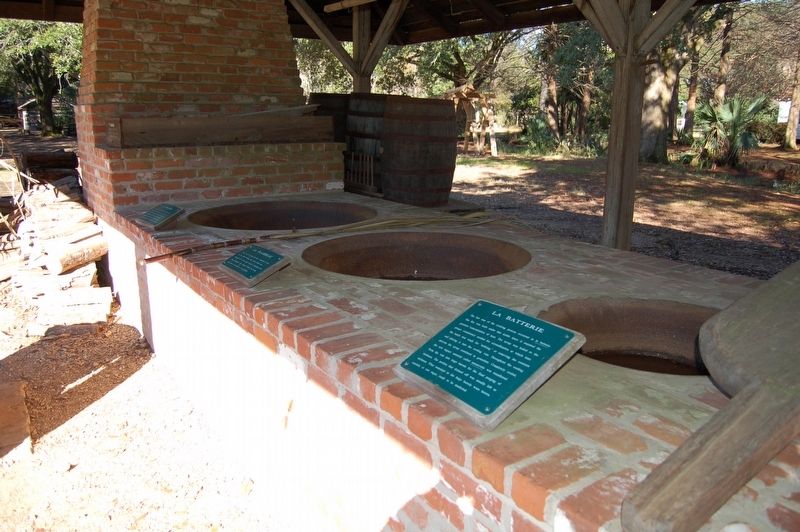
This production method utilized a group of iron kettles, usually four to seven arranged in a row from largest to smallest, set into a brick furnace. The row is sometimes referred to as a "Jamaica Train." The furnace's arched flue allowed the heat from the fire, built at the open end, to pass across the bottoms of the kettles and heat their contents before rising out of the chimney.
The least amount of heat was required to heat the raw juice in the largest kettle, la grande, while the greatest concentration of heat was needed for the syrup in the smallest kettle, la batterie.
Caption: Sugar house as viewed from mid-quarters
Erected by LSU Rural Life Museum. (Marker Number 12.)
Location. 30° 24.639′ N, 91° 6.884′ W. Marker is in
Click or scan to see this page online
Baton Rouge, Louisiana, in East Baton Rouge Parish. It is in Highlands/Perkins. It can be reached from Essen Lane (State Road 3064) south of Interstate 10, on the right when traveling south. Located on the grounds of the LSU Rural Life Museum. Touch for map. Marker is at or near this postal address: 4560 Essen Lane, Baton Rouge LA 70808, United States of America. Touch for directions.
Regionally, this marker is in Louisiana’s Florida Parishes. It is also in the American South, specifically in the Deep South, and in the Great River Road Region. Globally, it is in North America, a Gulf of Mexico state, the Western Hemisphere, the Western World, and the Anglosphere. Historically, it finds itself in what was once New Spain, the territory of the Mississippian Culture, the Louisiana Purchase, one of the Confederate States of America, and the Antebellum South.
Also see . . . LSU Rural Life Museum. (Submitted on December 31, 2017, by Cajun Scrambler of Assumption, Louisiana.)
December 28, 2017
3. 18th Century Style Sugar House Marker
December 28, 2017
4. La Grande
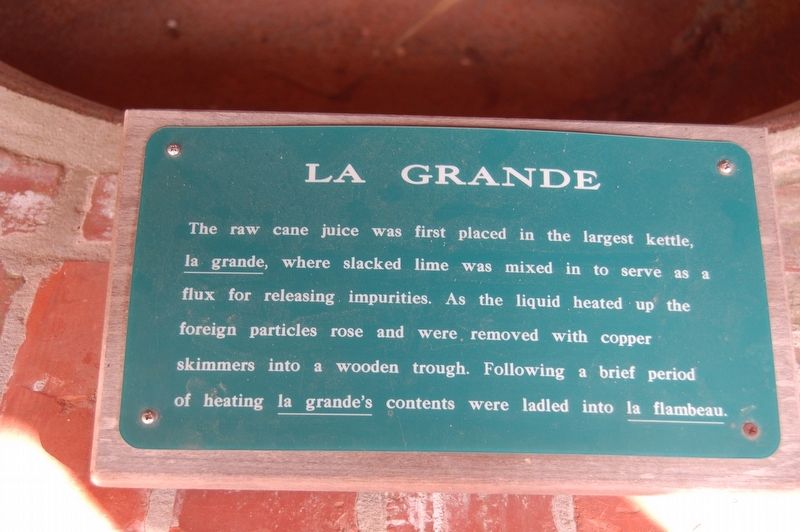
The raw cane juice was first placed in the largest kettle, la grande, where slacked lime was mixed in to serve as a flux for releasing impurities. As the liquid heated up the foreign particles rose and were removed with copper skimmers into a wooden trough. Following a brief period of heating la grande's contents were ladled into la flambeau.
Photographed by Cajun Scrambler, December 28, 2017
5. La Flambeau
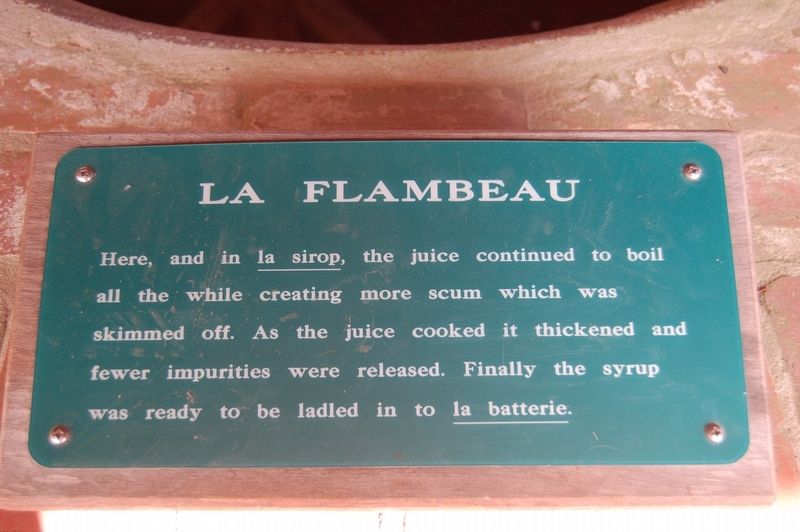
Here, and in la sirop, the juice continued to boil all the while creating more scum which was skimmed off. As the juice cooked, it thickened and fewer impurities were released. Finally the syrup was ready to be ladled in to la batterie.
December 28, 2017
6. La Batterie
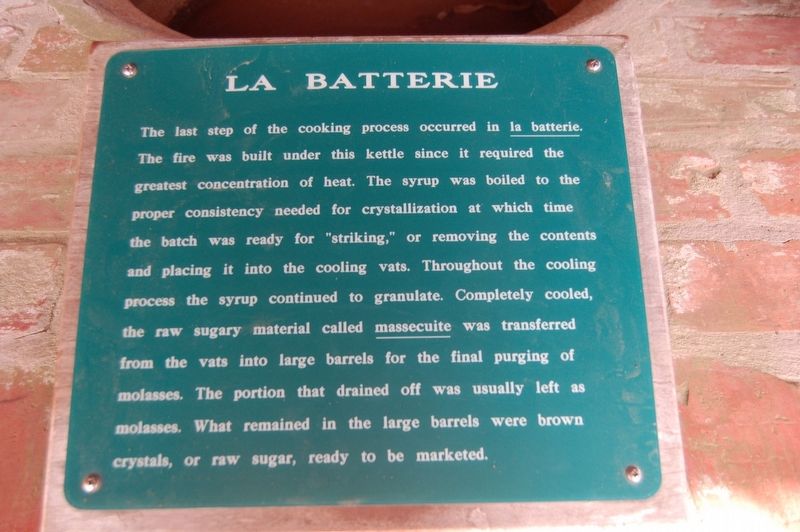
The last step of the cooking process occured in la batterie. The fire was built under this kettle since it required the greatest concentration of heat. The syrup was boiled to the proper consistency needed for crystallization at which time the batch was ready for "striking", or removing the contents and placing it into the cooling vats. Throughout the cooling process the syrup continued to granulate, Completely cooled, the raw sugary material called massecuite was transferred from the vats into large barrels for the final purging of molasses. The portion that drained off was usually left as molasses. What remained in the large barrels were brown crystals, or raw sugar, ready to be marketed.
Credits. This page was last revised on February 12, 2023. It was originally submitted on December 31, 2017, by Cajun Scrambler of Assumption, Louisiana. This page has been viewed 1,125 times since then and 75 times this year. Photos:1, 2, 3, 4, 5, 6. submitted on December 31, 2017.