Camden in Greater London, England, United Kingdom — Northwestern Europe (the British Isles)
Thomas Coram
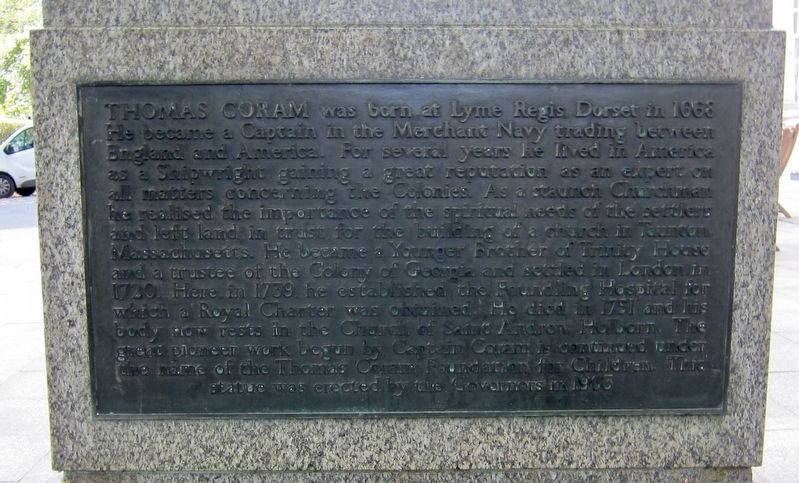
Photographed by Andrew Ruppenstein, October 12, 2017
1. Thomas Coram Marker
Erected 1963 by Governors of the Thomas Coram Foundation for Children.
Topics. This historical marker is listed in these topic lists: Charity & Public Work • Religion & Religious Structures • Science & Medicine. A significant historical year for this entry is 1668.
Location. 51° 31.509′ N,
this page online

Regionally, this marker is in the Greater South East. Globally, it is on the Atlantic Ocean, in the North Atlantic Region, in Europe, in Atlantic Europe, on one of the British Isles, in the Western World, and in the Anglosphere. Historically, it finds itself in what was once the Roman Empire.
Other nearby markers. At least 8 other markers are within walking distance of this marker: The Bloomsbury Group (within shouting distance of this marker); Welcome to Brunswick Square Gardens (about 120 meters away, measured in a direct line); The Brunswick Plane (about 120 meters away); Winifred Cullis (about 120 meters away); Stella & Fanny (about 120 meters away); Hilda Doolittle (about 180 meters away); Sarah Parker Remond (1826-1894) (about 180 meters away); Sir James Matthew Barrie (about 180 meters away). Touch for a list and map of
Photographed by Andrew Ruppenstein, October 12, 2017
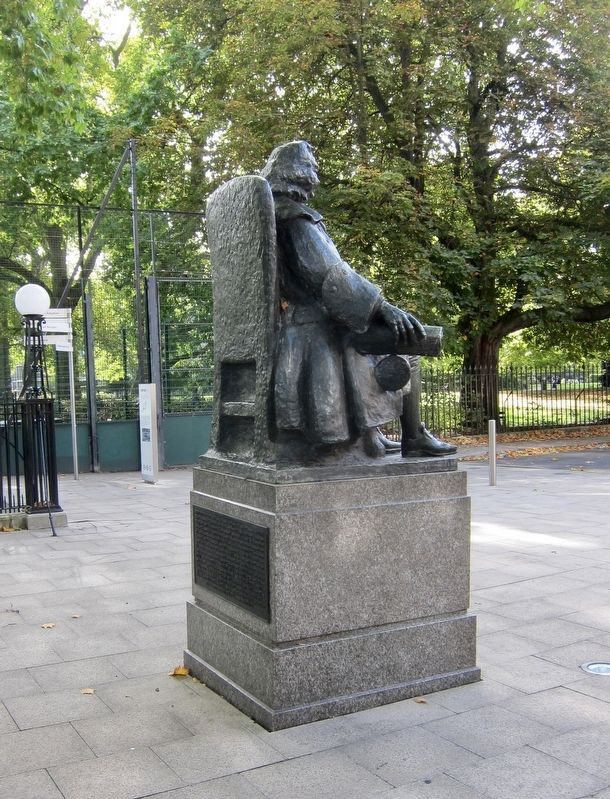
2. Thomas Coram Marker - Wide View
The marker is mounted to the back of the plinth for the statue of Thomas Coram that is located in the courtyard of the Foundling Hospital Museum.
Also see . . .
1. Thomas Coram (Wikipedia). (Submitted on January 1, 2018.)
2. Foundling Hospital (Wikipedia). "The Foundling Hospital in London, England was founded in 1739 by the philanthropic sea captain Thomas Coram. It was a children's home established for the "education and maintenance of exposed and deserted young children." The word "hospital" was used in a more general sense than it is today, simply indicating the institution's "hospitality" to those less fortunate. Nevertheless, one of the top priorities of the committee at the Foundling Hospital was children's health, as they combated smallpox, fevers, consumption, dysentery and even infections from everyday activities like teething that drove up mortality rates and risked epidemics." (Submitted on January 1, 2018.)
Photographed by Andrew Ruppenstein, October 12, 2017
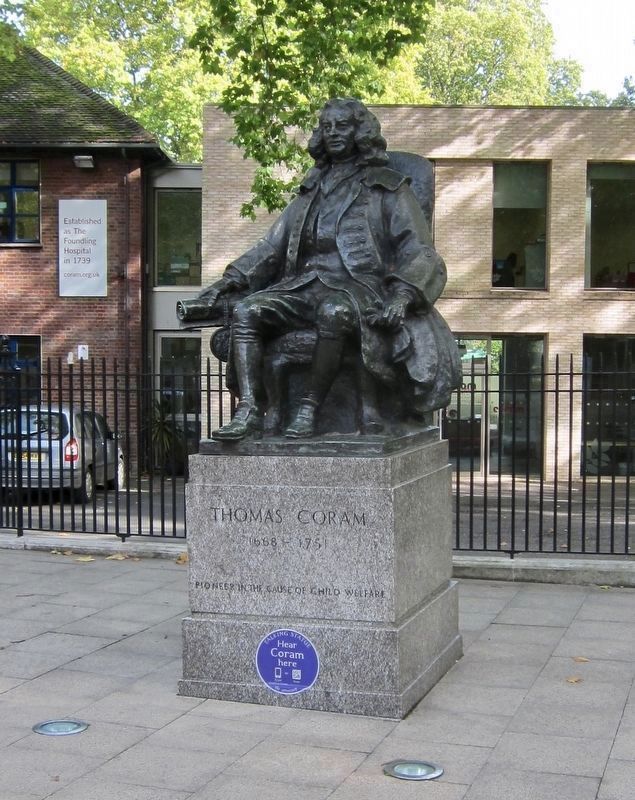
3. Thomas Coram Statue
"Captain Thomas Coram (c. 1668 – 29 March 1751) was a philanthropist who created the London Foundling Hospital in Lamb's Conduit Fields, Bloomsbury to look after abandoned children. It is said to be the world's first incorporated charity." - Wikipedia
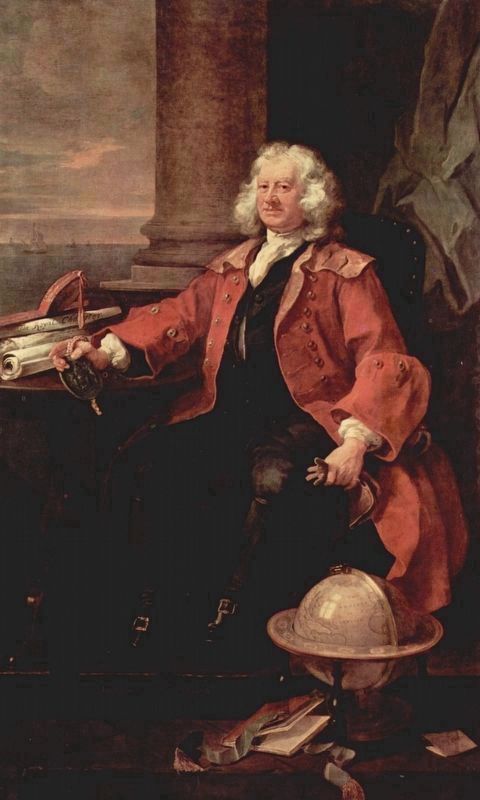
(See next photo, Portrait of Captain Thomas Coram, for the likely source of inspiration for this statue.)
William Hogarth (image via Wikimedia Commons), 1740
4. Portrait of Captain Thomas Coram
"Portrait of Captain Thomas Coram is a 1740 portrait of philanthropist Thomas Coram painted by William Hogarth. The portrait, which represents Hogarth’s highest achievement in direct portraiture, was not created as a commission and was instead donated to Coram's Foundling Hospital. The portrait is divided into two sections: The left side represents Coram's sea ventures, a major source of his wealth. The right side shows a curtain pulled over a mother figure with a child." - Wikipedia
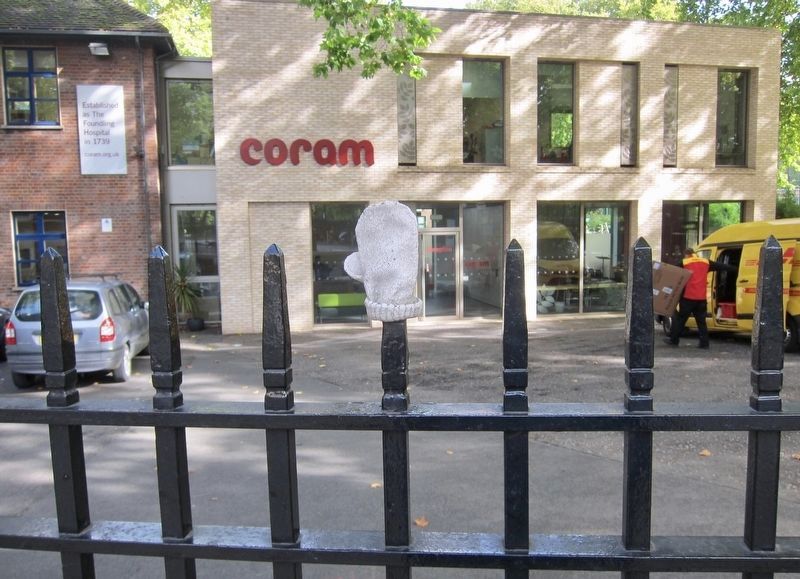
Photographed by Andrew Ruppenstein, October 12, 2017
5. Little Mitten
Attached to the fencing just behind the Thomas Coram statue (and barely visible also in Photo 3, on the left), is a tiny mitten sculpture, by noted artist Tracy Emin, put there, as the nearby sign in Brunswick Square indicates, to reflect "the tokens that mothers left with their children when they handed them over to the care of the Foundling Hospital".
Credits. This page was last revised on January 27, 2022. It was originally submitted on January 1, 2018, by Andrew Ruppenstein of Lamorinda, California. This page has been viewed 565 times since then and 26 times this year. Photos: 1, 2, 3, 4, 5. submitted on January 1, 2018, by Andrew Ruppenstein of Lamorinda, California.
