Georgetown in Northwest Washington in Washington, District of Columbia — The American Northeast (Mid-Atlantic)
Freed Slave and Future President
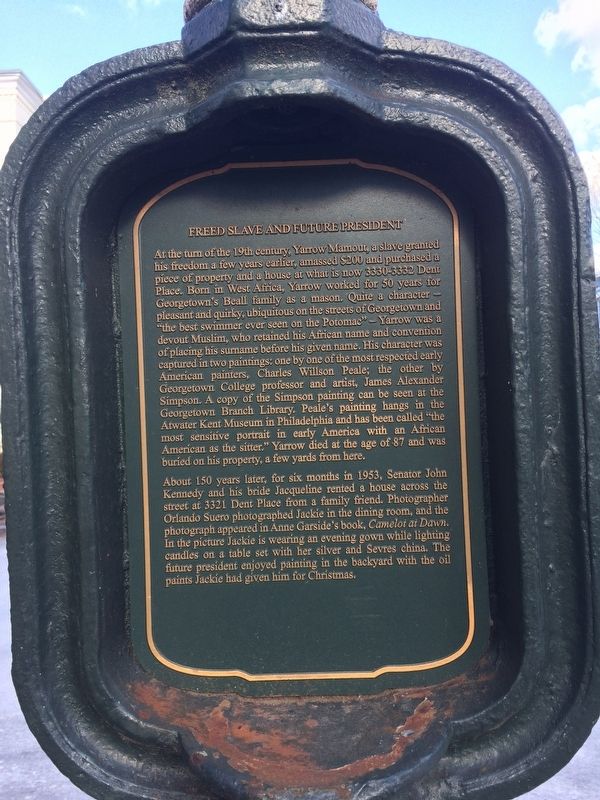
Photographed by Devry Becker Jones (CC0), January 1, 2018
1. Freed Slave and Future President Marker
About 150 years later, for six months in 1953, Senator
this page online
Erected by Cultural Tourism DC.
Topics and series. This historical marker is listed in these topic lists: African Americans • Arts, Letters, Music • Cemeteries & Burial Sites • Government & Politics. In addition, it is included in the DC, Art on Call, and the Former U.S. Presidents: #35 John F. Kennedy series lists. A significant historical year for this entry is 1800.
Location. 38° 54.699′ N, 77° 4.079′ W. Marker is in Northwest Washington in Washington, District of Columbia. It is in Georgetown. It is at the intersection of Dent Place Northwest and 34th Street Northwest, on the right when traveling east on Dent Place Northwest. Touch for map.
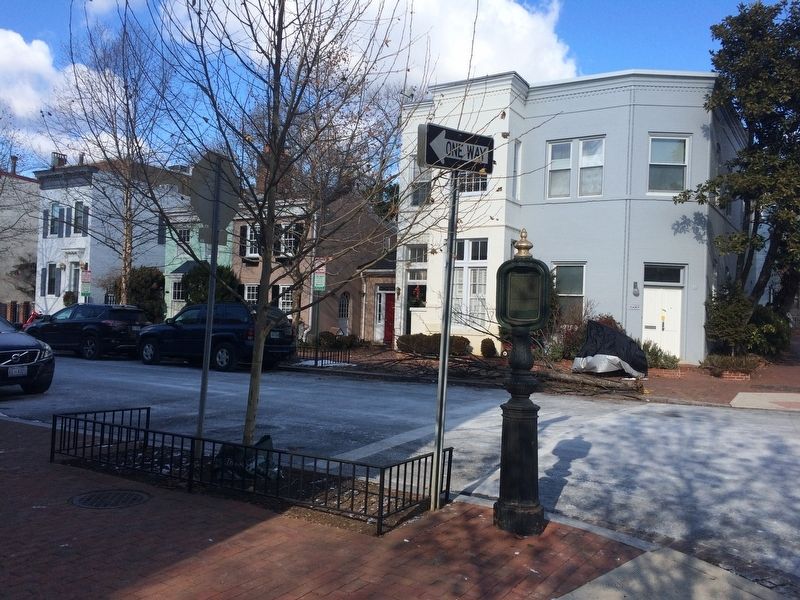
Photographed by Devry Becker Jones (CC0), January 1, 2018
2. Freed Slave and Future President Marker

Regionally, this marker is in the Washington Metropolitan Area. It is also in the American Northeast, in the Upper South, in the Mid-Atlantic, in the Tidewater, and in the Chesapeake Bay Region. Globally, it is in North America, the Western Hemisphere, the Western World, and the Anglosphere.
Other nearby markers. At least 8 other markers are within walking distance of this marker: Mahmoud Yarrow or Yarrow Mamout (about 300 feet away, measured in a direct line); "The Birth of Camelot" (about 300 feet away); Hilleary's Smiling Corner (about 400 feet away); In Memory of Grosvenor Chapman (about 500 feet away); Brinetown and Western High School (about 600 feet away); Daniel Boone Trail Marker (about 600 feet away); 1667 Wisconsin Ave. NW (about 700 feet away); The Original Georgetown Reservoir (about 700 feet away). Touch for a list and map of all markers in Northwest Washington.
Also see . . . Yarrow Mamout Residence Site, African American Heritage Trail. (Submitted on January 1, 2018, by Devry Becker Jones of Washington, District of Columbia.)
Additional keywords. Islam,
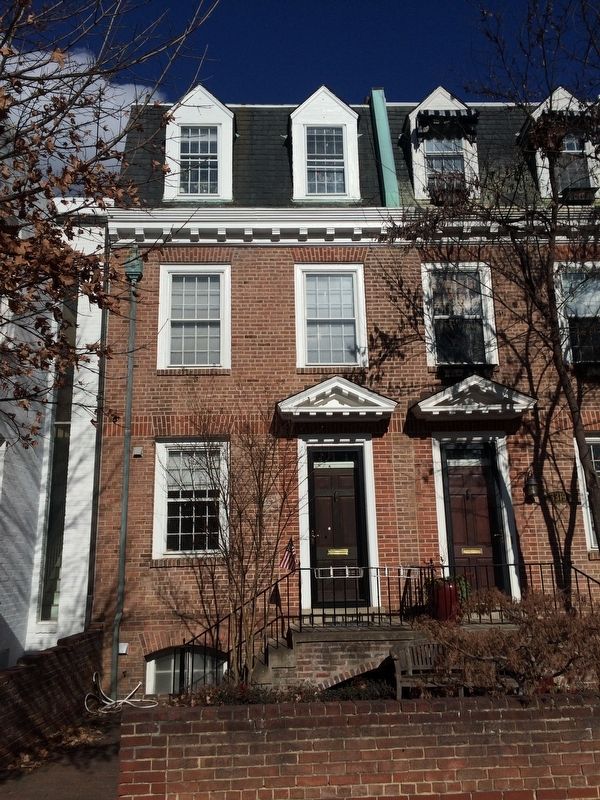
Photographed by Devry Becker Jones (CC0), January 1, 2018
3. 3321 Dent Place NW
Current house at 3321 Dent Place NW, former residence of John F. Kennedy
Photographed by Allen C. Browne, July 25, 2017
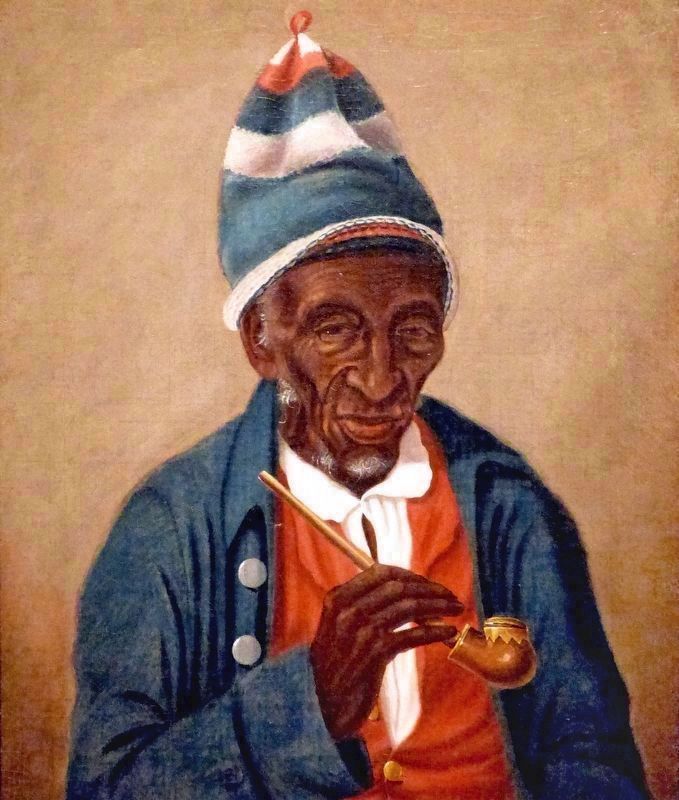
4. Yarrow Mamout
This 1822 portrait of Yarrow Mamout, “Old Yarrow”, by James Alexander Simpson is on loan from the Georgetown Branch Library to the National Portrait Gallery in Washington, DC.
“Yarrow Mamout’s remarkable story testifies to the contradictory attitudes toward slavery, the African diaspora, and Islam in the early years of the American Republic. When he was approximately sixteen, Yarrow was forcibly taken from his educated family in Guinea. He was bought by the Beall family in 1752, working first on a plantation near present-day Takoma Park, Maryland, and then in Georgetown, Washington, D.C. Gaining his freedom after forty-four years, Yarrow remained in Georgetown — living among the approximately four hundred freed slaves there — working at many different tasks: making brick and charcoal, loading ships, weaving baskets. With his earnings, Yarrow bought stock in the local bank and, in 1800, a log home (now demolished) on Dent Place, in the garden of which he would pray toward Mecca. James Alexander Simpson, Georgetown University’s first art instructor, painted this portrait amid rumors that Yarrow was a centenarian, which had turned him into a local celebrity of sorts. Indeed, for this reason, Charles Willson Peale, portraitist of George Washington and other luminaries, had made a special two-day visit to Georgetown to paint the 'chearfull' Yarrow a few years earlier. Upon his death, Yarrow was remembered as a pious Muslim and for his industriousness and determination in the face of adversity.” — National Portrait Gallery
“Yarrow Mamout’s remarkable story testifies to the contradictory attitudes toward slavery, the African diaspora, and Islam in the early years of the American Republic. When he was approximately sixteen, Yarrow was forcibly taken from his educated family in Guinea. He was bought by the Beall family in 1752, working first on a plantation near present-day Takoma Park, Maryland, and then in Georgetown, Washington, D.C. Gaining his freedom after forty-four years, Yarrow remained in Georgetown — living among the approximately four hundred freed slaves there — working at many different tasks: making brick and charcoal, loading ships, weaving baskets. With his earnings, Yarrow bought stock in the local bank and, in 1800, a log home (now demolished) on Dent Place, in the garden of which he would pray toward Mecca. James Alexander Simpson, Georgetown University’s first art instructor, painted this portrait amid rumors that Yarrow was a centenarian, which had turned him into a local celebrity of sorts. Indeed, for this reason, Charles Willson Peale, portraitist of George Washington and other luminaries, had made a special two-day visit to Georgetown to paint the 'chearfull' Yarrow a few years earlier. Upon his death, Yarrow was remembered as a pious Muslim and for his industriousness and determination in the face of adversity.” — National Portrait Gallery
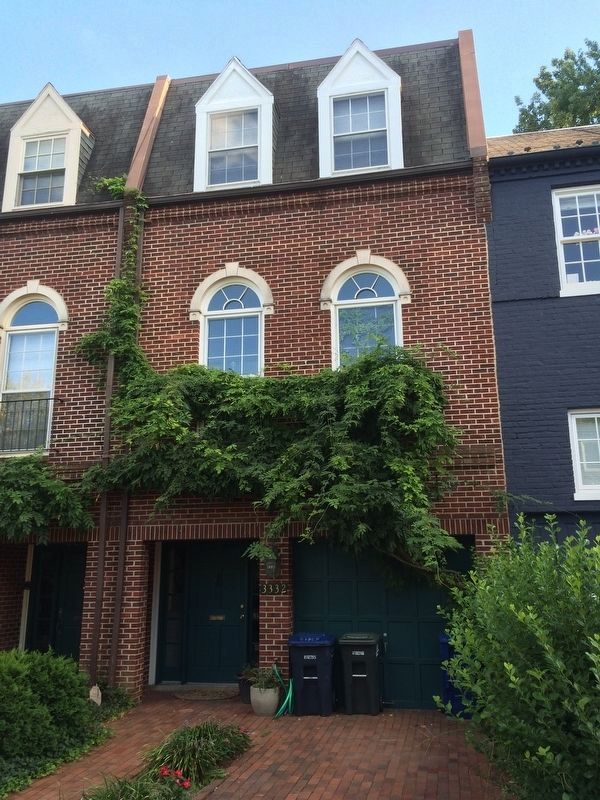
Photographed by J. Makali Bruton, September 12, 2016
5. 3330-3332 Dent Place, location of Yarrow Mamout's former residence
Credits. This page was last revised on January 30, 2023. It was originally submitted on January 1, 2018, by Devry Becker Jones of Washington, District of Columbia. This page has been viewed 864 times since then and 49 times this year. Photos: 1, 2, 3. submitted on January 1, 2018, by Devry Becker Jones of Washington, District of Columbia. 4. submitted on March 28, 2018, by Allen C. Browne of Silver Spring, Maryland. 5. submitted on April 4, 2018, by J. Makali Bruton of Washington, District of Columbia. • Bernard Fisher was the editor who published this page.
