Oak Ridge in Anderson County, Tennessee — The American South (East South Central)
K-25 The Gaseous Diffusion Plant
Photographed by Tom Bosse, December 30, 2017
1. K-25 – The Gaseous Diffusion Plant Marker
Inscription.
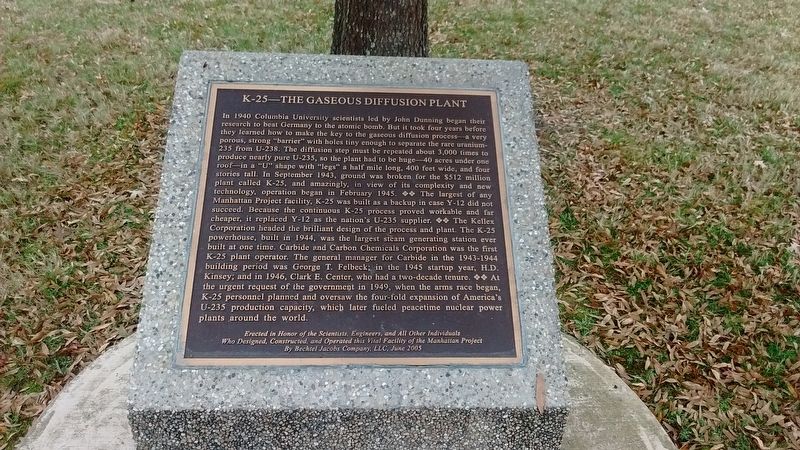
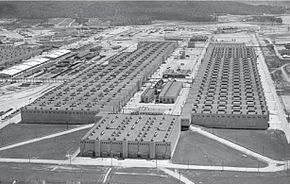
K-25 The Gaseous Diffusion Plant. . In 1940 Columbia University scientists led by John Dunning began their research to beat Germany to the atomic bomb. But it took four years before they learned how to make the key to the gaseous diffusion process a very porous, strong barrier with holes tiny enough to separate the rare uranium-235 from U-238. The diffusion step must be repeated about 3,000 times to produce nearly pure U-235, so the plant had to be huge 40 acres under one roof in a U shape with legs a half mile long, 400 feet wide, and four stories tall. In September 1943, ground was broken for the $512 million plant called K-25, and amazingly, in view of its complexity and new technology, operation began in February 1945. The largest of any Manhattan Project facility, K-25 was built as a backup in case Y-12 did not succeed. Because the continuous K-25 process proved workable and far cheaper, it replaced Y-12 as the nations U-235 supplier. The Kellex Corporation headed the brilliant design of the process and plant. The K-25 powerhouse, built in 1944, was the largest steam generating station ever built at one time. Carbide and Carbon Chemicals Corporation was the first K-25 plant operator. The general manager for Carbide in the 1943-1944 building period was George T. Felbeck; in the 1945 startup year, H.D. Kinsey; and in 1947, Clark E. Center, who had a two-decade tenure. At the urgent request of the government in 1949, when the arms race began, K-25 personnel planned and oversaw the four-fold expansion of Americas U-235 production capacity, which later fueled peacetime nuclear power plants around the world., Erected in Honor of the Scientists, Engineers, and All Other Individuals Who Designed, Constructed, and Operated this Vital Facility of the Manhattan Project By Bechtel Jacobs Company, LLC, June 2005.
In 1940 Columbia University scientists led by John Dunning began their research to beat Germany to the atomic bomb. But it took four years before they learned how to make the key to the gaseous diffusion process a very porous, strong barrier with holes tiny enough to separate the rare uranium-235 from U-238. The diffusion step must be repeated about 3,000 times to produce nearly pure U-235, so the plant had to be huge 40 acres under one roof in a U shape with legs a half mile long, 400 feet wide, and four stories tall. In September 1943, ground was broken for the $512 million plant called K-25, and amazingly, in view of its complexity and new technology, operation began in February 1945. The largest of any Manhattan Project facility, K-25 was built as a backup in case Y-12 did not succeed. Because the continuous K-25 process proved workable and far cheaper, it replaced Y-12 as the nations U-235 supplier. The Kellex Corporation headed the brilliant design of the process and plant. The K-25 powerhouse, built in 1944, was the largest steam generating station ever built at one time. Carbide and Carbon Chemicals
Click or scan to see this page online
Corporation was the first K-25 plant operator. The general manager for Carbide in the 1943-1944 building period was George T. Felbeck; in the 1945 startup year, H.D. Kinsey; and in 1947, Clark E. Center, who had a two-decade tenure. At the urgent request of the government in 1949, when the arms race began, K-25 personnel planned and oversaw the four-fold expansion of Americas U-235 production capacity, which later fueled peacetime nuclear power plants around the world.
Erected in Honor of the Scientists, Engineers, and All Other Individuals Who Designed, Constructed, and Operated this Vital Facility of the Manhattan Project By Bechtel Jacobs Company, LLC, June 2005.
Location. 36° 0.817′ N, 84° 15.474′ W. Marker is in Oak Ridge, Tennessee, in Anderson County. It is at the intersection of Oak Ridge Turnpike (Tennessee
Photographed by Tom Bosse, December 30, 2017
2. K-25 – The Gaseous Diffusion Plant Marker

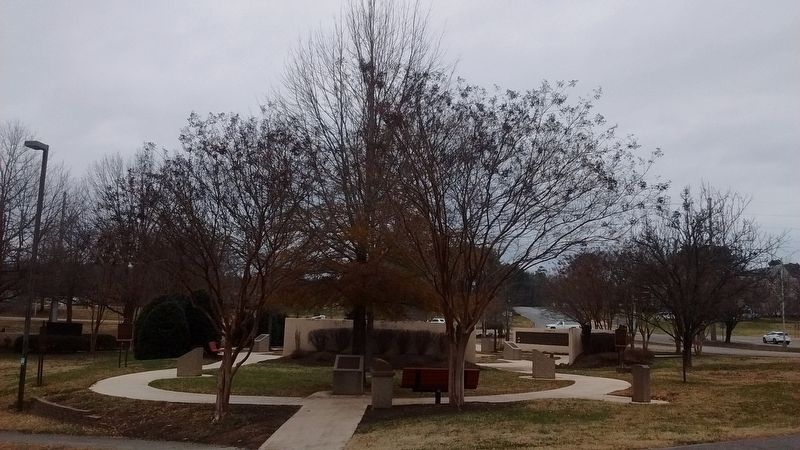
Route 95) and South Tulane Avenue, on the right when traveling east on Oak Ridge Turnpike. Located in Alvin K. Bissell Park. Touch for map. Marker is in this post office area: Oak Ridge TN 37830, United States of America. Touch for directions.
Regionally, this marker is in East Tennessee and in Greater Knoxville. It is also in the American South, specifically in the Upper South, in Appalachia, and specifically in Southern Appalachia. Globally, it is in North America, the Western Hemisphere, the Western World, and the Anglosphere. Historically, it finds itself in what was once the original Cherokee Nation, the territory of the Mississippian Culture, one of the Confederate States of America, and the Antebellum South.
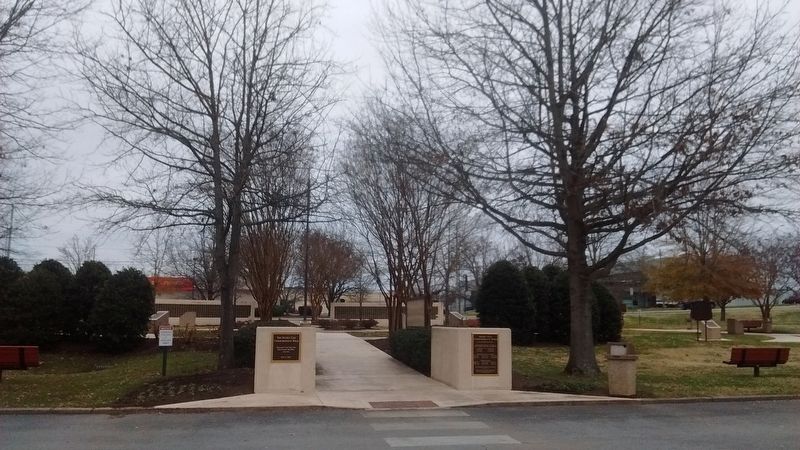
Other nearby markers. At least 8 other markers are within walking distance of this marker: 1944 (here, next to this marker); Oak Ridge Hospital (here, next to this marker); 1947 (here, next to this marker); 1949 (here, next to this marker); 1945 (here, next to this marker); X-10 The Clinton Laboratories (here, next to this marker); 1943 (here, next to this marker); Oak Ridge Secret City (here, next to
Also see . . . 1. Oak Ridge, TN. (Submitted on January 6, 2018, by Tom Bosse of Jefferson City, Tennessee.) 2. Secret City Commemorative Walk. (Submitted on January 6, 2018, by Tom Bosse of Jefferson City, Tennessee.)
Photographed by Tom Bosse, December 30, 2017
4. Secret City Commemorative Walk
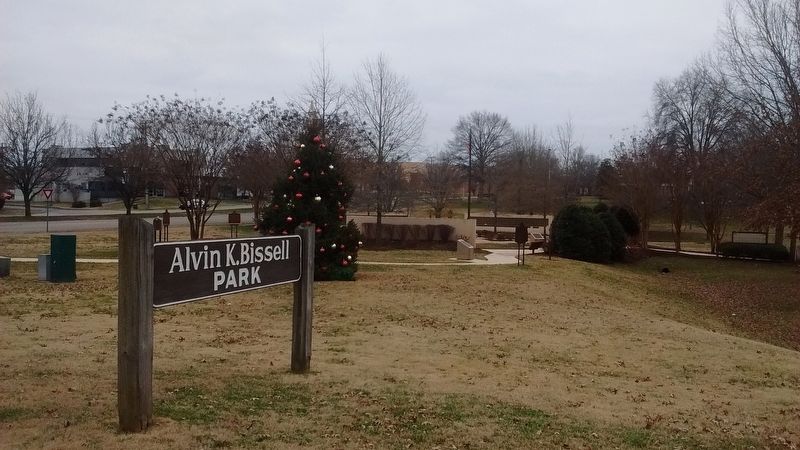
Photographed by Tom Bosse, December 30, 2017
5. Secret City Commemorative Walk
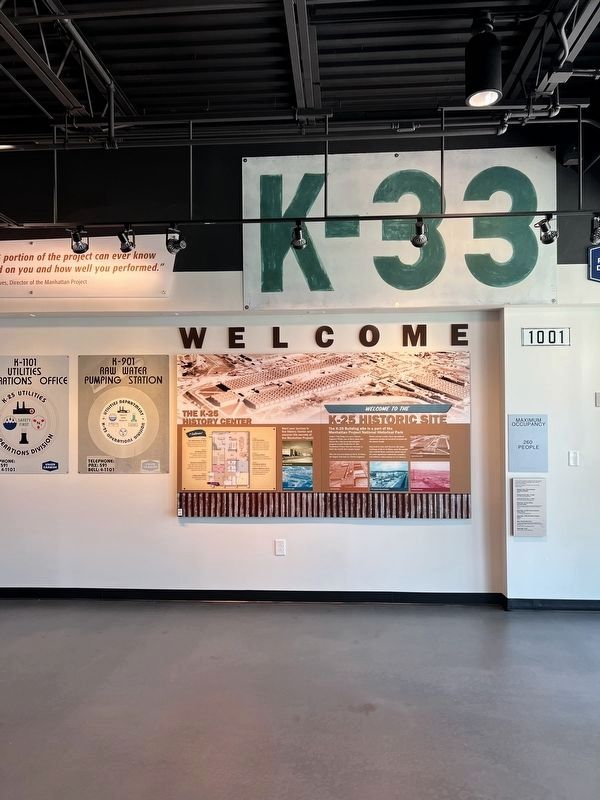
Photographed by Garry L Ridinger, July 23, 2022
6. Visitor center entrance K-25 The Gaseous Diffusion Plant
Credits. This page was last revised on July 23, 2022. It was originally submitted on January 6, 2018, by Tom Bosse of Jefferson City, Tennessee. This page has been viewed 940 times since then and 57 times this year. Photos:1, 2, 3, 4, 5. submitted on January 6, 2018, by Tom Bosse of Jefferson City, Tennessee. 6. submitted on July 23, 2022, by Garry L Ridinger of Knoxville, Tennessee. • Bill Pfingsten was the editor who published this page.