Ninety Six in Greenwood County, South Carolina — The American South (South Atlantic)
The Star Fort
Heart of the Loyalist Defense
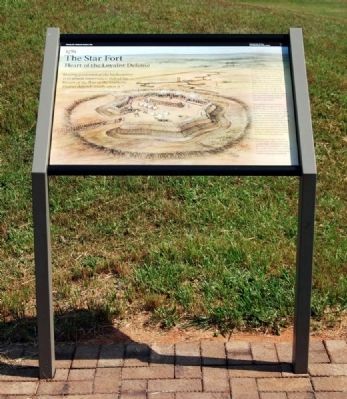
Photographed by Brian Scott, May 13, 2010
1. The Star Fort Marker
The eight-pointed fort was erected by slaves, who struggled along with British soldiers to fashion it from the heavy red soil. To out eyes, the interior hardly seems adequate space for 200 Loyalists -- and their artillery -- trapped here during the weeks of the 1781 siege. In the hot South Carolina spring, with limited provisions and difficult access to water, the Loyalists withing must have questioned their survival. Notice the ridge in the center. It is a traverse, of fallback provision, in case the Patriots breached the walls.
The ingenious design of the Star Fort permitted
this page online
Erected 2009 by National Park Service.
Topics. This historical marker is listed in these topic lists: Forts and Castles • Man-Made Features • Settlements & Settlers • War, US Revolutionary. A significant historical month for this entry is June 1780.
Location. 34° 8.753′ N, 82° 1.107′ W. Marker is in Ninety Six, South Carolina, in Greenwood County. It can be reached from South Cambridge Street (State Highway 248). Marker is located at the southern entrance to Star Fort. Touch for map. Marker is in this post office area: Ninety Six SC 29666, United States of America. Touch for directions.

Regionally, this marker is in Upstate. It is also in the American South and specifically in the Deep South. Globally, it is in North America, the Western Hemisphere, the Western World, and the Anglosphere. Historically, it finds itself in what was once the territory of the Mississippian Culture, one of the original Thirteen
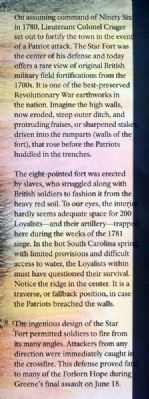
Photographed by Brian Scott, May 13, 2010
2. The Star Fort Marker
Other nearby markers. At least 10 other markers are within walking distance of this marker: The Well (within shouting distance of this marker); The Forlorn Hope (within shouting distance of this marker); Covered Way (within shouting distance of this marker); The Attack (within shouting distance of this marker); The Mine (within shouting distance of this marker); The Rifle Tower (about 300 feet away, measured in a direct line); Second Approach Trench (about 400 feet away); Second Parallel (about 400 feet away); Approach Trench (about 400 feet away); Ninety Six (about 500 feet away). Touch for a list and map of all markers in Ninety Six.
More about this marker. The current version of the marker is shown in Photo 1.
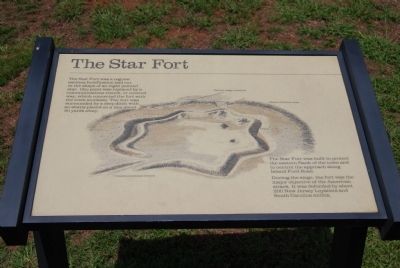
Photographed by Brian Scott, September 5, 2008
3. Original The Star Fort Marker
The Star Fort was a regular earthen fortification laid out in the shape of an eight pointed star. One point was replaced by a communications trench, or covered way, which connected the fort with the town stockade. The fort was surrounded by a deep ditch with an abatis placed on a line about 30 yards away.
The Star Fort was build to protect the eastern flank of the town and to control the approach along Island Ford Road.
During the siege, the fort was the major objective of the American attack. It was defended by about 200 New Jersey Loyalists and South Carolina militia.
The Star Fort was build to protect the eastern flank of the town and to control the approach along Island Ford Road.
During the siege, the fort was the major objective of the American attack. It was defended by about 200 New Jersey Loyalists and South Carolina militia.
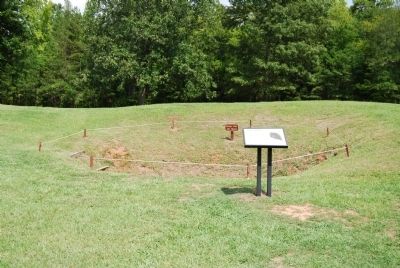
Photographed by Brian Scott, September 5, 2008
4. Walking Path Leading to The Star Fort Marker
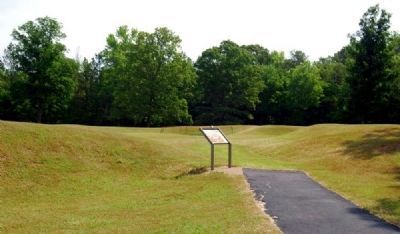
Photographed by Brian Scott, May 13, 2010
5. Entrance to the Star Fort and Current The Star Fort Marker
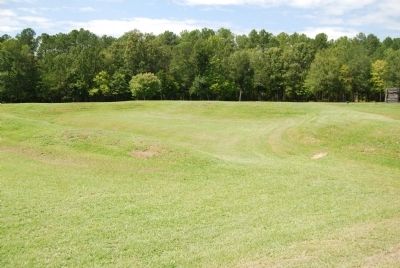
Photographed by Brian Scott, September 5, 2008
6. View Atop from Star Fort Wall Looking West
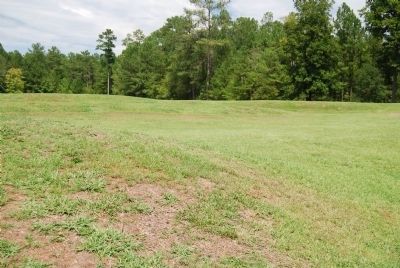
Photographed by Brian Scott, September 5, 2008
7. Star Fort Walls Looking West
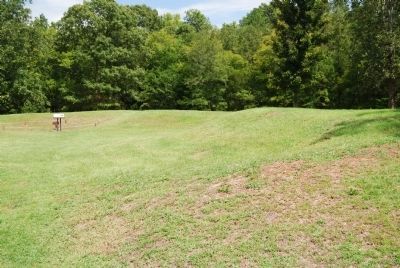
Photographed by Brian Scott, September 5, 2008
8. Star Fort Walls Looking East
Note the fort's well in the background.
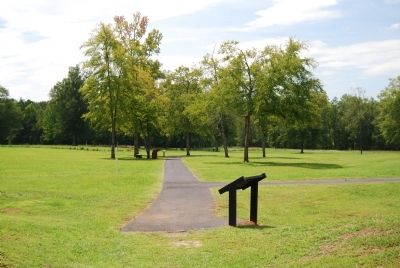
Photographed by Brian Scott, September 5, 2008
9. View South from the Original The Star Fort Marker
The marker in the distance denotes the site of the old village of Ninety Six.
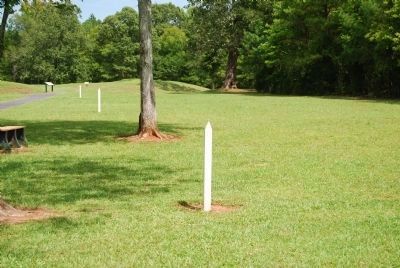
Photographed by Brian Scott, September 5, 2008
10. Communication Trench
The white posts show the location of the communication trench that connected Star Fort with Ninety Six. The Star Fort Marker is in the distance.
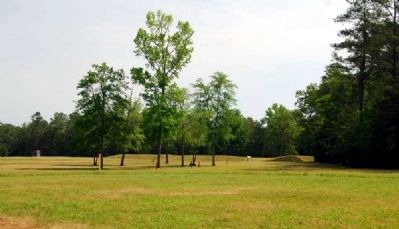
Photographed by Brian Scott, May 13, 2010
11. The Star Fort from the Start of the Gouedy Trail
Credits. This page was last revised on July 10, 2016. It was originally submitted on September 8, 2008, by Brian Scott of Anderson, South Carolina. This page has been viewed 1,407 times since then and 32 times this year. Photos: 1, 2. submitted on July 16, 2010, by Brian Scott of Anderson, South Carolina. 3, 4. submitted on September 8, 2008, by Brian Scott of Anderson, South Carolina. 5. submitted on July 16, 2010, by Brian Scott of Anderson, South Carolina. 6, 7, 8, 9, 10. submitted on September 8, 2008, by Brian Scott of Anderson, South Carolina. 11. submitted on July 25, 2010, by Brian Scott of Anderson, South Carolina. • Craig Swain was the editor who published this page.
