The National Mall in Southwest Washington in Washington, District of Columbia — The American Northeast (Mid-Atlantic)
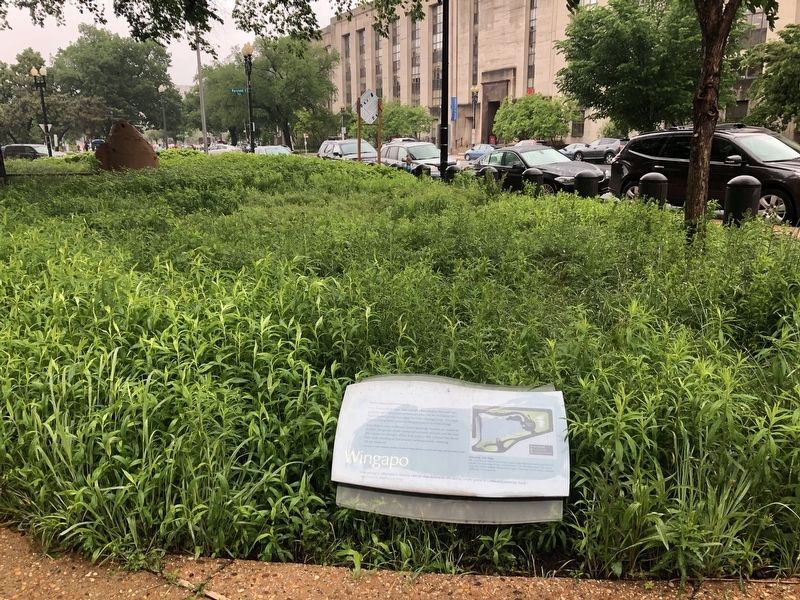
Wingapo
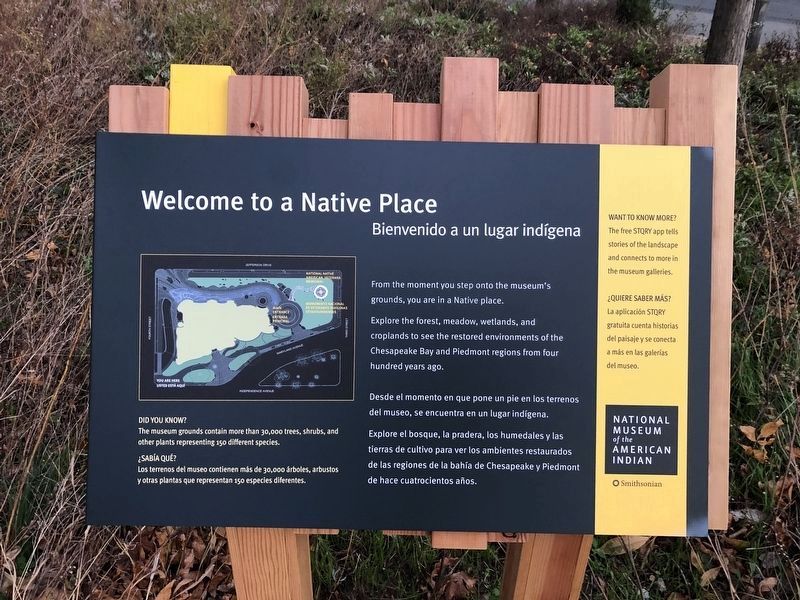
Welcome to a Native Place
| — | Native American Astronomy | — |
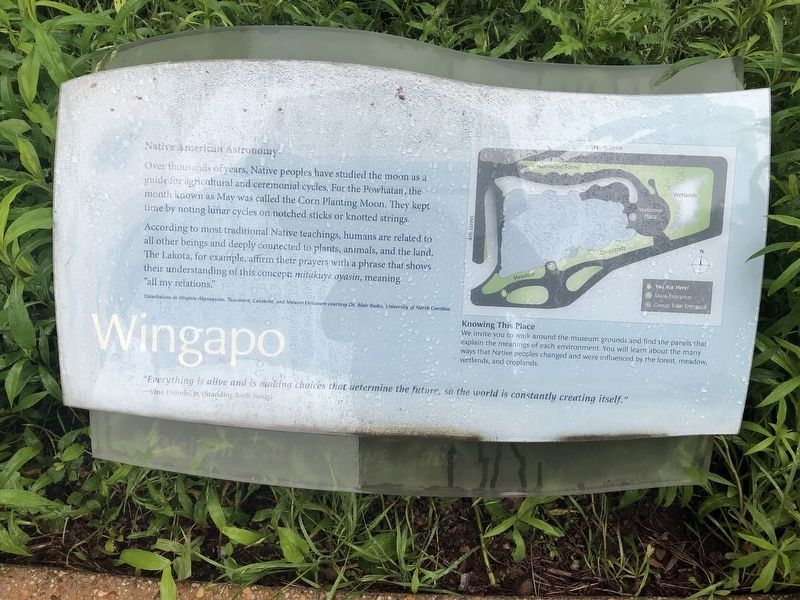
Over thousands of years, Native peoples have studied the moon as a guide for agricultural and ceremonial cycles. For the Powhatan, the month known as May was called the Corn Planting Moon. They kept time by noting the lunar cycles on notched sticks or knotted strings.
According to most traditional Native teachings, humans are related to all other beings and deeply connected to plants, animals, and the land. The Lakota, for example, affirm their prayers with a phrase that shows their understanding of this concept: mitakuye oyasin, meaning "all my relations."
Erected by Smithsonian Institution.
Topics. This historical marker is listed in these topic lists: Environment • Indigenous Peoples and Communities.
Location. This marker has been replaced by another marker nearby. It was located near 38° 53.267′ N, 77° 1.029′ W. Marker was in Southwest Washington in Washington, District of Columbia. It was in The National Mall. It could be reached from Independence Avenue Southwest east of 4th Street Southwest, on the right when traveling west. On the grounds of the National
this page online

Regionally, this marker was in the Washington Metropolitan Area. It was also in the American Northeast, in the Upper South, in the Mid-Atlantic, in the Tidewater, and in the Chesapeake Bay Region. Globally, it was in North America, the Western Hemisphere, the Western World, and the Anglosphere.
Other nearby markers. At least 7 other markers are within walking distance of this location: Eastern Meadow (a few steps from this marker); a different marker also named Nora Naranjo-Morse (within shouting distance of this marker); a different marker also named Nora Naranjo-Morse (within shouting distance of this marker); Cardinal Direction Marker: West (within shouting distance of this marker); a different marker also named Traditional Croplands (within shouting distance of this marker); a different marker also named Cardinal Direction Marker: South (within shouting distance of this marker); The Growth of Social Security (within shouting distance
Other markers no longer nearby. Broomsedge (was a few steps from this marker but has been permanently removed); Meadow (was a few steps from this marker but has been replaced with another marker now near it); Nora Naranjo-Morse (was a few steps from this marker but has been replaced with another marker now near it); Lunar Calendars (was within shouting distance of this marker but has been permanently removed); a different marker also named Nora Naranjo-Morse (was within shouting distance of this marker but has been replaced with another marker now near it); Eastern Redcedar • Muráhk (mah-dok) (was within shouting distance of this marker but has been permanently removed); Cardinal Direction Marker: South (was within shouting distance of this marker but has been replaced with another marker now near it); a different marker also named Cardinal Direction Marker: West (was within shouting distance of this marker but has been replaced with another marker now near it); Traditional Croplands (was within shouting distance of this marker but
Photographed by Devry Becker Jones (CC0), December 3, 2020
3. Welcome to a Native Place
The marker has been replaced with this signage, which does not include any historical information.
More about this marker.
[Background information on the plaque:]
Translations in Virginia Algonquian, Tuscarora, Catawba, and Munsee Delaware courtesy Dr. Blair Rudes, University of North Carolina.
Knowing This Place
We invite you to walk around the museum grounds and find the panels that explain the meanings of each environment. You will learn about the many ways that Native peoples changed and were influenced by the forest, meadow, wetlands, and croplands.
"Everything is alive and is making choices that determine the future, so the world is constantly creating itself."
—Vine Deloria, Jr. (Standing Rock Sioux)
Credits. This page was last revised on January 30, 2023. It was originally submitted on November 14, 2017, by Devry Becker Jones of Washington, District of Columbia. This page has been viewed 463 times since then and 23 times this year. Last updated on February 10, 2018, by Devry Becker Jones of Washington, District of Columbia. Photos: 1, 2. submitted on May 13, 2019, by Devry Becker Jones of Washington, District of Columbia. 3. submitted on December 3, 2020, by Devry Becker Jones of Washington, District of Columbia. • Andrew Ruppenstein was the editor who published this page.
