The National Mall in Southwest Washington in Washington, District of Columbia — The American Northeast (Mid-Atlantic)
Wingapo
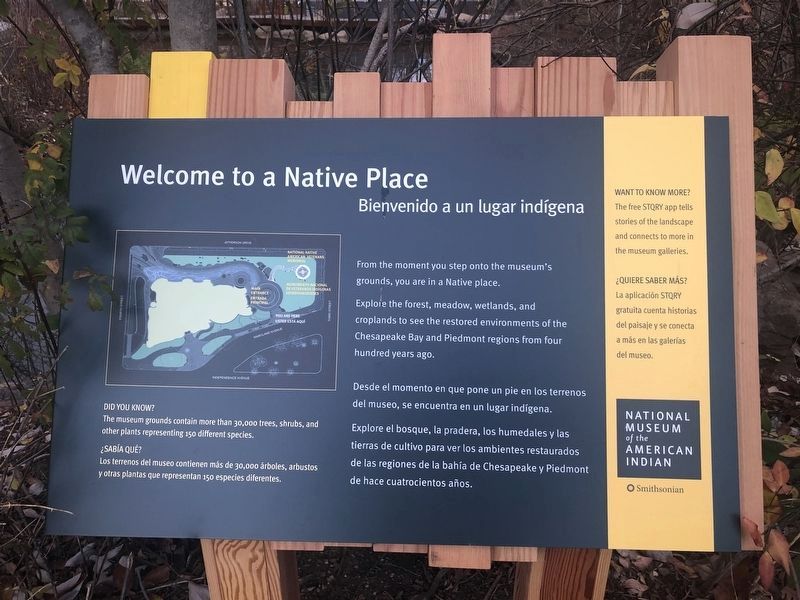
Welcome to a Native Place
| — | Lessons from the Sun | — |
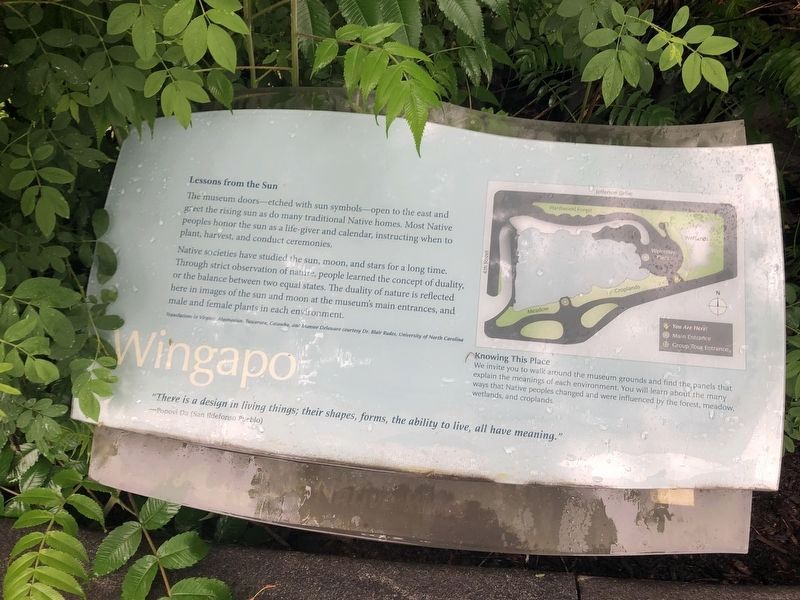
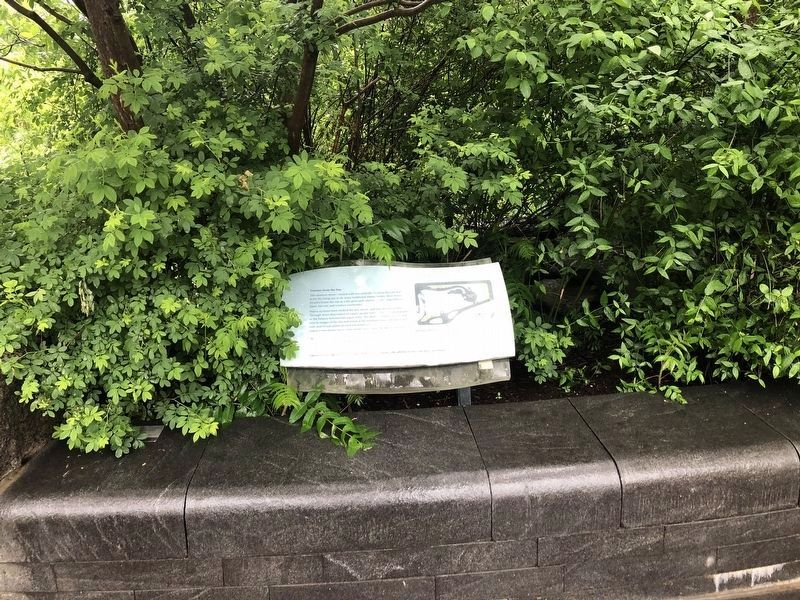
The museum doors—etched with sun symbols—open to the east and greet the rising sun as do many traditional Native homes. Most Native peoples honor the sun as a life-giver and calendar, instructing when to plant, harvest, and conduct ceremonies.
Native societies have studied the sun, moon, and stars for a long time. Through strict observation of nature, people learned the concept of duality, or the balance between two equal states. The duality of nature is reflected here in images of the sun and moon at the museum's main entrances, and male and female plants in each environment.
"There is a design in living things; their shapes, forms, the ability to live, all have meanings."
Popovi Da (San Ildefonso Pueblo)
Erected by Smithsonian Institution.
Topics. This historical marker is listed in these topic lists: Anthropology & Archaeology • Indigenous Peoples and Communities.
Location. This marker has been replaced by another marker nearby. It was located near 38° 53.294′ N, 77° 0.949′ W. Marker was in Southwest Washington in Washington, District of Columbia.
this page online

Regionally, this marker was in the Washington Metropolitan Area. It was also in the American Northeast, in the Upper South, in the Mid-Atlantic, in the Tidewater, and in the Chesapeake Bay Region. Globally, it was in North America, the Western Hemisphere, the Western World, and the Anglosphere.
Other nearby markers. At least 5 other markers are within walking distance of this location: A different marker also named Cardinal Direction Marker: East (a few steps from this marker); National Native American Veterans Memorial (within shouting distance of this marker); a different marker also named George Rivera (within shouting distance of this marker); Mrs. Lyndon Johnson Planted Azaleas Here (within shouting distance of this marker); Cardinal Direction Marker: South
Other markers no longer nearby. Swamp Milkweed • Wihsakán (wee-sah-quam) (was here, next to this marker but has been permanently removed); Wetlands (was a few steps from this marker but has been replaced with another marker now near it); Can you find symbols… (was a few steps from this marker but has been permanently removed); Cardinal Direction Marker: East (was a few steps from this marker but has been replaced with another marker now near it); Bald Cypress • Ártu (ar-too) (was a few steps from this marker but has been permanently removed); Broadleaf Cattail • Káhkáhaskwar (kaw-kaw-has-quar) (was within shouting distance of this marker but has been permanently removed); Sunflower • Wádxaweew (wah-ha-way-oh) (was within shouting distance of this marker but has been permanently removed); What is a Grandfather Rock? (was within shouting distance of this marker but has been permanently removed); George Rivera (was within shouting distance of this marker but has been replaced with another marker now near it); Witchhazel • Suhwe?t (suh-whet)
Photographed by Devry Becker Jones (CC0), December 3, 2020
3. Welcome to a Native Place
The marker has been replaced with this signage, which offers no historical context.
More about this marker.
[Background information on the marker:]
Translation in Virginia Algonquian, Tuscarora, Catawba and Munsee Delaware courtesy Dr. Blair Rodes, University of North Carolina
Knowing This Place
We invite you to walk around the museum grounds and find the panels that explain the meanings of each environment. You will learn about the many ways that Native peoples changed and were influenced by the forest, meadow, wetlands, and croplands.
Credits. This page was last revised on January 30, 2023. It was originally submitted on November 14, 2017, by Devry Becker Jones of Washington, District of Columbia. This page has been viewed 729 times since then and 16 times this year. Last updated on February 10, 2018, by Devry Becker Jones of Washington, District of Columbia. Photos: 1, 2. submitted on May 13, 2019, by Devry Becker Jones of Washington, District of Columbia. 3. submitted on December 3, 2020, by Devry Becker Jones of Washington, District of Columbia. • Andrew Ruppenstein was the editor who published this page.
