Civil War
Louisiana's Role in the War
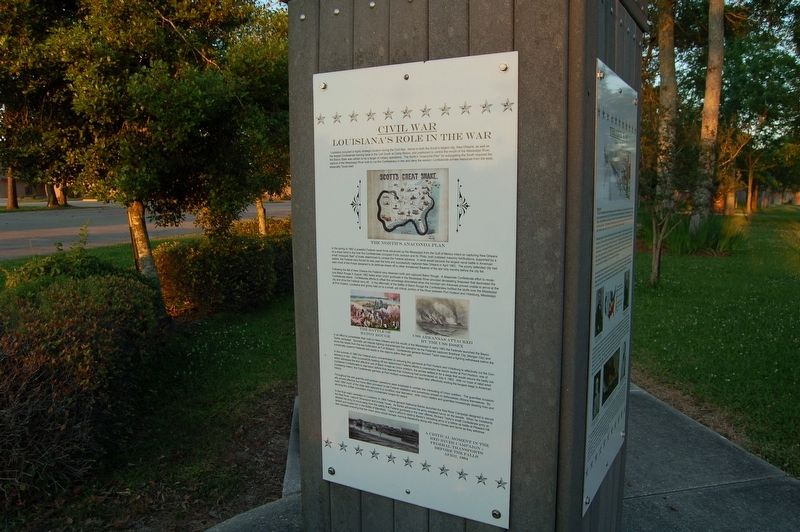
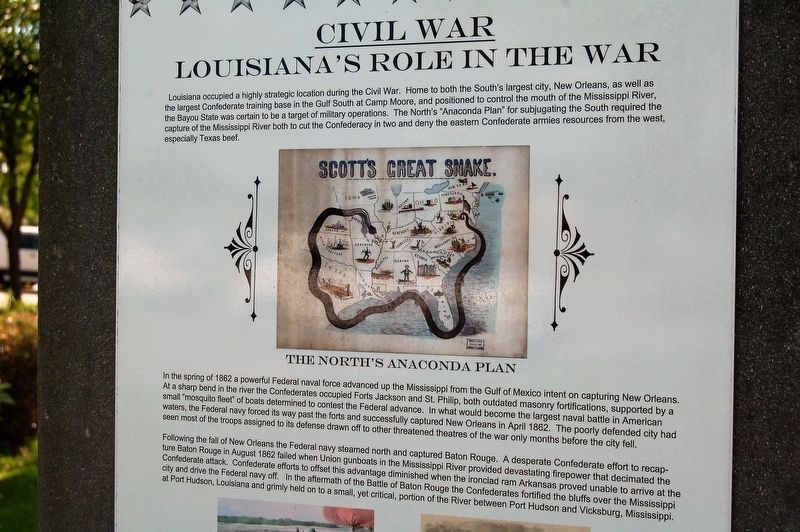
Louisiana occupied a highly strategic location during the Civil War. Home to both the South's largest city, New Orleans, as well as the largest Confederate training base in the Gulf South at Camp Moore, and positioned to control the mouth of the Mississippi River, the Bayou State was certain to be a target of military operations. The North's “Anaconda Plan” for subjugating the South required the capture of the Mississippi River both to cut the Confederacy in two and deny the eastern Confederate armies resources from the west, especially Texas beef.
In the spring of 1862 a powerful Federal naval force advanced up the Mississippi from the Gulf of Mexico intent on capturing New Orleans. At a sharp bend in the river the Confederates occupied Forts Jackson and St. Philip, both outdated masonry fortifications, supported by a small “mosquito fleet” of boats determined to contest the Federal advance. In what would become the largest naval battle in American waters, the Federal navy forced its way past the forts and successfully captured New Orleans in April 1862. The poorly defended city had seen most of
this page online
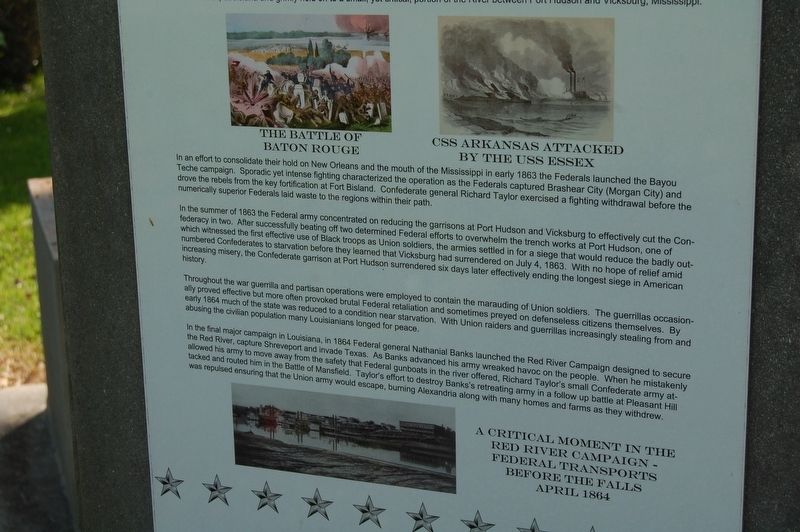
Following the fall of New Orleans the Federal navy steamed north and captured Baton Rouge. A desperate Confederate effort to recapture Baton Rouge in August 1862 failed when Union gunboats in the Mississippi River provided devastating firepower that decimated the Confederate attack. Confederate efforts to offset this advantage diminished when the ironclad ram Arkansas proved unable to arrive at the city and drive the Federal navy off. In the aftermath of the Battle of Baton Rouge the Confederates fortified the bluffs over the Mississippi at Port Hudson, Louisiana and grimly held on to a small, yet critical, portion of the River between Port Hudson and Vicksburg, Mississippi.
Topics. This memorial is listed in this topic list: War, US Civil.
Location. 30° 13.71′ N, 90° 54.801′ W. Memorial is in Gonzales, Louisiana, in Ascension Parish. It can be reached from South Irma Boulevard north of East Worthey Street, on the right when traveling north. Touch for map. Memorial

Regionally, this memorial is in one of Louisiana’s River Parishes, in Acadiana — Cajun Country, and in Greater Baton Rouge. It is also in the American South, specifically in the Deep South, and in the Great River Road Region. Globally, it is in North America, a Gulf of Mexico state, the Western Hemisphere, the Western World, and the Anglosphere. Historically, it finds itself in what was once New Spain, the territory of the Mississippian Culture, the Louisiana Purchase, one of the Confederate States of America, and the Antebellum South.
Other nearby markers. At least 8 other markers are within walking distance of this marker: A different marker also named Civil War (here, next to this marker); a different marker also named Civil War (here, next to this marker); a different marker also named The Civil War (here, next to this marker); World War I (a few steps from this marker); "The War to End War" (a few steps from this marker); A View From The Trenches: A Doughboy From Donaldsonville Writes Home (a few steps from
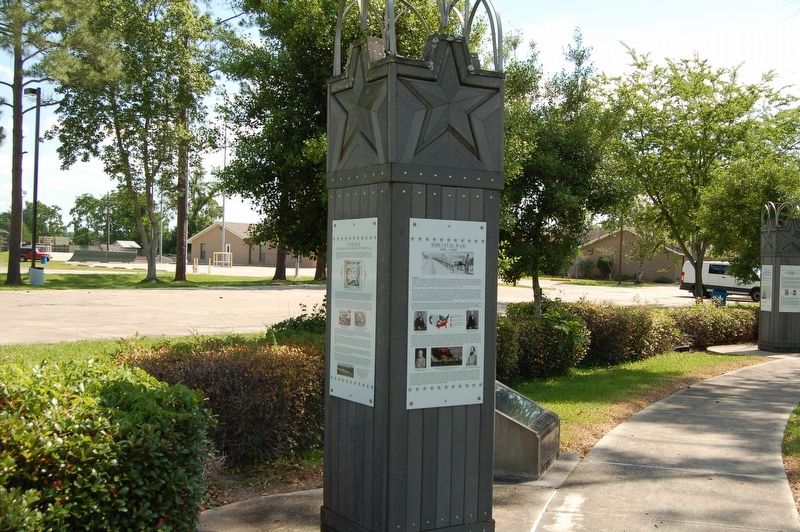
More about this memorial. Located in the Gonzales Veterans Memorial Park.
Credits. This page was last revised on February 24, 2024. It was originally submitted on March 11, 2018, by Cajun Scrambler of Assumption, Louisiana. This page has been viewed 822 times since then and 29 times this year. Photos: 1, 2, 3, 4. submitted on March 11, 2018.
