Memphis in Shelby County, Tennessee — The American South (East South Central)
Natchez, Mississippi
Mississippi River Walk

Photographed by Jason Voigt, August 2, 2024
1. Natchez, Mississippi Marker
Marker was replaced by one put up by Mud Island Park.
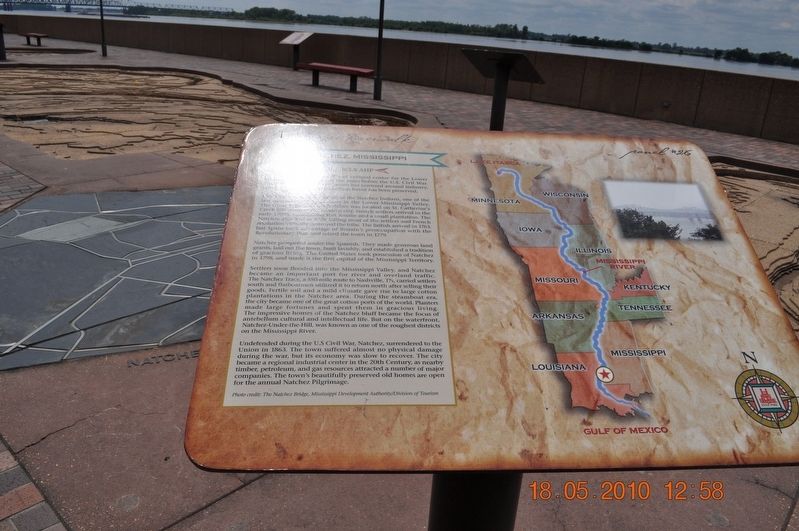
This area was long the home of the Natchez Native Americans, one of the last mound-building cultures in the Lower Mississippi Valley. The Great Village of the Natchez was located on St. Catherine's Creek just south of the modern city. French settlers arrived in the early 1700’s establishing Fort Rosalie and a small plantation. The Natchez attacked in 1729, killing most of the settlers and French retaliation virtually destroyed the tribe. The British arrived in 1763, but Spain took advance of Britain’s preoccupation with the Revolutionary War and seized the town in 1779.
Natchez prospered under the Spanish. They made generous land grants, laid out the town, built lavishly, and established a tradition of gracious living. The United States took possession of Natchez in 1798 and made it the first capital of the Mississippi Territory.
Settlers soon flooded into the Mississippi
this page online
Undefended during the U.S. Civil War, Natchez, surrendered to the Union in 1863. The town suffered almost no physical damage during the war but its economy was slow to recover. The city became a regional industrial center in the 20th Century, as nearby timber, petroleum, and gas resources attracted a number of major companies. The town’s beautifully preserved old homes are open for the annual Natchez Pilgrimage.
Erected by Mud Island Park. (Marker Number
Photographed by Sandra Hughes, May 18, 2010
2. Natchez, Mississippi Marker
Topics. This historical marker is listed in these topic lists: Settlements & Settlers • War, US Civil • Waterways & Vessels. A significant historical year for this entry is 1779.
Location. 35° 8.832′ N, 90° 3.573′ W. Marker is in Memphis, Tennessee, in Shelby County. It can be reached from Island Drive. Located at Mud Island Park. Touch for map. Marker is at or near this postal address: 25 Island Dr, Memphis TN 38103, United States of America. Touch for directions.

Regionally, this marker is in West Tennessee. It is also in the American South, specifically in the Deep South, in the Upper South, in the Mississippi Delta, and in the Great River Road Region. Globally, it is in North America, the Western Hemisphere, the Western World, and the Anglosphere. Historically, it finds itself in what was once the territory of the Mississippian Culture, one of the Confederate States of America, and the Antebellum South.
Other nearby markers. At least 8 other markers are within walking distance of this marker: Natchez Island / Vidalia, Louisiana / Giles Cutoff (here, next to this marker); Waterproof, Louisiana/Ashland Landing, Mississippi
Photographed by Sandra Hughes, May 18, 2010
3. Natchez, Mississippi Marker
Also see . . . Natchez, Mississippi. Natchez /ˈnætʃɪz/ is the county seat and only city[2] of Adams County, Mississippi, United States. Natchez has a total population of 15,792 (as of the 2010 census).[3] Located on the Mississippi River across from Vidalia in Concordia Parish, Louisiana, Natchez was a prominent city in the antebellum years, a center of cotton planters and Mississippi River trade. Natchez is some 90 miles (140 km) southwest of Jackson, the capital of Mississippi, which is located near the center of the state. It is approximately 85 miles (137 km) north of Baton Rouge, Louisiana, located on the lower Mississippi River. Natchez is the 25th-largest city in the state.[4] The city was named for the Natchez tribe of Native Americans, who with their ancestors, inhabited much of the area from the 8th century AD through the French colonial period. (Submitted on March 18, 2018, by Sandra Hughes Tidwell of Killen, Alabama, USA.)
Credits. This page was last revised on September 10, 2024. It was originally submitted on March 18, 2018, by Sandra Hughes Tidwell of Killen, Alabama, USA. This page has been viewed 562 times since then and 35 times this year. Photos: 1. submitted on September 10, 2024, by Jason Voigt of Glen Carbon, Illinois. 2, 3. submitted on March 18, 2018, by Sandra Hughes Tidwell of Killen, Alabama, USA. • Bill Pfingsten was the editor who published this page.
