Memphis in Shelby County, Tennessee — The American South (East South Central)
Grand Gulf, Mississippi
⎯⎯⎯
Yucatan Cutoff
⎯⎯⎯
Big Black River
Mississippi River Walk
Photographed by Jason Voigt, August 2, 2024
1. Grand Gulf, Mississippi / Yucatan Cutoff / Big Black River Marker
Marker was replaced with one put up by Mud Island Park.
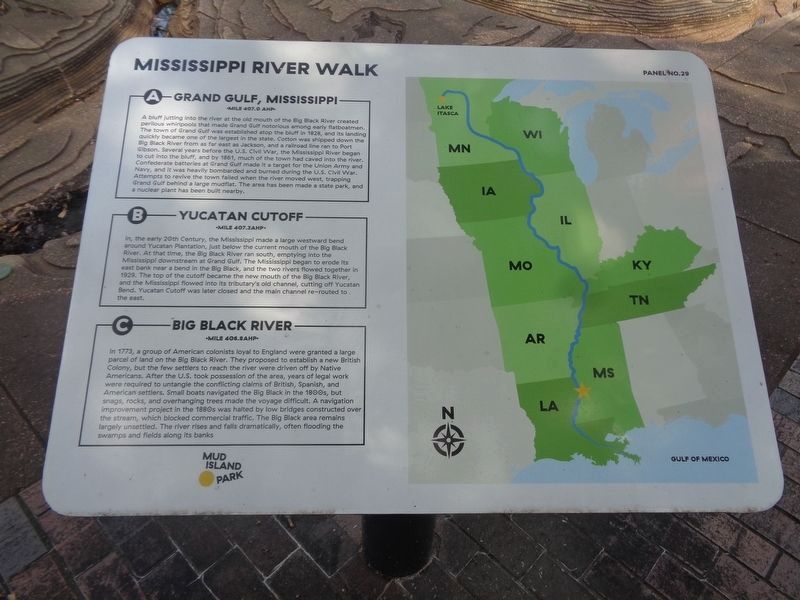
A) Grand Gulf, Mississippi
Mile 407.0 AHP
A bluff jutting into the river at the old mouth of the Big Black River created perilous whirlpools that made Grand Gulf notorious among early flatboatmen. The town of Grand Gulf was established atop the bluff in 1828, and its landing quickly became one of the largest in the state. Cotton was shopped down the Big Black River from as far east as Jackson, and a railroad line ran to Port Gibson. Several years before the U. S. Civil War, the Mississippi River began to cut into the bluff and by 1861, much of the town had caved into the river. Confederate batteries at Grand Gulf made it a target for the Union Army and Navy, and during the U. S. Civil War it was heavily bombarded and burned. Attempts to revive the town failed when the river moved west, trapping Grand Gulf behind a large mudflat. The area has been made a state park, and a nuclear plant has been built nearby.
B) Yucatan Cutoff
Mile 407.3 AHP
In the early 20th Century, the Mississippi made a large westward bend around Yucatan Plantation, just below the current most of the Big Black River. At that time, the Big Black
this page online
C) Big Black River
Mile 408.6 AHP
In 1773, a group of American colonists loyal to England was granted a large parcel of land on the Big Black River. They proposed to establish a new British Colony, but the few settlers to reach the river were driven off by Native Americans. After the U. S. Took possession of the area, years of legal work were required to untangle the conflicting claims of Births, Spanish, and American settlers. Small boat novitiate the Big Black in 1800’s but snag, rocks, and overhangs had med the voyage difficult. A navigation improvement project in the 1860’s was halted by low bridges contraction over the which blocked commercial traffic. The river rises and falls dramatically and the swamps and

Photographed by Sandra Hughes, May 18, 2010
2. Grand Gulf, Mississippi/Yucatan Cutoff/Big Black River Marker
Erected by Mississippi River Walk. (Marker Number 29.)
Topics. This historical marker is listed in these topic lists: Railroads & Streetcars • War, US Civil • War, US Revolutionary • Waterways & Vessels. A significant historical year for this entry is 1861.
Location. 35° 8.845′ N, 90° 3.561′ W. Marker is in Memphis, Tennessee, in Shelby County. It can be reached from Island Drive. Located at Mud Island Park. Touch for map. Marker is at or near this postal address: 25 Island Dr, Memphis TN 38103, United States of America. Touch for directions.

Regionally, this marker is in West Tennessee. It is also in the American South, specifically in the Deep South, in the Upper South, in the Mississippi Delta, and in the Great River Road Region. Globally, it is in North America, the Western Hemisphere, the Western World, and the Anglosphere. Historically, it finds itself in what was once the territory of the Mississippian Culture, one of the Confederate States of America, and the Antebellum South.
Other nearby markers. At least 8 other markers are within walking distance of this marker: Davis Island, Mississippi/Kents Island

Photographed by Jason Voigt, August 2, 2024
3. Grand Gulf, Mississippi / Yucatan Cutoff / Big Black River Marker
Also see . . .
1. Grand Gulf, Mississippi – A Bustling Port Along the River. ocated in the northwest corner of Claiborne County, Mississippi, Grand Gulf was once a bustling river port town in the first half of the 19th Century. Between the years of 1680 and 1803, the land which would become Mississippi Territory was controlled by the French and Spanish governments. (Submitted on March 18, 2018, by Sandra Hughes Tidwell of Killen, Alabama, USA.)
2. Yucatan Cutoff - Cultural Feature (Channel) in Claiborne County. Yucatan Cutoff is a cultural feature (channel) in Claiborne County. The primary coordinates for Yucatan Cutoff places it within the MS 39150 ZIP Code delivery area. (Submitted on March 18, 2018, by Sandra Hughes Tidwell of Killen, Alabama, USA.)
3. Big Black River (Mississippi). Big Black River is a river in the U.S. state of Mississippi and a tributary of the Mississippi River. Its origin ( WikiMiniAtlasregion:US-MS&title=Big+Black+River+source 33°41′40″N 89°07′59″W) is in Webster County near the town of Eupora in the north central part of the state. From there it flows 330 miles (530 km) in a generally southwest direction until it merges with the Mississippi River 25 miles (40 km) south of the city of Vicksburg.[1] It is the major contributor to the Big Black River Basin.[2] It forms part of the northern border of Choctaw County, passes through Montgomery County, and forms the eastern border of Holmes County and the northern border of Claiborne County. The Big Black River and most of its tributaries are silt-filled. The rivers carry large amounts of suspended sediment, resulting mostly from agricultural runoff. These tributaries are slow-flowing muddy streams. However, some are swift-flowing with sandy bottoms.[3] The Battle of Big Black River Bridge, fought during the Battle of Vicksburg, was part of the Vicksburg Campaign in the American Civil War.[4] (Submitted on March 18, 2018, by Sandra Hughes Tidwell of Killen, Alabama, USA.)
Credits. This page was last revised on September 10, 2024. It was originally submitted on March 18, 2018, by Sandra Hughes Tidwell of Killen, Alabama, USA. This page has been viewed 800 times since then and 36 times this year. Photos: 1. submitted on September 10, 2024, by Jason Voigt of Glen Carbon, Illinois. 2. submitted on March 18, 2018, by Sandra Hughes Tidwell of Killen, Alabama, USA. 3. submitted on September 10, 2024, by Jason Voigt of Glen Carbon, Illinois. • Bernard Fisher was the editor who published this page.
