Memphis in Shelby County, Tennessee — The American South (East South Central)
Davis Island, Mississippi/Kents Island
Mississippi River Walk

Photographed by Jason Voigt, August 2, 2024
1. Davis Island, Mississippi/Kents Island Marker
Marker was replaced with one put up by Mud Island Park
A) Davis Island, Mississippi
Mile 415.0 AHP
A large bend once curved around this land which the first settlers name Palmyra. Jefferson Davis established his Briercliffe Plantation here in 1835, next to his brother Joseph’s Hurricane Plantation. The Davis properties were well known and the bend became known as Davis Bend, Jefferson Davis resigned as U. S. Senator from Mississippi when the state seceded from the Union in 1861. and was then elected President of the Confederacy. Briercliffe Plantation was confiscated by the Lion in 1863 and was made a model work colony for free slaves. The U. S. Offered to return the property to Davis after the war in exchange for a single statement repudiating the Confederacy. Davis refused. In 1867, the river cut through the neck of land east of the old Davis property cutting off Davis Bend and creating Davis Island. Diamond Cutoff moved the river into its current channel in 1933. Davis Bend is now named Palmyra Lake, and Davis Island is Mississippi territory embedded in Louisiana shore.
B) Kents Island
Mile 431.5 AHP
A new river channel constructed to its east made Kents Island
this page online
Erected by Mississippi Riverwalk. (Marker Number 30.)
Topics. This historical marker is listed in these topic lists: Settlements & Settlers • War, US Civil • Waterways & Vessels. A significant historical year for this entry is 1809.
Location. 35° 8.852′ N, 90° 3.563′ W. Marker is in Memphis, Tennessee, in Shelby County. It can be reached from Island Drive when traveling south. Located at Mud Island Park. Touch for map. Marker is at or near this postal address: 125 N Front St, Memphis TN 38103, United States of America. Touch for directions.

Regionally, this marker is in West Tennessee. It is also in the American South, specifically in the Deep South, in the Upper South, in the Mississippi Delta,
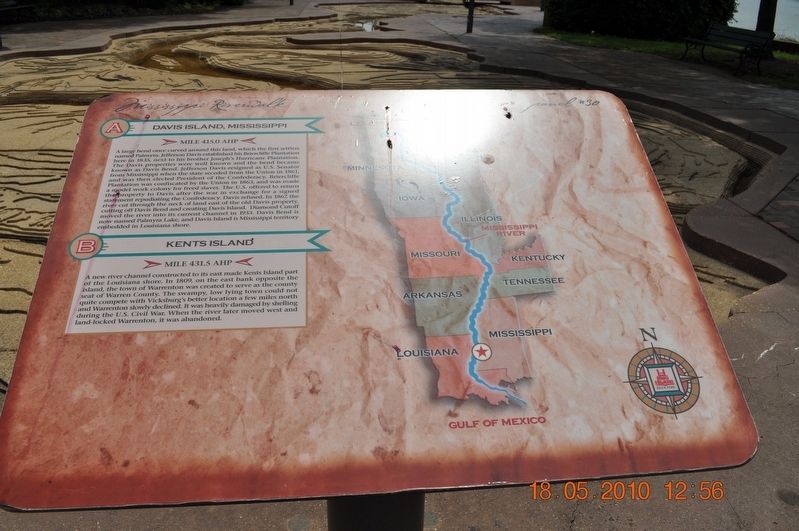
Photographed by Sandra Hughes, May 18, 2010
2. Davis Island, Mississippi/Kents Island Marker
Other nearby markers. At least 8 other markers are within walking distance of this marker: Vicksburg, Mississippi (a few steps from this marker); Grand Gulf, Mississippi / Yucatan Cutoff / Big Black River (a few steps from this marker); Yazoo River/Centennial Cutoff (a few steps from this marker); Young’s Point / Milliken’s Bend / Omega Landing (a few steps from this marker); Rodney Cutoff/Bayou Pierre (a few steps from this marker); Willow Cutoff/Salem Crevasse/Goodrich Landing,Louisiana (a few steps from this marker); Waterproof, Louisiana/Ashland Landing, Mississippi (within shouting distance of this marker); Lake Providence, Louisiana/Stack Island (within shouting distance of this marker). Touch for a list and map of all markers in Memphis.
Also see . . .
1. Jefferson Davis. Davis was born in Fairview, Kentucky, to a moderately

Photographed by Jason Voigt, August 2, 2024
3. Davis Island, Mississippi/Kents Island Marker
Located at Mud Island Park
2. Warrenton, Mississippi. The earliest settlement in this community was Hopewell Methodist Church and Cemetery, established in 1805. It was the first church in Warren County, and still exists a short distance east of Warrenton.[2][3] Sometime after 1809, a brick courthouse was constructed at Warrenton, and the town became the first county seat.[4] A post office was established in 1811,[5] and the town incorporated in 1820.[6] At the time, Warrenton was the largest, most centrally located, and most important place in the county.[7] Nearby Vicksburg began to prosper due to its better landing, higher location, and more vigorous leadership. The county seat was moved there in 1825.[4][8] During the 1830s, Warrenton continued as a place of cotton export.[9] Due to the town's low-lying swampy location, it suffered from river floods and epidemics such as yellow fever, smallpox and cholera.[8] During the Civil War, Confederate forces established a fortification at Warrenton. The town was badly damaged by shelling during the war.[8] (Submitted on March 18, 2018, by Sandra Hughes Tidwell of Killen, Alabama, USA.)
Credits. This page was last revised on August 24, 2024. It was originally submitted on March 18, 2018, by Sandra Hughes Tidwell of Killen, Alabama, USA. This page has been viewed 1,363 times since then and 128 times this year. Photos: 1. submitted on August 24, 2024, by Jason Voigt of Glen Carbon, Illinois. 2. submitted on March 18, 2018, by Sandra Hughes Tidwell of Killen, Alabama, USA. 3. submitted on August 24, 2024, by Jason Voigt of Glen Carbon, Illinois. • Bernard Fisher was the editor who published this page.
