Discovering the Jones Falls
Heritage Walk
| — | Powering America's Industrial Revolution | — |
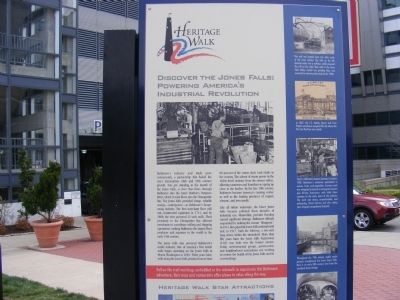
The Jones Falls also powered Baltimore’s textile industry. One of America’s first textile mills began operating on the Jones Falls at Mount Washington in 1810. Thirty years later, mills along the Jones Falls produced more than 80 percent of the cotton duck (sail cloth) in the country. The advent of steam power in the 1820’s freed industry from the stream valleys, allowing canneries and foundries to spring up close to the
this page online
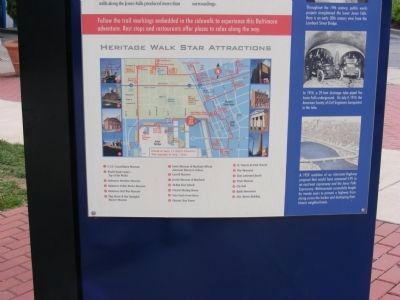
Like all urban waterways, the lower Jones Falls became polluted from decades of industrial use. Meanwhile, periodic flooding caused significant damage. Baltimore officials responded by making the stream “disappear.” In 1914, they piped the Jones Falls underground and, in 1917, built the Fallsway, a two-mile long street, within the streambed. More than fifty years later, the Jones Falls Expressway (I-83) was built over the former stream. Today, environmental groups, government, and neighborhood associations are working to restore the health of the Jones Falls and its surroundings.
Topics. This historical marker is listed in these topic lists: Industry & Commerce • Waterways & Vessels. A significant historical year for this entry is 1711.
Location. 39° 17.202′ N, 76° 36.33′ W. Marker is in Baltimore, Maryland. It is in the Inner Harbor. It is on East Pratt Street just west of Falls Avenue. Touch for map. Marker is in this post office area: Baltimore MD 21202, United States of

Regionally, this marker is in Central Maryland. It is also in the American Mid-Atlantic, in the Chesapeake Bay Region, and on the Eastern Seaboard. Globally, it is in the North Atlantic Region, North America, the Western Hemisphere, the Western World, and the Anglosphere. Historically, it finds itself in what was once one of the original Thirteen Colonies and also the Antebellum South.
Other nearby markers. At least 8 other markers are within walking distance of this marker: Baltimore Riot Trail (within shouting distance of this marker); Welcome (about 300 feet away, measured in a direct line); Be A Part of Something Bigger Than A New Space: Baltimore History (about 300 feet away); The Candler Building (about 400 feet away); Discover Baltimore: Four Centuries of Change (about 400 feet away); Baltimore Slave Trade (about 600 feet away); Dr. William V. Lockwood (about 600 feet away); The Star Spangled Banner Flag was Born Here (about 600 feet away). Touch for a list and map of all markers in Baltimore.
Another marker is no longer nearby. Baltimore Riot Trail (was within shouting distance of this marker but has been replaced with another marker now near it).
Credits. This page was last revised on April 17, 2020. It was originally submitted on November 8, 2012, by Don Morfe of Baltimore, Maryland. This page has been viewed 1,136 times since then and 39 times this year. Last updated on March 20, 2018, by Devry Becker Jones of Washington, District of Columbia. Photos: 1, 2. submitted on November 8, 2012, by Don Morfe of Baltimore, Maryland. • Andrew Ruppenstein was the editor who published this page.
